
Tag: Pico Iyer

  • A long way away from home

    The Global Soul’ is not my favourite Pico Iyer book (though he is a favourite anyway) mostly because I couldn’t connect to three out of its six chapters. I picked up the book because, in addition to it being a Pico book, it was about a subject that has fascinated me for a while now – the concept of ‘home’. This, in a multicultural world whose corporate citizens are rapidly making sure that ‘Everywhere is made up of everywhere else..’ I remember writing about this almost three years ago, in the context of another travel book and my visit to what I still consider home – Cochin. It was evoked by the presence of the same brands that I might see in a mall in Bangalore, the disappearance of familiar landmarks, and the residents referring to new landmarks that I really didn’t know of. It is perhaps unfair to expect that even as I changed, the idea of home would remain a constant. Maybe I will get used to that in a while too.

    I had wondered whether, in our pursuit of convenience and familiarity, we might end up creating a homogeneous world. Now I wonder if we might be one of the last generations to live in a truly heterogeneous world, as, in addition to the corporate imperialism, culture also becomes the most exported and imported product, courtesy technological advances – real and virtual. Home is, as the t-shirt goes, where the wifi connects automatically, and I’d be able to recreate it anywhere, with all the props made available to me.

    Every year, around this time, there is usually a home visit, and I would be chronicling it, this year there isn’t. Our regular visit targets are missing in action, and going there doesn’t make sense. I wonder if this is how it begins, and a couple of decades later, when I’m traveling, a bout of homesickness would hit me, and I would realise that it wasn’t Cochin I was thinking of. I’ll probably feel sad then, and guilty. But for now, I am closing my eyes, and recreating Cochin in my mind, with no props. I am able to, I can sense the wistfulness as I walk through the streets (without Google) and they haven’t changed. It’s heartening to know that while I have left Cochin, it hasn’t left me.
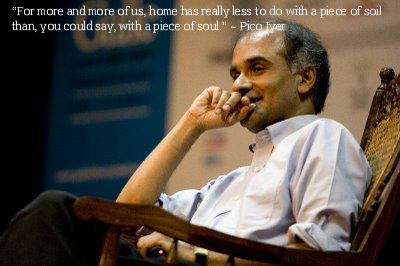
    picoiyersrilankaimg_0140

    until next time, homegrown can be grown?

  • The Lady and the Monk: Four Seasons in Kyoto

    Pico Iyer

    In the autumn of 1987, Pico Iyer begins his journey into Japan, one that would last a full cycle of seasons. Depending on the prism you choose to see it through, the book could be many things.

    It could be a travelogue, though quite different from any I have read yet, and yet one that not only dispels any ‘second-hand’ notions (eg. the Japanese’ take on Kurosawa was surprising) but also captures the nuances of a place unknown to me, in a very sensitive manner.

    It could be the journey and yearning of one human being to understand and experience a culture alien to him/her. Him, from the perspective of Pico in Japan, whose original wonder and positive bias changes into a more pragmatic view as time passes, and her, from the perspective of Sanchiko, a vivacious Japanese lady with a husband and two children, whose heartfelt desire it is to escape the confines and constraints of her culture and upbringing.

    It could be a glimpse into the world of Zen – its monasteries and about living in the moment, without the baggage of the past or the future.

    It could be a relationship between cultures – not just east and west, as shown between the author and Sanchiko or other nuances captured through various other characters, but also within Japan itself – the free spirited Sanchiko versus her friends and family who are against this freedom she desires and wants her to just make the best of her marriage and the duties it entails.

    Or it could be an elegant love story, with Japanese poetry and beautiful descriptions of nature, and in the way of Japanese, one with a poignant ending, just like the story which seems to be the inspiration for the title.

    A wonderful read, and an armchair journey that has given me much to think about.

  • Abandon : A Romance

    Pico Iyer

    I’m quite a fan of Pico Iyer’s travelogues, so this was a book that had to be checked out. The protagonist is John Macmillan, an Oxford-educated Englishman, in California to study the work of the Sufi poet, Rumi, and complete his thesis under the guidance of his professor Sefadhi. On a trip to Damascus, he happens to meet a reclusive professor, who requests him to carry a package to California, to be handed over to a Kristina Jensen. While doing that, he happens to meet Camilla, Kristina’s sister, who, despite her flighty and fragile nature, makes inroads into his life. And then starts a journey that’s part a search for an Iranian manuscript, part an inward search for John, much like the sufis – “We are even mysterious to ourselves, they believe: a part of us going through the rituals of our daily life, while another part, a deeper part, cries out for whatever it is that can take us back. The stranger whose voice we recognize as our own.“, “..for the true Sufi, the looking is the key. Even if you don’t know what you’re looking for.

    The word ‘Abandon’ too can be seen from different perspectives – from the Sufis’ mystical version of abandoning themselves to a higher power, John’s need to let go of his notions and caution, and Camilla’s seemingly unconscious way of living her life in abandon, even as she fears that John might her leave her because of it. To me, the novel by itself was a kind of ‘abandon’, just like John’s thesis in the book – as though the author worked on a structure for some part before, towards the end, he let the work chart its own course.

    I do think the book might have a lot of subtext that deals with Islam, its interpretations, and its relationships with the rest of the world, but I’m not really qualified to explore those aspects. Even otherwise, its a very good read, in which there seem to be layers hidden beneath each statement, waiting to be uncovered, just like the excellent poetry that is shared within.

  • Books and Labels

    Not sure if a lot of people do this, but sometimes I ‘drag’ my reading. Not because the book is boring, but just because I want it to go on for some more time. 🙂

    The last recipient of this treatment was Pico Iyer’s “The Lady and the Monk”, which is part travelogue, part human journey, part Zen primer, part romance and possibly several other things too. I think this book will come up many times in this blog in future too, because it gave me multiple feed (foods didn’t sound right) for thought.

    Among other things, it has left me with a great interest for the Zen school of Buddhism. I have started looking for more information on that. Meanwhile, in the book was this guy who had a seemingly simplistic approach to ‘labeling’ things – ‘necessary’, ‘useful’ and ‘useless’. When I think about the things I own/ am passionate about/ spend a lot of time on, and try to categorise it on those labels, it gives tremendous perspective, and I wonder if applying these labels regularly and mindfully would make me more, or less human. Try it out 🙂

    until next time, non zens?

  • Armchair travel plans

    If I discount Pico Iyer, the travelogues of Pankaj Mishra, and Mishi Saran’s Chasing the Monk’s Shadow, I hardly read travel books. But I picked up Rahul Jacob’s ‘Right of Passage’ on a whim (influenced by Pico Iyer’s comment on the jacket) and quite liked it, mostly because its really not just a travelogue. Shall publish a more detailed post on that later.

    I was hooked on early enough thanks to the last lines of the preface

    Still, there is this final paradox of travel: time and again, these memories come back unbidden with the clarity of something that happened yesterday, long after we have returned to the rhythm of our lives

    Later in the book, he compares flight travels with train journeys – that he can remember his first flight journey but the rest are a blur. In contrast, however, he remembers most of his train journeys. Though I’m not really the most frequent of fliers, I can relate to that.

    I wonder if its to do with memories of childhood, in which train journeys played a very important part (for me), and that affinity meant that later journeys would also be cataloged better by the brain. Or is it the entire set of experiences – from ‘uniform’ airports to passengers consciously avoiding each other even if it means staring resolutely at the seat in front compared to colorful railway stations that seem to be oozing character to seats facing each other and almost forcing conversations?

    I juxtaposed this with cities and their culture too. Recently, when I went to Cochin, and dropped in at its most ‘happening’ mall, I wondered how much of homogeneity was being created by malls. The same brands, almost the same store experiences, familiar multiplex chains that somehow give you an air of familiarity even in an unknown town (not Cochin for me, but otherwise). How much of a city’s original hangouts and culture will survive this  onslaught? In fact, I even told D that I could already see landmarks of my days in Cochin  (local shops famous for some particular item) disappearing and the new ones (like a Nilgiris store) being unfamiliar to me. Would most people prefer familiarity over serendipity? Or would a middle ground be found – carefully packaged serendipity?

    Going beyond the things to be seen in a place, every travel experience is also about the  discovery of the character of the place you visit. Will we end up creating a homogeneous world, in our constant quest for convenience, and change travel from the train journeys they should be (opinion) to controlled fancy flights?

    Fortunately for this generation, this is perhaps not a reality we’ll live to see, and even in the sunset years we will have our memories and photographs and be thankful that not all journeys need travel.

    until next time, planed travel