Tag: Pico Iyer

  • The Half Known Life: In Search of Paradise

    Pico Iyer

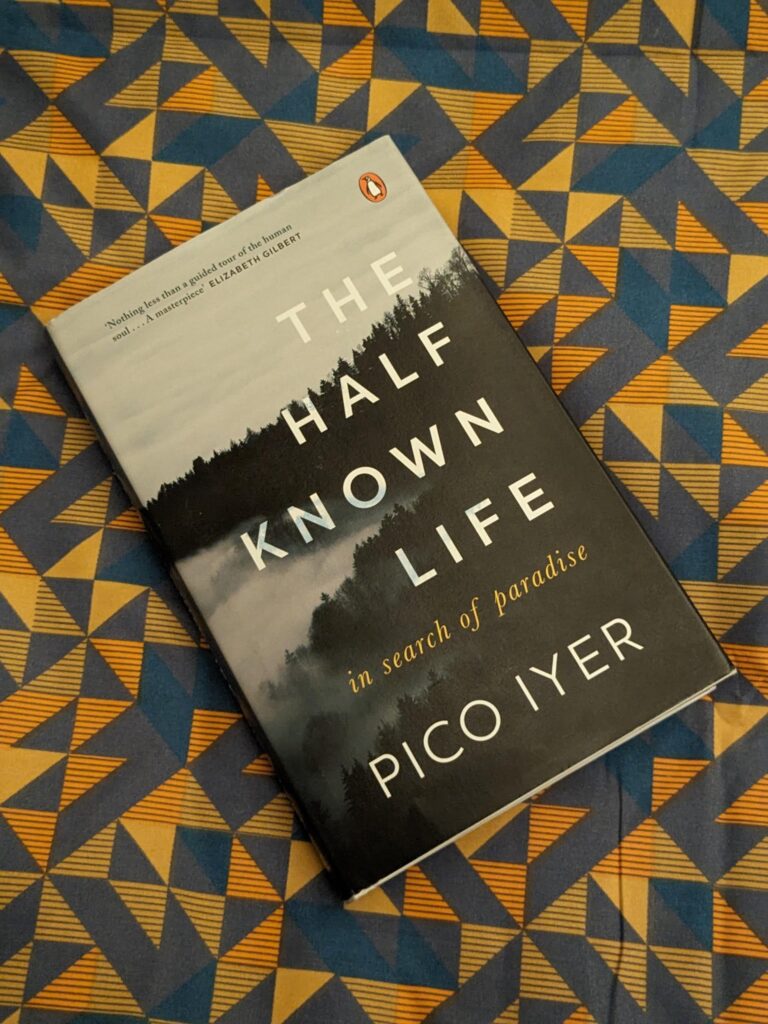
    I always have a bias for Pico Iyer’s writing, and many a time I end up reading his books at times when I need an alternate perspective. In The Half Known Life: In Search of Paradise, the search is for what different people define as paradise – a place with no worry or anxiety. Except, for some it is a particular place, for others a moment in time and something that can be accessed if we put our mind to it, and for some others it can only be enjoyed after death.

    From Jerusalem to Benaras, and Japan to Ladakh, Pico explores these concepts and the people who believe in the different definitions. As is usually the case with his writing, it is as much introspection as it is travel, and written in wonderful prose. He blends his personal experiences with philosophical musings seamlessly. Through the people he meets, and his encounters with those from varied backgrounds, he reflects on the nature of life, and its many meanings.

    In solitude and contemplation, he reaches out to thinkers before him- from the Stoics to William James to Henry David Thoreau, in an effort to decipher the complexities of our existence. Each essay is a meditation, and amidst the noise and chaos of this busy world, I’ll probably pick it up again later in life to get a different rendition of the half-known truths that lie deep inside all of us.

    The Half Known Life
  • Clarity begins at home

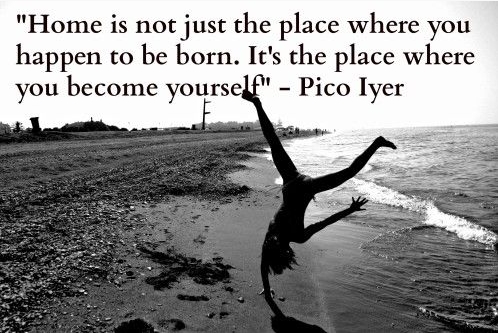
    Maybe it’s a 40s thing, or maybe it’s just me projecting my top-of-the-mind thought on to others, but these days, ‘the place to retire to’ is a recurring theme in many conversations with friends. Once upon a time, in line with Pico Iyer’s “Home is not just the place where you happen to be born. It’s the place where you become yourself”, Bangalore was an obvious choice. A few years ago, Cochin got back into the consideration set, as I veered more towards who I was than what my self image was. The mind and its narratives.

    During a recent trip to Cochin, when a classmate described my school-self to D, I had a moment straight out of a Kazuo Ishiguro book. He is one of my favourite writers, and at least two of his books feature narrators with flawed memory constructions. In the books, it is fascinating to watch the peeling of reality against the narrator’s reconstructions. Ishiguro is kind, and usually brings the narrator down gently. In my case, I was first shocked to realise how I was like one of his narrators, and then pleasantly surprised at how my friend remembered me. Maybe he was being kind. But this isn’t the first time. When a similar recollection about me had happened with one of our other classmates during a reunion a few years ago, I had brushed it off as his false narrative. Because my own perception of who I was then was different. But after this, I realised that this was the key to Cochin behaving like a magnet!

    In Capital, Rana Dasgupta wrote – ‘when one becomes homesick, it is not a place that one seeks, but oneself, back in time.’ Despite my conscious mind’s narrative constructions, my subconscious probably remembers it more accurately. It remembers someone whose sense of humour did not have the cynicism that an adult life gifted it. Someone whose whistling skills seemed like magic to his friends because it was not self-conscious. Maybe, by pulling me back to a place, the mind believes it can also pull me back to a time and a self that was happy with itself. That him who I was.

    And maybe it’s not just that. Before I left Cochin, I made it a point to visit an old hangout. An aunt’s home. My mother’s cousin, whose granddaughters were roughly my age, but insisted on calling me ammava (uncle) especially in public. My memories of that place and my aunt, and these I am sure of because there are physical spaces that could testify to it, are ones I cherish and am deeply grateful for. The place and the person brought a sense of warmth and security to a teen life that was troubled by loss, and a mind that did not even realise it was unmoored. I see the afternoons and evenings I have spent there as an incomparable act of kindness. A refuge from the world at large.

    So maybe what drags me back to Cochin is a little more than who I was. It is also about those around me at a certain stage of my life. The friends who made me feel special. The people who made me feel secure. And places that are so deeply etched in my memory that it would be impossible to feel lost even now. Even as I realise that the places and people may no longer be around and that this construct is one that fits the current idea that I have of myself, I also think that somehow the mind will conspire to project an environment that can anchor me.

    P.S. As I began writing this, I had an intense sense of deja-vu. Very meta. I had gone through these thoughts before, I was sure. And indeed I had. That is somehow reassuring.

  • Falling off the map

    Pico Iyer

    The timestamp for the first chapter is 1990. I imagine myself then, 26 years ago, cognizant of the places being referred to in the book only thanks to an atlas, and a penchant for remembering country-capital-currency courtesy school quizzes. Just text in the head, with no images to go along, in a world before the internet.
    What then, are these lonely places? From Iceland up there to Australia down south and from North Korea to the right and Paraguay to the left (ideologically, just the opposite!) Pico writes about seven places (the others being Vietnam, Cuba and Bhutan) that have seemingly exiled themselves from the world. In Pico’s words, “Lonely Spaces are not just isolated places, for loneliness is a state of mind“.
    Australia is probably the one place that can be deemed ‘alone’ (in terms of geography) too, but all of the other places are just that – lonely, despite being inhabited by populations vibrant in their own way, or being surrounded by nations that are seemingly not too different from them. “More than in space, then, it is in time that Lonely Places are often exiled, and it is their very remoteness from the present tense that gives them their air of haunted glamour.”

    (more…)

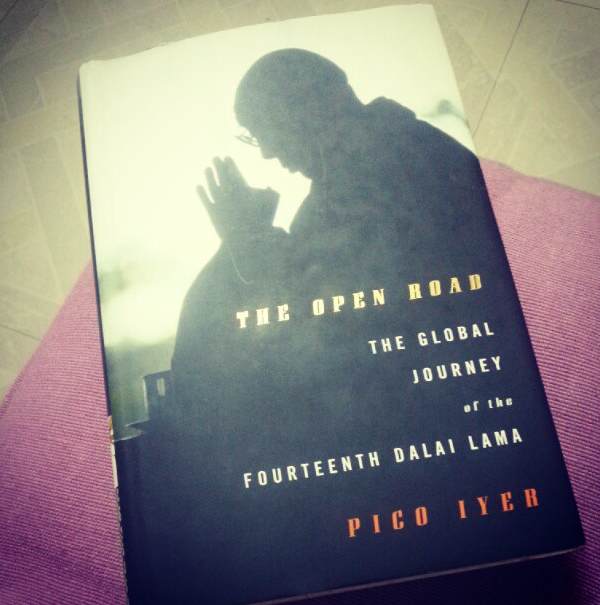
  • The Open Road: The Global Journey of the Fourteenth Dalai Lama

    Pico Iyer

    One of my favourite authors writing about a human being who has intrigued me from the time I read Siddhartha. It didn’t disappoint at all!

    What is it like to live, practice, preach a faith while facing oppression from one of the most powerful countries in the world? Even as Tibet becomes more of a Chinese province day by day – the Potala Palace is treated as just another tourist attraction and the streets of Lhasa are filled with entertainment and shopping options – and several Tibetans question the wisdom of his approach, he is respected across the globe as a spiritual leader for the universal truths he espouses.

    And yet, he underplays the role of religion, and stresses his own humanity while creating a future for Tibetans that is less dependent on him. He has brought Tibet to the world – a culture that was as hidden as a treasure and also gave the world a brand of Buddhism that is universal in appeal. Pico puts Tibet well in the context of a world that has moved from too little info about itself to too much in a few years.

    Pico also writes well about how even with all the respect, people probably see his images and messages through the ‘keyhole of their own priorities’. He once mentions an instance when the Dalai Lama cried- he was asked ‘what is the quickest, cheapest, easiest way to attain enlightenment’.

    While much of the book deals with His Holiness’ thoughts and perspectives, there are also mentions of his family, his early days including the time he was forced to flee from Tibet, and quite a few pages devoted to Dharmasala. Dharamsala – where foreigners come seeking wisdom, antiquity and mysticism from every Tibetan they see, and some Tibetans play the part to understand and probably even reach the lands of ‘abundance and freedom’. Pico Iyer writes about the confusion faced by young Tibetans – on whether to stay on in Dharmasala or go back to Tibet to either change or be changed. Dharmasala – also the place to which Tibetans flock, braving persecution by the Chinese, just for a glimpse of their leader and their belief that at some point in time, he will solve their problems.
    In addition to all of this, the wonderful quotes, the additional sources of information on the subject, and various perspectives all offer us some thoughts on ‘joyful participation in a world of sorrows’.

    Clipboard02

  • Notion states

    My last post on the subject of home was in the context of the multicultural world we are creating, how in our pursuit of convenience and familiarity we might end up creating a homogeneous world, and whether the idea of home would change with time, as we begin to choose places that connect to our soul over the soil we were born in. (soul vs soil courtesy Pico Iyer)

    One of my main punching bags in the institutional realignment line of thinking is the concept of the nation state, more specifically its relevance in a massively connected world. A simplistic view is that economics, trade and many other things might be better off without them, given how much of an enabler technology is turning out to be, and geo politics will anyway be a lesser phenomenon if there aren’t any nation states. Arguable, yes.

    However, I had very little idea on the replacement concept. Geography (land) would exist and would have to be organised in some way. What way? In a wonderful display of appropriateness, Wired gave a possible answer – in the form of a post titled “Software Is Reorganizing the World“. I loved the concept of ‘geodesic distance’, and the mapping of not nation states but states of mind. (soul) The idea of (what is now) cloud communities taking physical shape is fantastic! While it might sound far fetched, it really isn’t – the post gives historical precedence and emerging patterns to back up the idea. As does Tony Hsieh’s The Downtown Project in the present day to transform the decaying and blighted part of the old Vegas Strip into the most community-focused large city in the world.

    Around the same time, I came across this Facebook (official) note titled “Coordinated Migration“, (thanks MJ) which shows how Facebook is using ‘hometown’ and ‘current city’ descriptions to track migratory patterns across the world. Probably, in a few years, this would be a mapping everyone would take a keen interest in, to find kindred souls, and to be what they are destined to be.

    pico2

    (via)

    until next time, a state of bliss