Tag: people

  • Processes, People & Culture

    It has been more than three years since I wrote about my Indigo fandom. Since then, they have been my preferred airline, mostly thanks to their on-time promise. A few weeks ago, Karthik wrote an excellent post “Why I love an errant Meru and hate the awesome Indigo!” that offered some unique perspectives based on a few of his recent experiences with the airline. He ends the post with When did the ‘plastic’ nature of Indigo’s customer-facing organization set in? May be around the same time their hostesses were asked to use wigs? It restored a sense of objectivity to my fandom.

    Our way of doing things” is how one definition of culture goes and I remembered Gautam’s recent insightful post on the components that make up ‘culture’ in an organisation. If you look at these factors, you’d wonder whether a cultural change was at the root of Indigo’s new avatar. It made me think of something I wrote earlier – Culture Architecture – the thrust of which  was culture being a strategic business advantage. But how can that be made sustainable? I’ve been a big fan of processes. Indeed, one of my favourite posters is

    626854484bf91ac616669379d9a394fd

    (via)

    (more…)

  • Agile @ Scale

    Prelude

    I think I used ‘dis-aggregated social network‘ on this blog for the first time in 2009, referring to Google’s basket of services that were connected relatively flimsily then. IMO, Google has always been that way, even including Google+. (read) I remembered it when I tweeted this about Facebook – around the time news of their Fan Audience Network started trickling in.

    It got me thinking (again) on ‘scale’, a recurring theme here. In a less complicated world, where the trends in the business landscape were significantly more linear, (growth, competition, consumption, economy) scale was a powerful weapon to wield. But it’s a different world now. Artificial Intelligence, 3D Printing, Internet of Things, Wearables  and a hundred other things might completely disrupt the status quo and the need an incumbent brand satisfies. These are the known ones, and then there are the conceptually invisible (at this point) ones. Surviving (let alone thriving) in this shifting scenario requires agility, and it is difficult (though not impossible) to see scale and agility together. I looked to Google and Facebook for an approach towards this because not only are they surviving, they seem to be thriving. Yes, we’ll get to Amazon in a while.

    What does it take to be agile at scale? I can think of four ingredients, the last three repurposed from the title of this post by JP Rangaswami.

    Purpose

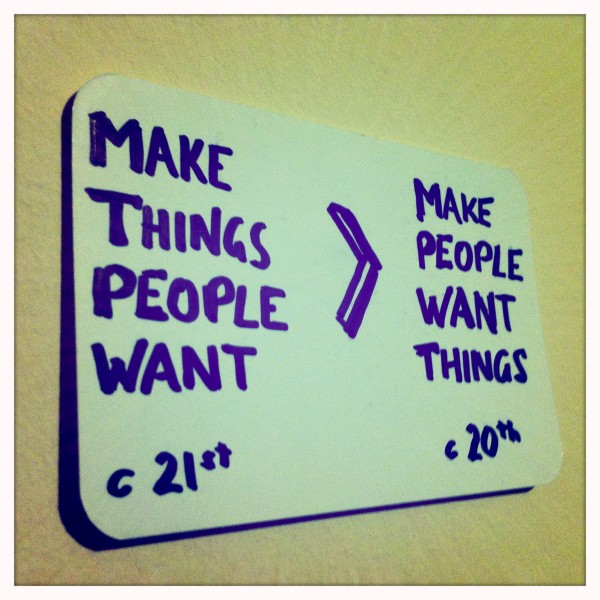
    I remember talking about re-defining of scale at the Dachis Social Business Summit. The thrust of the presentation was that brands could engage consumers at scale only if they use currencies that create value for the user in the context of a shared purpose. I have elaborated it in this post at Medianama. Recently, I saw that Hugh MacLeod has brought it out beautifully here. Simply put

    Make-Things-People-Want-600x600

    (via)

    Possibilities

    The purpose need not have one constant rendition. As the landscape changes, a business will need to adapt it to suit changing circumstances. For that, a business needs to understand the possibilities. I saw a very good line in this post about being a maker – the more you work in the future, the less competition you will have. How much into the future a business needs to be working is subjective and depends on its dynamics, but if it doesn’t disrupt itself, someone else will gladly do it for them. (“The Jeff Bezos School of Long-Term Thinking” is a good read in this context)

    Platforms

    While purpose and possibilities are all good at high altitudes, a business also needs strong operational  platforms to back it up. As organisations scale, I have seen two things that affect agility. One, the processes that are introduced to create efficiency @ scale more often than not, become the goal instead of a means, slowing things down and taking away from actual goals. Two, as processes and manpower increase, silos are created. The good news is that it is easy to see technology platforms bringing more efficiency into processes as well as an iterative way of thinking in the near future. It is already happening in marketing. This, and many other factors are also dictating a consumer experience driven approach and are forcing organisations to break silos. As the entire brand/organisation becomes a platform (read) that regularly revisits its context and purpose in the life of a consumer, ‘everything becomes a node on the network

    People

    HuffPo had a post sometime back, citing Zappos, calling 2014 the year of workplace reinvention. It is interesting to note that parent company Amazon has apparently aped Zappos’ ‘pay to quit’ policy, even as more and more stories about working there being a ‘soul crushing experience‘ are coming out. Meanwhile, the two points it mentioned for this to happen are purpose and trust. These I’d say are the bedrock of culture. It’s intuitive that a workforce mindful of the organisation’s purpose and their role in it would keep an eye out for the business’ possibilities, be ready to work beyond silos towards a great consumer experience, and bring in others who would help the business scale. This, along with purpose, has to be the glue that holds it all together, enabling the organisation to move fast without cracking.

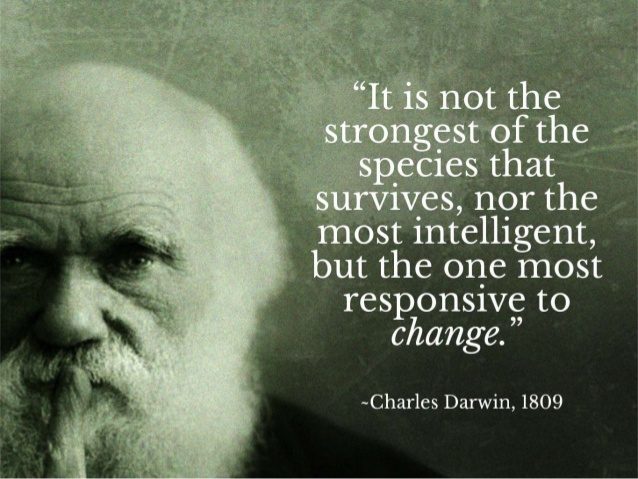
    While different sectors are at disparate distances from a radical shift necessitated by technological developments, it is, I think, inevitable. In this fantastic post titled ‘Knowledge is faster than mortar‘, which looks at scale through a different lens, the author makes the point that ‘the old mechanisms don’t fit the new social structure.Old mechanisms were built to scale stability, new ones will have to be built to scale despite instability. Anti-fragile, so to speak. Indeed, we will see many manifestations as existing structures try to adapt – internal mechanisms like Amazon’s 2 pizza rule, consumer facing disaggregation like Facebook that have a corresponding internal wiring, or brands tweaking their 4Ps even further for different contexts. But whatever paths businesses choose, this will hold true

    responsive-to-change

    until next time, the fast and the curious

  • Social Induction

    ‘Disparate’ perhaps wouldn’t describe it best, but definitely 3 different posts in terms of scope and point of focus, but which I thought were in their own way, circling one of this blog’s favourite topics – how organisations can fundamentally become more social – not just from a usage of tools across its ‘silos’ but more from an ‘adding meaning to the individual and society’ perspective.

    Stowe Boyd’s post titled ‘Are you ready for social software‘ not only gave me perspectives on the subject of the post, and title – social software, but also gave me a way to connect these three posts. He starts of with challenging the belief that Sherlock Holmes used deduction to solve the mysteries.

    It turns out he (or better, Arthur Conan Doyle) was using induction, which is, according to Webster’s, “the act or process of reasoning from a part to a whole, from particulars to generals, or from the individual to the universal.” In working from a paltry collection of clues to a full understanding of the actions and motives of the butler and his victim, Holmes/Doyle was, basically, developing a picture of the universe surrounding the crime from a few hints.

    He goes on to distinguish social software from software built for several purposes taken to mean ‘social’.

    Social software is based on supporting the desire of individuals to affiliate, their desire to be pulled into groups to achieve their personal goals. Contrast that with the groupware approach to things where people are placed into groups defined organizationally or functionally…..Traditional groupware puts the group, the organization or the project first, and individuals second….. Social software reflects the “juice” that arises from people’s personal interactions. It’s not about control, it’s about co-evolution: people in personal contact, interacting towards their own ends, influencing each other.

    Its a fascinating read and he quotes Kenneth Boulding, the economist, humanist and social scientist,“We make our tools, and then they shape us.” I thought that was an amazing way to look at it, and if you think for a moment on how tools have changed the way you behave, interact, consume, I’m sure you’ll appreciate it too.

    Amazingly, even without getting into software or technology, I saw an application of this thought process in Tom Fishburne’s Wiki Wall, a symbol of organisational creativity that could prove more useful than the traditional ‘brainstorm’. The wiki wall (a real whiteboard/surface)  allows ideas to be shared, collaborated on, and evolve over a period of time beyond the silos that the organisation might have. Shared belief systems and thoughts around which people could group together.

    Which then brings us to the ‘larger purpose’ that an organisation exists for. This purpose is something that has popped up here many times in the recent past, the last being ‘A Social Culture‘. I found it expressed extremely well in Umair Haque’s post on the way ‘social’ needs to evolve.

    Social is significance. The real promise of social tools is societal, not just relational; is significance, not just attention. You’ve got to get the first right before you tackle the second — and that means not just investing in “gamification,” a Twitter account, or a Facebook group. It means thinking more carefully how to utilize those tools to get a tiny bit (or a heckuva lot) more significant, and starting to mean something in enduring terms.

    For now, most organisations are looking at social tools (including software) to meet their business ends, and not looking to make the business’ ‘reason for existence’ itself something people – both employees and consumers- would associate with. Hopefully, by the time they deduct the importance of this, it won’t be too late.

    until next time, elementary? 🙂

  • But what do I know?

    Unlike in my other blog, Seth Godin is rarely referenced here. But when I read this post (rant, he says) from him titled “Deliberately uninformed, relentlessly so“, I sensed some vague connection with something I’d written a while back.

    Unlike other posts of Godin, whose blog I religiously follow for its ‘food for thought’, I found a smugness to this post – perhaps the rant provides the liberty. But as always, he manages to make a point. However, for a second, I wondered about the irony of this post coming from someone who does not allow comments on his blog. And thus this post.

    It is to be noted that he did not switch off comments just like that, he has valid reasons. Even if one just looks at the scale (1858 people retweeted and 2373 ‘Like’s) and considers  only a certain % commenting, it would tend towards chaotic. But whatever the reasons, he has chosen not to use comments as a channel.

    Ok, lets move on to me now. 🙂 I don’t read business books, however I follow several blogs in my line of work and otherwise. I rely on my Twitter, Reader and (occasionally) Facebook connections to point me to interesting reads. I also use Wikipedia extensively, despite the accusation that crowdsourced content can only be so trustworthy. From all this consumption, I have ‘superficial’ information on a lot of subjects, which make good conversation. This is also because I have way too many interests, and I’m forever in awe of things I don’t easily understand. My interest sometimes wears off after I’m able to bring a subject to my horizons of understanding. Sometimes, a more knowledgeable person corrects me/points me to things he/she thinks might interest me further and whenever I need/want to know more about a subject, I try and use the web’s sources to the fullest.

    But here’s the thing. Once upon a time, I could remember websites in context and add to discussions (offline), but increasingly I rely on delicious, among other things. I’m forced to prioritise my memory thanks to the ton of information out there that I process daily. Ok, that, and age.  🙂 And this is not a problem that will end soon, and its something I keep bringing up here. (Read)

    Time is the new currency, and I increasingly feel that people now react mercilessly to an “I don’t know”. Is that an excuse for people to claim knowledge of things they know nothing about? Maybe not, but perhaps like many other things, it is one of the ways for them to feel accepted and have a sense of belonging. So yes, it might be easy to label it as being deliberately uninformed, but in judging people so, without context and more understanding, we might be falling into the same trap ourselves – about people this time, as opposed to subjects.

    until next time, judge mental capabilities?

  • Services, Information, People

    Even as the first trailer of ‘The Social Network‘ was released last week, and even as fresh rounds of humour/angst on Facebook’s privacy algo (Google’s too) are unleashed regularly, I found that the amount of things I share on Facebook has vastly increased, though the time spent hasn’t increased in proportion. Its probably the ease of sharing information, the threaded conversations (none of my usual twitter clients have it) around the shared item, or the lack of (self imposed) constraints that my blogs suffer from, but photos, videos, comments and all sorts of content (my own as well as the ones I find) get shared on FB. Sometimes I even miss not being able to send a quick mail (where is Project Titan?!) to someone on FB from GMail (yes, I have FB friends who I don’t connect with on GTalk) In a recent interview, Mark Zuckerberg also shared his views on credits, and its portability. With search and location coming up as major initiatives, I wonder when my Facebook data will become portable.

    In this context, I saw the three kinds of webs (similar to the ones mentioned in the last post) and more that are almost seamlessly connected now – information, service and people. The need for filters in this information deluge is indeed pressing. While I do see some nifty tools that are being developed (eg. Pivot , Avoidr, specific search engines or even Twitter’s annotations) I sometimes wonder if it can ever catch up with the broadening scope of commonly used services. That’s also the reason why I think Facebook’s Open Graph search engine, which aims for social semantic search, is a big step, even while granting that not everyone’s on Facebook and their execution still has some way to go. Add to this privacy/security concerns (even Twitter was pulled up recently), and it does look complicated. Further layers like location will only add to this. And I wonder what new levels of complexity Google Me will bring. With each new service, the deluge of information increases, many times in the form of repetition, and our consumption changes.

    The increasing usage of these services has meant that the web of ‘friends’ have also increased. In my case, while FB consisted of only real friends earlier, in the last few months, the number of virtual friends – mostly from Twitter, have increased manifold. Since I don’t usually share anything on the web that I don’t want anyone to see, my problems with privacy have been limited. But as the amount of sharing increases, I realise there are things I share that could be taken out of context. There is also the fact that personal and professional lives are no longer silos. (Read) The other take out from the last point is that its not just communication from brands/services that need to be looked at closely, but people too.

    When the three webs are absolutely seamless, we will also see a shift in the kinds of relationship we have shared with brands, services and people. Facebook making payment for advertisers easier, sending me marketplace links, services making it easier for embedding ads, posts from my ‘friends’ plugging services/products with no disclosure, all work as signs for me. I do see a lot of work in setting up new ‘trading currencies’ and even different kinds of social networks (mobile phones – closed network ) and also note that the one factor that all the three entities need to keep in mind is trust. And that’s when I begin to wonder if similar systems are being developed for ‘sharing’ trust and whether they can keep pace with the deluge of information, services and people. Or maybe its already working under the radar – new services (endor.se), recommendations on LinkedIn, Twitter lists etc.

    until next time, SIP investments for mutual benefits 🙂