
There was a time, a long long ago, in the era of cassettes, when one had no idea about whether the entire soundtrack of the movie would be good. One just bought it on the first day of release, sometimes relying on the music director/s, or snippets heard as ‘forthcoming attractions’ from the previous soundtrack released by the same company, if it was T-Series, TIPS, HMV etc, or by begging the shopkeeper to open that cellophane wrapper and play the tape for a while. And thus, in those days, one would sometimes receive serendipitous delight and be transported by the music. Closed eyes, smile on the lips, and body slowly rocking, lost in the world of some ethereal track. These days, even if you don’t go searching for tracks, they find you, either on FM or through the algorithm of some feed that is supposed to have gleaned your preferences. (more…)
Tag: passion
-
That passion – profession debate, again
In many beer fueled conversations, I have heard the sentiment of “quitting my job and doing something I am passionate about.” While I see merit in that line of thought, these days I also end up playing party-pooper by asking if he/she has a business model in mind, especially since the ‘passion’ is more often than not from the usual suspects list – digital photography, cooking/baking, writing, travel and so on. To clarify, unlike funded startups this model doesn’t even have to scale, but in the medium-long term, the revenue has to be greater than expenditure. That’s a requisite for survival in the world, unless one has alternate sources of income.
I saw a meeting of worlds when I noticed yet another job listing that demanded the person to be “passionate about digital marketing“? As someone who has been working in the domain since 2004, I have seen a version of this phrase appear in many job descriptions. I could replace digital marketing with startups, consumer insights, programming and so on, the question remains the same. (more…)
-
Framing passion
A lovely Malayalam movie came out earlier this year – Maheshinte Prathikaaram – a simple premise based on actual events. The movie is set in Idukki, which makes for a great backdrop and also provides excellent material in the form of the simplicity of the people and their lifestyles. We saw the movie soon as it released and I loved it. Very few scripts manage to bring together an enjoyable mix (read balance) of humour and poignancy, and it requires a well chosen and talented cast to execute it well. This movie did both.
While the principal narrative track (the revenge that is suggested in the film’s name) around Mahesh, the protagonist, is entertaining in itself, the idea around his father’s character – Vincent Bhavana – interested me a tad more. Recently, I saw the movie again, and now that I knew how it would play out, I could pay more attention to this track. (more…)
-
Lovestrong
Slightly dated in the context of real time, but I thought this was a pertinent read in the Armstrong era. It’s titled “Honesty of the long-distance runner” and is about a Spanish runner Iván Fernández Anaya. He was running second in a race he had no chance of winning when he saw race leader Abel Mutai pull up about 10 meters before the finish, thinking he had already crossed the line. Instead of exploiting the situation, he let the Kenyan win using gestures to communicate. He thought it was the fair thing to do. He also candidly said that if a Eur/World medal was at stake, he’d probably have done things differently.
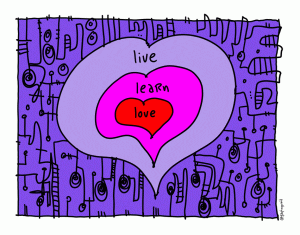 I saw this poster at gaping void, related to purpose, but twisted it a bit in this context. It isn’t as though there aren’t things we love to do. As we move further in life, we learn more about the way life works. Sometimes these things we love make business sense, sometimes they don’t or requires either stellar talent or more hard work than we are willing to put in. Some of us work at it, some of us lock the love away and some of us decide to find an easy way out. And thus it is that even things which involve love and passion – sports and arts – have been converted into competitions and ruthless economically viable phenomena. So really, where does the corruption begin?
until next time, strong-armed
-
Plan C
This post has been pending for a while, the date of publishing of the article that inspired the post is evidence enough. It is about people who leave their jobs to follow their passion, but instead of the success stories we are used to, it focuses on the difficulties on that path. Even if you’ve not taken that path already, it’s quite possible that you have contemplated it. It’s romantic – the freedom, being your own boss and doing the thing you like – Plan B. But it’s not easy, and it begins as early as even identifying one’s passion. (must read)
Interestingly, NYT themselves had an article almost a year later that asked “What Work is Really For” and answered that with an Aristotle quote “we work to have leisure, on which happiness depends.” Though I didn’t know about this quote until recently, this is a perspective that I have often used to debate with people who say those who do not like their jobs should quit. There are many reasons why people don’t, and one of them is consciously making a choice to work (possibly on things they don’t enjoy) for the 2 days (and vacations) when they are able to spend their resources – money, effort and time – on things they enjoy.
The reasons people don’t scale up those 2 days could be many, including the difficulties involved in the early stages of setting up, and then maintaining a positive balance – of money and life. Money is after all an essential resource. It buys things, it opens doors. But when your passion becomes your work and your principal source of money, does it feel the same? Or does it become a job?
I liked the second NYT article also for its last 3 paragraphs. It addresses the money conundrum. It talks about how right from when we are born, we are taught to be consumers, thanks to capitalism, which though calls itself an open market where we have the freedom to buy is actually a system unto itself. The choices are not really independent. It points out that education should be meant to make us self determining agents. True freedom requires that we take part in the market as fully formed agents, with life goals determined not by advertising campaigns but by our own experience of and reflection on the various possibilities of human fulfillment. But that’s not an easy path either. It calls for independent thinking and a subjective view of fulfillment and happiness. And that brings us to the familiar “to each his own”
until next time, work it out 🙂
Bonus Read: Six Rules to guide your career