
Tag: organisations

  • Social Office

    A couple of days back, I happened to read this report by Jakob Nielsen (via RWW) on social networking on intranets, that throws light on the enterprise use of 2.0 tools. From the RWW article

    Neilsen’s 168-page report includes case studies from 14 companies in 6 countries, including Sprint, Sun, Intel, IBM, and Johnson & Johnson. Several times throughout the summary, he points out that when he asked these companies about their enterprise 2.0 strategy, they told him to come back in a year.

    The report, a result of research done across 14 companies in 6 countries, highlights the pitfalls of both the quick adoption as well as slow track methods of using web 2.0 in the enterprise – risk to corporate culture and loss of employees who expect quick adoption respectively. The study points out that while the tools are important, it is what it lets people do and how it helps them solve business problems that actually matter, an emphasis on the sometimes forgotten fact that the new shiny object on the www need not be of use to the organisation and even the reverse – an old tool might work best for the intent/objective. It also highlights the different aspects that need to be taken care of, while implementing the tools in the enterprise – content, training, encouraging the community, speed of integration, open communication, the need for corporate communications to adapt to the reality of real-time and so on.

    And in the end, were raised two things that I thought were the most important components in this discussion – the change in corporate culture it entails (especially the ‘knowledge is power’ tenet) and the time the implementation would take, precisely because of that (and hence the need to start right now).

    The social media strategy (if any) of many companies is either the brand’s Twitter/Facebook presence and the ROI discussions for the same, or the use of these and networks like LinkedIn for actual sales (yes, broad generalisation). When compared to the corporate culture change discussed above, these are tactical uses of social media – utilising tools, for (usually and unfortunately) broadcast or direct selling. Yes, in some rare cases, the channels are used for two way communication too. (a story on Indian IT firms)

    While many efforts are commendable, in many ways, the tactics resemble a building with a gleaming facade whose insides truly reflect the state of affairs – peeling paint, bad plumbing, poor service etc. These are bound to come out. As the Ad Contrarian wrote a couple of years back in his post titled ‘Brand Tinkering‘,

    ……………tinkering with the brand is way more fun than solving real business problems. Solving problems requires unpleasantness. Floors have to be swept and walls have to be painted. People have to be fired. Systems have to be changed. Products have to be redesigned.

    The need for a more comprehensive approach to social media, and the need for internal change is something we often discuss here. On one of the LinkedIn groups I am part of, Pallavi Bhardwaj asked a question recently. It happens to be quite pertinent to this post, albeit in a tangential way. The question was ” Do you keep a track of employees’ personal blogs?” And its not just blogs these days – microblogs, social/business networking sites, and a tribe of self expression and sharing platforms that grows daily.

    It made me wonder if this is related to the enterprise not keeping pace with the evolution of the web and its tools? Assuming that a company monitors employee activities, does it then (in addition to/instead of) ‘deal’ with the employee or question why something was posted/shared, and address that? Does it again show the need for control, rather than understanding the need for a change in the way business is done? A short term view instead of real strategic vision? I’m not saying that the immediate ‘fire’ does not need to be handled, but is a thought being spared for what lies ahead? Maybe, if the enterprise had a thriving communication and sharing network, and an efficient response mechanism, the need for ‘policing’ would be drastically reduced? As one of my favourite Dilbert strips says,
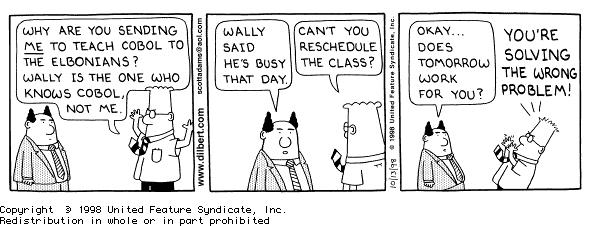
    wrong-problem

    (meanwhile, down with the syndicate!!)

    Perhaps, the brands who are just listening on the tools like Twitter, and using the information to change the fundamentals of how they do business are the ones who stand to gain more in the long term. As part of this, they could also be creating a culture, where each person is aligned to the organisation’s goals, rather than only the narrow focus of the department he works in. We really need more like Zappos, and more ‘culture creators‘.

    until next time, enterprise..start the trek 🙂


  • Sizing up

    Quite sometime back, Chris Brogan had written a small post on ‘Small is a weapon’ with its many advantages like the ability to experiment more and respond faster (than big companies).  Before going further, let me clarify that this is a broad generic view, and I’m sure there might be large companies that manage all this. But perhaps smaller companies have a better chance. The comments on the post reinforced these advantages – internally, a flat structure that makes effective decision making easier, a willingness to change, the importance given to ideas, and externally, faster turnaround for customer issues, a personal touch, and so on. These characteristics struck me as very important ones from the perspective of social media interactions.

    Is social media a better tool in the hands of small companies? In a small organisation, would the qualitative metrics of social media be appreciated much more? Would the community – external and internal be connected because of the passion they share for what they’re building together? An idea, (via dina) which binds the audience?

    As organisations become bigger, ideas become products/services and then become brands?  And as brands grow in stature, does this size dictate everything else? Is that why mass media seems appealing? Because somewhere along the line brands picked up larger audiences and found that one way communication to this audience was easier? Does the focus of the brand move on to marketing communication, monetisation of the audience etc, because the  brand cements itself in terms of its attributes and perceptions in the mind of people and all it wants to do then is reinforce?

    Can larger organisations handle the expectations of social media users – both from an internal perspective (empowerment, for example) as well as from a customer standpoint – (speed, personal touch, conversation). Do they feel limited by  the number of interactions that can be handled? Are they too used to conveying the single brand message irrespective of context, and do they find ‘scalable intimacy‘ difficult to handle? Do they then try to dictate the kind of ‘official’ use that their employees find for social media? After reading Mashable’s post on a similar topic, I had another thought – would an international brand be able to make sure the cultural differences and sensibilities across geographies are handled in the right manner always, in a medium that’s not limited by geography?

    Perhaps the solution is to move back from the narrow confines of the brand’s architecture to the original generic idea space, because there will be the old audience with new experiences who can help the brand connect with a new audience? New ideas would emerge leading to a new lifecycle?

    I guess its not quite easy to answer since the phenomenon of social media has been making its presence felt only recently, and its difficult to figure out organisations that have been using it for a long time and also scaled up at the same time. Meanwhile, McKinsey Quarterly has a great read on 6 ways to make web 2.0 work. (for companies)

    until next time, scale the walls

  • Conversations in social media

    The Facebook redesign and the possible redefining of brands’ interaction with users on the service would perhaps make organisations dwell a little more on their new media strategy. I say this, mostly considering the reach of Facebook, and the importance and influence that conversations there, are acquiring in people’s lives. The growing reach of Twitter cannot be ignored either. So it does seem a good time to reflect on creating a digital footprint, getting to know the platforms – be it Facebook (via Vijay Sankaran), Twitter, (links point to good ‘How to’ resources) or any other service, and how they could benefit the brand, looking at what has/hasn’t worked for other brands, thinking about a long term social media strategy,  and then figuring out the measurement criteria that could be adopted for the strategy that is adopted.

    Amidst all the hoopla surrounding Facebook’s new design, and Twitter’s integrated search, Paul Worthington wrote a very interesting post on Mashable reminding brands not to lose their focus. From the post

    The initial challenge is not to better understand and respond to the customer. The challenge is to start with better understanding who you are, what you truly believe in, and what you can realistically offer to your customer.

    Because if all you focus on are what customers are telling you, you risk losing sight of who you are, what you believe in and what drives you forwards.

    A purpose that is first bought into by their employees, before being presented to the consumer in a way that brings a natural self-confidence to that conversation.

    While crowdsourcing has many advantages, and now has various platforms including Facebook, Twitter and more focused services like Get Satisfaction, and consumers also benefit from having big brands on these platforms, I completely agree with the thoughts shared above. This is what I’d consider as the middle path between adhering strictly to brand manuals only and plunging into social media without a clear objective/strategy and trying to please everyone in the crowd.

    So, perhaps what brands should do first is search themselves (yes, without Google), understand what’s the real value that they offer to their consumers – potential and current, figure out whether the entire organisation is in aligned on this, then consider how new media can play a part in sharing and collaborating with the users as well as communicating to them what the brand stands for and what value it can deliver, ensure that they continue providing this value, keep listening to users to find what more they expect from the brand, figure out the feasibility of these expectations, tweak it further by bringing in the internal factors, and continue this process. For many organisations, internal democracy as well as complete internal transparency would themselves be a significant steps. But these are a must before aiming to engage with consumers, because in social media brand custodians are not the only ‘broadcast’ source, every employee is a potential source.(a wonderful presentation on the micro sociology of networks)

    In essence, its not just a brand strategy shift, its an organisational culture transformation. As a brand, and as an organisation, it is important to be clear about the levels of transparency you can work with. The challenge then becomes that of creating and maintaining a harmonized balance between user needs and brand deliverables.

    until next time, drawing the line and walking it

    PS: A great story on how two fans made Coke the second most popular fanpage on Facebook, and Coke’s reaction.

  • Brands & Media Metrics

    Rajesh Lalwani raised an interesting point in his post a few days back, on how the performance of a social media campaign should not be judged solely by the buzz it generates, since a lot of conversations flow ‘below the surface’ i.e. emails, telecons and face-to-face. I’d also add Chat (the GTalk type) and DM.

    My reply consisted of several parts, and some of it got me thinking on the concept of ‘measurement’.  Among other things,  I felt that, relatively speaking, it is more convenient to measure buzz (a social media search or even a Google search) than the ‘below the surface’ versions. You really can’t track what I speak with someone else on GTalk. But more importantly I felt that this love for measurement stems from a need for control.

    So I looked back at the brand campaigns around, the media used and the measurement. Following is a rant.(and is quite India specific) Though its extremely relevant, I shall, for now, ignore brands’ following a ‘campaign strategy’ at the cost of brand strategy. Generally, the campaign would consist of Outdoor (billboards), Print, Television, Radio and *new* Internet. So, lets see the measurement criteria for these. Outdoor – you can’t go wrong with one on Brigade Road- Residency Road (that’s Bangalore) junction, everyone goes there. Print – XYZ has circulation and readership of …. Television – XYZ channel and the TRPs it delivers. Radio – say RAM and listenership. While there are numbers and numbers, there is really no way to figure out exactly how many people saw/heard the ad and responded (not even if you put call centre numbers/email ids/call ins).  The sales spike that happens on the day the ad is released is the indicator of its success in print. If ‘people’ saw/heard it, TV/Outdoor/Radio has worked. Yes, I’m generalising, and I do know what value market research can offer. And so Internet. Now the internet obviously needs to match up to the awesome quantitative measurement options that the other media provide. 😐

    And so the brand guys waited for the net to show some real numbers. And it did, as it was bound to. Depending on who you ask, this number could now vary anywhere over 28 million users. ComScore puts India’s net population at 32 million, and within that, the social networking population at 19 million, Orkut firmly leading with 12.8 million. The figure reminded me of the leading English daily’s readership – as per IRS R2 2008, it was 13.3 million. 🙂

    And while the numbers rose, the digital sellers walked in with the stats and taught the brand guys CTR, CPC, CPM (no, that’s not political)  and to use banners and site takeovers and microsites on the net. The measurement criteria was made up of numbers. So, the internet with the amazing CPT (cost per thousand) it provides, is no longer an afterthought in a media plan (Thanks to R, who gave me her valuable thoughts on media planning). Pay for Performance was the mantra and its pillars were leads and clicks.Is that a problem? Not by itself, but when you consider the potential the medium offers, and how it can be used for measurable branding, its not a problem, its an injustice. To quote from this wonderful article on the subject

    In fact it is precisely this cult of accountability that is getting in the way of the digital community progressing from clever marketing handymen to the architects of brand success….So long as the digital community clings to its obsession with accountability over effectiveness it will remain in the unedifying position of creating engaging brand fluff on the one hand and highly measurable but largely pointless direct response advertising on the other.

    All these are not unknown issues. WATBlog’s panel discussion in Delhi covered much of this. And with all this playing in the background, arrives social media. And it won’t make sense because brands only use media on a campaign to campaign basis, and social media is about the brand’s strategy and a consistent presence- building an audience, listening to them, asking their views, collecting insights, making better products, and so on. It is not about statistics and definitely not a get in-bombard with ads- collect leads-get out deal. Besides, measurements are more qualitative!! The criteria that mass media provides for measurement are almost irrelevant here, and rightly so!! Because in social media, the crowd responds, they talk to each other, and if you don’t participate, and attempt to treat it like a broadcast medium (the way the measurement based web is being treated), someone is likely to have fun, most likely at your expense. And in social media, what a brand says is less important than what the brand’s consumers say.

    Like the general web before it, it is only a matter of time  before the social web  reaches a scale which forces brands to use it. I hope they don’t use it like broadcast media, and instead learn to use it – not as a templated solution, but as a subjective, evolving mechanism.

    until next time, cast away

    Note: i have nothing against mass media. It has its uses. I have a problem with this social media measurement obsession, without the correct metrices and by involving it only from a communication perspective and not the other parts of the brand’s life cycle, and finally stating that it’s just fun and doesn’t work for brands.

  • BoT – Brands on Twitter

    A few days back, there were a couple of very interesting posts on Mashable – on the topic of whether brands belong to Twitter- one post against, and a couple of days later, a rebuttal. The first post first suggests a fee for brands to be part of Twitter, and then says that they should be banned altogether since it would be against the spirit of Twitter. It finally advocates the use of personalities, since people like to talk to people. The second post, while agreeing that spam accounts are generally disliked, states that brands can have personalities too, and gives some great examples, and tips for brands on Twitetiquette.

    I thought these posts and the issue of bloggers being paid to write posts about brands (which surfaces when we are sufficiently bored of doing this guy’s job of finding revenue models for social media) were two sides of the same coin. The issue of trust is being tackled from two sides.

    In the case of brands being on Twitter, the argument is that faceless brands cannot be authentic or transparent like a real person. How can we trust such an entity? In the case of bloggers who are paid to write posts about brands, the argument is that if they are paid for it, how can we trust the veracity of what they’ve written?

    In both the cases, the answer will emerge by itself, in time. If brands use this as a one way communication medium, to just broadcast, without having interesting conversations or adding value for the audience, the crowd will treat it as a broadcaster and move away, unless there is some really awesome content being shared all the while. If bloggers make up stuff about a brand, and transmit it to their readers, the crowd will remember not to trust them the next time.

    A bit more on the topic of brands on Twitter, since its debatable whether the brand should be itself, or have a spokesperson who represents it. Its understood that behind every brand (not including spam accounts) on Twitter, is a human being, even he is one that first configured Twitterfeed to send out ‘auto tweets’. So, I am guessing that what would’ve happened more often than not, is that an individual came on to twitter, discovered how cool it was, and then decided that it was a great place for his organisation/brand to communicate to the outside world, which contains his consumers and potential consumers. A chance for the brand to talk about itself, and hear from consumers what they had to say.

    The individual would already have an equity on Twitter, and would enjoy the trust of those who follow him. Considering how a blogger who writes a paid-for-post (even with disclosure) is almost crucified, it is understandable if he wouldn’t want to mix his own equity with that of the brand’s equity, especially when there is every chance that the organisation may not have a policy on social media, and he wouldn’t be getting paid like the celebrity blogger. Also he doesn’t even know how long he would be with the organisation. Lastly, by mixing a personal account with a brand, the person might be constrained to speak of things in context with what the organisation does.

    Keeping all this in mind, I’d have liked to say that brands belong on Twitter, as brands. After all, we already have people building personal brands. In fact, organisations should perhaps look at multi functional teams which can communicate with consumers on different aspects with authority and domain knowledge, so that over a period of time, they can re-create the credibility they enjoy in the real world, in the digital world too. This post, however, gives some great points on why the logo should be replaced by a public face.

    In summation, though, I’d have to say that as always with any strategy, it’d have to boil down to intent. As this wonderful post correctly says, “The beauty of Twitter is that it is what you make of it, and you can make so many things of it”. What do you think?

    until next time, brands are limitless characters?

    PS. … and in this season of giving, here are 2 good resources I’d like to share with you

    In return, i’d request you to give a few minutes of your time and participate in the Exchange4Media.com & Blogworks.in Blog & Social Media survey.

    Merry Christmas everyone, have a great 2009, and I’ll see you next year . 🙂