
In vs Amazon, I had cited Simon Andrews’ article – it might be “easy” to get about $50m, the journey to $100m and beyond gets tougher because efficiencies start maxing out. In this context, “efficiencies” relate to acquisition when building a DTC business. It led me to think of “maxing out efficiencies” in the broader context of the organisation and the business environment it operates in. (more…)
Tag: organisation
-
Evolving against entropy
In the last fortnight, I had two interactions with customer care teams. The first was Kotak, for a bank account. There were failures at multiple levels, but the biggest takeaway was how difficult it was to get through to a human. Chatbots have their uses but this was extreme! Twitter DMs weren’t a help either. The second was Amazon, and that surprisingly included being put on hold for about 15 minutes and transferred 5 times! Thankfully, the problem was resolved in 30. But given the famed Amazon customer-centricity, this was a disappointment, and I wondered if at scale, it was inevitable.
What causes it? The best frame I have seen is entropy. (via) Yes, that physics and thermodynamics thing – the degree of disorder/randomness in the system. Though the meaning remains the same, the application changes. In the context of a business, it is the tax applied by the system between input and output. Just imagine the effort that is required to get things done in a corporate structure as against a startup. While it is theoretically possible for a complex system to have lesser entropy than a simple system, I have not seen it in practice. I can imagine why it is so – the randomness that can be generated by different touchpoints, and their optimization for following rules as opposed to providing solutions. What happened to me with Kotak and Amazon were examples of that. (more…)
-
The Second Job
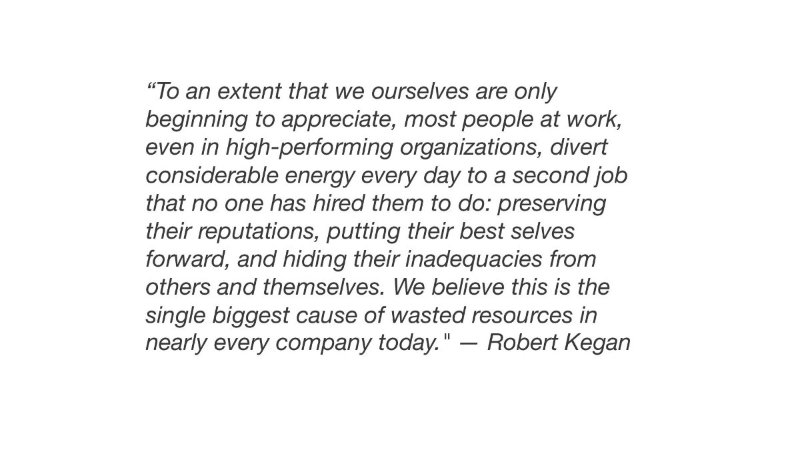
I caught this in the Farnam Street newsletter, and went about looking for the source. An HBR article from 2014 titled Making Business Personal, which also writes at length what and how certain organisations overcome this.
-
Re: Org
Timehop, which takes me on a nostalgia trip everyday, reminded me recently that it has been a year since I wrote The Change Imperative. The opening slide features a quote – “If you don’t like change, you’re going to like irrelevance even less“- attributed to Gen. Eric Shinseki. In the times we work in, I believe this cannot be overstated, not just for individuals but for organisations as well. Even as business dynamics force changes on the external manifestation of an organisation – the brand – any organisation that faces a client/consumer will also be forced to adapt its internal structure and practices to suit changing needs.
For a long while now, I have been ambivalent about processes. I have worked in an era, and in organisations, where processes had a way of getting things done. But in parallel, I have also felt that many a time, processes have a way of forgetting what they were made for. The output overshadows the outcome. Over the last few months, my surmisal has been that, to use a Taleb classification, processes can make an organisation robust, but not anti-fragile. This very informative post by Aaron Dignan of Undercurrent – The Last Re-Org You’ll Ever Do -highlights many ways that organisations have tried to change standard structures and practices, and even suggests a six step path to reorganisation. (more…)
-
Re: Skill
In The Entrepreneur and the Professional, I brought up the challenges at work faced by my generation. The focus was on an approach to work and the changes that have been forced on it because of rapidly shifting business environments. In addition to the business’ external dynamics, another factor that has been changing the organisation is the entry of a different kind of workforce.
“How the Millennial Workforce is Changing Business” calls this a revolution, and writes further that they will prepare the organisation for the future by making them Digital, Clear, Fluid, Fast. PwC’s layered report on the same subject brings out this workforce’ motivations, acknowledges the generational tensions and suggests what the organisation would need to do to attract, develop and manage millennials. (more…)