Tag: Open Graph

  • Social @ Myntra – Part 2

    continued from Part 1

    Creating, correcting and maintaining brand perception and resolving customer issues were fundamentally the objectives when operating in the customer care and brand domains respectively. But this was not an end in itself. The end objective of the business is revenue, and that makes up the remaining story.

    3. Product: In this context, it includes the website itself, and the various features/enhancements/new products (eg. gift cards) that get introduced on a regular basis. Including social buttons on the home page and product pages were a given, though getting them above the fold was a mission I lost! The first major change was switching from FB Connect to the Open Graph. The potential applications, using social and interest graphs, are phenomenal, but we never progressed that far. At a basic level, I had slotted activities in this domain under acquisition and retention, and we have only implemented a small portion of the former. The easiest application of the social graph was using it for social proof. Kuliza’s Echo made that job relatively easy for us. It not only helped seamlessly amplify word-of-mouth, but also gave us a lot of data on consumption. One of the plans was to integrate this with Elevate, another Kuliza app – but inside Facebook, to try and beat FB’s throttling of organic reach. 🙂 Another application of Echo, which should soon see the light of day, is a Fab-like social feed. If a user has registered on Myntra using Facebook, he/she would see the actions (Likes, Purchases, Wishlist additions) of his/her friends on a separate feed inside Myntra. Our expectation is that this would prompt more social actions inside Myntra and accelerate word-of-mouth inside FB further. This was actually a Phase 1 of a larger plan I had in mind. Let me explain.

    While brand and customer connect can provide a strategic advantage on social, I’ve always felt that it was in the product domain that social could provide a sustainable strategic advantage. This came from my notion that ‘loyalty’ existed when the exit barrier for a customer to leave Myntra was high enough to beat any sustainable offering from a competitor. ‘Brand’ is one standard way to achieve it, but it is relatively less tangible, and in a commoditised marketplace, it would take more time. Generic discounting is not sustainable. I think, in this context, ‘Product’ can reach this ‘barrier’ in lesser time, and at lower costs. An ideal in my mind was using the social, intent and interest graphs of users from across various platforms to build a personalised experience, and through that, a gamified customer acquisition and retention architecture inside Myntra, (thereby minimising dependencies on other platforms) and then using social media to amplify relevant actions to further drive acquisition. But this approach has a high dependency on changes in the existing product and every new product/feature having relevant social features baked in (or at have it in the vicinity on its roadmap) to contribute to the larger agenda of the architecture. It also takes a mindset and backing. I did have a rough blueprint, but at this point in the e-commerce wars, this approach probably seemed a nice-to-have. 🙂

    4. Sales: Conventional notions claim that social media should not be used for sales pitches, but from my humble experience, I’d beg to differ. It’s just a matter of what-when-how, and how much. From generic product pitches on the Facebook Page as part of the larger content strategy, to custom links on Twitter, we have consistently shown and tracked revenue from social channels. Even Pinterest and Google+ are contributors! I must admit that in the larger scheme of Myntra’s monthly revenue, these are insignificant, but let’s just say that the total contribution are in double digit lakhs every month. In fact, it reached a point where we were given a budget to see if we could scale it. In this context, I have to mention this brilliant idea by S – she used customer generated product images from our Pinterest ‘Shopped from Us’ board every week to make sales pitches on Facebook! Works like a charm. 🙂

    The area where there were a few attempts, but didn’t really pick up was enterprise collaboration. We managed to build a fairly large community on Yammer, but what I’ve realised is that it needs champions at the highest level in all parts of the organisation using it on a consistent basis for it to be sustainable. I also had this grandiose vision of using Google+ and circles to connect customers, Customer Connect teams, Partner brands and employees in general, but this one was limited to a word document! This is an area that I believe to be a must-have as we evolve towards social business, but in the larger list of priorities, is still a few steps away.

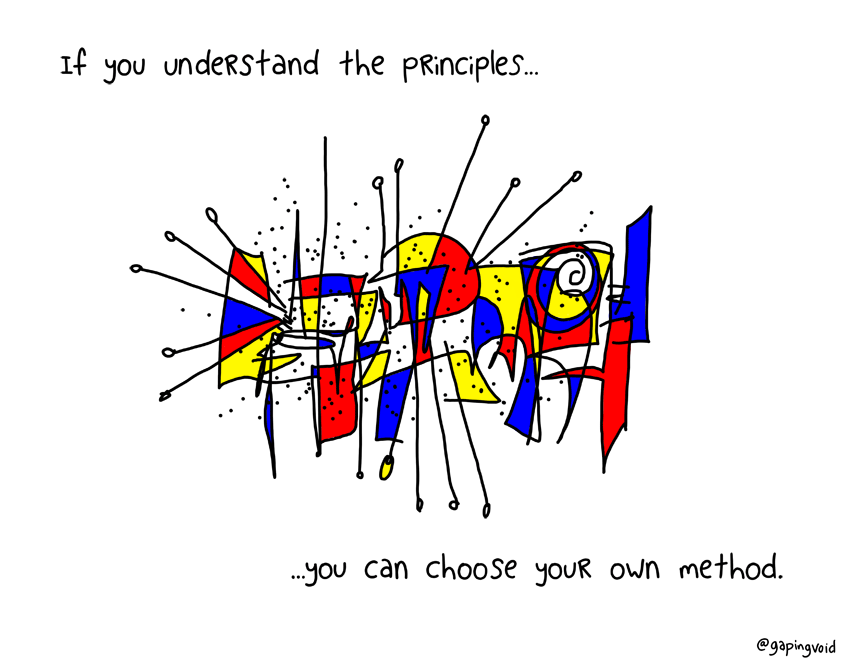
    That gives a broad view of what I’ve been up to for two years. The generic point I’m trying to make through the two posts is that from basic business outcomes like customer satisfaction and sales to more nuanced ones like brand perception and sustainable strategic advantage, social can and should play an integral part. There will be differences in terms of scale, strategy, resources etc depending on the domain, maturity of the industry/organisation, target audience and so on, but the important part is to begin because the brand/organisation needs to evolve as well. Social media has shortcuts, I’m inclined to think that social does not. These are days of nascence, and social will continue to evolve – enterprise social networks, social business, big data, the Internet of Things (add buzzwords to taste) and more will all have their hype cycles and age of maturity. By all means, measure ROI, but remember, we spend on movie tickets, we invest in mutual funds. I think we’re clear on the expected time frame of returns in both cases.
    understand_the_principles

    (via)

    Myntra will remain dear to me, like all the other brands I have worked on, but it will probably have a more lasting signature, because not since my days at GIM have I experienced such a rewiring of my worldview. This stint has given me oodles of confidence, friends whom I hope will last a lifetime, and relationships of trust that I will cherish.

    Before I end, the last hat tip – to the super S, who joined the team mid last year and has since then, proven time and again that she’s the best social ‘investment’ we made, and made this little social adventure a total joy! “I used to believe that we are here to teach what we know. Now I know that we are here to teach what we are meant to discover

    until next time, </ head – social media> 🙂
  • Revisiting Social Commerce

    It’s been more than 2 years since I wrote about social commerce on afaqs, and since then, there have been massive changes right from the definitions to the operations of social commerce. Karthik’s recent post on the subject led me to think about it again.

    I’ve always felt that most of the popular definitions of social commerce have constrained its actual scope. Back in 2011, facebook stores accounted for most of the social commerce discussions. These days, it is mostly referral traffic and sales from social, and that too, in terms of last-touch attribution, as the Ecommerce quarterly (that Karthik cites) would suggest. While I’d not contest EQ’s methodology or assessment, I think it’s only fair to point out that there have been a great number of exceptions. (read; Disclosure: that list includes Myntra where I work) I’m not a fan of how Facebook has throttled what we used to call organic reach, but if you want to read about how Facebook helps target users at different levels of the funnel, Zappos serves as a good example. Facebook’s Custom Audiences and FB Exchange products allow different ways of targeting consumers. Twitter is a bit late to the party, but their products also have excellent potential from what I’ve seen, and they’re moving quickly! (already into retargeting)  YouTube is already a big bet for advertisers, and Pinterest is already being used by scores of Etsy users! (read) From small experiments, I also suspect that Google+ is a potential top rung player. Even if you’d like to leave the $ out and consider (for example) only organic (eg. Open Graph actions) there are case studies evolving. (example)

    tumblr_lteusu0d0K1r54seio1_500

    So, can commerce be driven through social channels – advertising as well as organic? An emphatic yes would be my answer. Yes, it might score low if one considers only last-touch attribution, but hey, many of Facebook’s strategic PMDs are getting a handle on multi-touch attribution. (Kenshoo is an example) One should also consider that other traffic channels like search, affiliates etc have been around for longer and have tried and tested models. The point is rather simple – if we judge social’s contribution on the basis of models created for an earlier version of the web, it would not measure up. We’re at a stage where both technology and tools are still evolving to help measure social on terms that balance its uniqueness with the needs of the business. The good news is that the little that I have seen of Facebook’s strategic PMDs has been inspiring!

    (Image via)

    But I think using social channels as sources of traffic/revenue for commerce is still not capturing ‘social commerce’ in its entirety. Though arguable and reducing in favour, I’d still label many group buying options as social commerce. (example) But to me, the elephant in the room is  p2p commerce. Though the collaborative economy is more vast in scope, I’d put it in the same bucket in this context. (do read Jeremiah Owyang on the subject) From Airbnb to RelayRides to Loosecubes to TaskRabbit to even KickStarter, commerce is now happening between individuals with everyone playing creator, buyer and seller as per context. While the $ is inevitable, trust and one’s network itself are becoming currencies. Yes, these also use social platforms for extended reach, but this is inherently more social than the pure commerce play of brands.

    It is interesting to see social platforms working on these lines as well. Facebook’s Marketplace was probably a bit ahead of its time, but nothing stops them from bringing it back. I read recently that Google is planning to release Mine – a service integrated with G+ that allows users to keep track of “belongings” and then share those with friends in different circles. (via) Yes, there will obviously an Android App. It’s not just these platforms, I’d think that Amazon is slowly approaching it from a different direction as well. (read)

    To sum it up, commerce has always been social, it’s only the dynamics that keep changing.

    until next time, commercial breaks

  • Search me..

    I was quoted in a recent Social Samosa post – on Facebook Graph Search. Do check it out on their website, it has useful thoughts from various others as well.

    Given that it is a fairly large move, (third pillar, Facebook calls it) I thought I’ll add to my quote there. As a final goal, both Google and Facebook are trying to organise and display information to users, because contextually relevant information is still a means to revenue, especially in the era of information overload. Google crawls the web, and Facebook uses social connections as a means to gaining this information. Google is also trying to add social as a context, and Facebook has Bing’s support. It’s not a war now, but it’s definitely armament.

    Facebook has tons of data to get this right, and this is dynamic data, thanks to the information we supply, and this is going to get better as Pages (and people) start optimising for Graph Search. Also, once the Open Graph is integrated and actions outside FB also start becoming data, it will become a larger treasure trove of information. Though there’s no advertising product in sight, I will wager that it is an advertising foray in the guise of a consumer tool. As I wrote in the article, Facebook now has the user’s intent broadly divided into 4 categories (people, places, photos and interests), along with his/her ‘influencers’. All of this will allow for some massive segmentation, and thus better targeted ads. And this is not necessarily evil, it can be damn useful because discoverability will be increased.

    In terms of implication for brands, (like I said in the quote) brands with organic signals (eg. for a retail outlet, check in at a physical location) will have a starting advantage. Once the Open Graph kicks in, social actions on websites will become a huge advantage. Content marketing takes on added significance since every action on FB increases the chances of a brand being discovered. Oh yes, Like is a back with a vengeance! On a tangential note, recruiters could use Graph Search as a hiring tool.

    It’s a long shot, but what would happen if Graph Search was thrown open to Pages. Think about it – as a page admin, I already have the ability to target my post to a certain level (about 7 parameters) but that’s really basic demographics. What if I were able to target (organically) (as Myntra) an Angry Birds t-shirt post at people in India who Like Angry Birds. (or even standard apparel brands)

    Meanwhile, there are two immediate concerns. One – privacy. Users will, over a period of time, calibrate the information they supply to Facebook with the advantages of doing so, but it will be a difficult process. The second, I will highlight through a comment made by Romit on Twitter

    But this is just version 1. I’m sure Facebook will have/build more signals inside the hood to filter data. Social just became even more interesting. For that. Facebook gets a thank you.

    until next time, Like I said…

  • Early Bird Rewards

    At least two major virtual happenings, one that has massive implications on the future of the web, and the other, slightly more subdued, but not lacking in potential. The latter – Twitter Annotations, announced at Chirp, allowing developers to “add any arbitrary metadata to any tweet in the system.” You can take a look at the various possibilities here, here and here. The former – Facebook’s  Open Graph, unveiled at the f8 conference, and aimed at making itself the centre of everything that happens on the www. A  combination of  plugins, developer tools, new markups which can make the user experience on any site that plays along increasingly personal, social, semantic, from plain hyperlinks to layered information. Already, one small manifestation can  be seen at the bottom of this post – a Facebook ‘Like’ button, which will carry your liking of this post into your activity stream on Facebook. More and more data, not just what you do on FB, but outside as well, across the web. From what I read, smells like Google, perhaps worse, because the flow of information seems possible only through the Facebook conduit. A good round up of implications here.

    When I returned from he break, and read up on these developments, my first thought, which i also tweeted was

    1

    And that’s the point of the post. During the break, the only network I was hooked on to was Foursquare. One of the things that happened, thanks to long waiting times in the Kolkata airport was that I became mayor of the neat CCD outlet just outside the airport complex.

    CCD has completed the re-branding at this outlet (unlike the one inside the airport) and has done a decent job at establishing ‘conversations’ as the prime focus area, in terms of in-store design. The feedback posters, ‘snippets’ at each table and the ‘quotes’ design on the roof were nice touches. When I got back, I found a CCD account following me on Twitter. Seemed like a more synergistic effort after the earlier snafu.

    It made me think once again about how alert brands need to be in such a dynamic scenario. If CCD were an early adopter, would they have braved the earlier storm better? What if they become active on Foursquare now, experiment with the new services being built on top of it – friendticker, snacksquare etc, still in their nascent stages. Or at least acknowledge their outlets on Foursquare and engaging the users. “@xyz congrats on becoming the mayor of our abc outlet”, and then build on top of that relationship. Won’t that help them gain some crucial evangelists in a new medium? If not evangelists, at least someone who will listen to their side of the story when something nasty happens? Wouldn’t they get a headstart on ‘authority’ by being an early bird?

    Even the era of quick responses being a reasonable expectation seems to be blurring by fast. Perhaps brands are now required to have an advance scout mechanism, to test out new services, features, changes, understand the implications and see whether/how business and objectives needs to be realigned. Page Rank, Social Platforms at consumer and enterprise level, Social CRM, Location based services, tools and platforms keep shifting. Early adoption and balancing objectives with diverse ways and platforms of engagement may become an imperative. Multiple options, two way communication manifestos, its all changing real time. Hold on tight.

    until next time, service level disagreements