
Tag: Nike

  • The Social Product

    A few days ago, I read this post that cited studies on consumer sentiment (US, UK) about brands being present on social media. There are plenty of interesting perspectives and nuanced insights but one key takeaway is that consumers feel there is a glut of companies on social media, though it seems the younger age group feel that presence on social media adds to trust. Around the same time, I also came across the theory of peak advertising which begins with the decreasing effectiveness of online advertising and moves through various stages to suggest alternatives to the current business models that sustain the internet.  Collectively, it would seem as though the (generic) advantage of just being present on social is plateauing, or probably even going down. There are obviously brands that are using these platforms effectively, but increasingly, social is being used as media and this is easily replicated by other brands. At a larger level, the advertising barrage on social is also reducing effectiveness. That led me to think – before the utopia of social business, what opportunities does social have beyond the traditional marketing, advertising media based approach, enterprise collaboration, and social CRM?

    In the second Myntra post, I’d written about how I felt that ‘product’ was best placed to deliver sustainable business advantage. Though it was related to the website/features in that context, I’m now considering if this is applicable across the board – to physical products as well. Also, the more I see social evolving on customer care, marketing, advertising and sales, the more I think these are becoming hygiene. I have omitted marketing because I think there is scope to build a unique brand and thus some business advantage in the long run. However, I also think that this marketing will have to significantly integrated with ‘product’.

    In this context, I found this Forrester post titled “There is no Internet of Things” extremely interesting. Though we’re in the early stages of this phenomenon, I think it’s a good time for her to have raised the point of fragmentation and apps/brands working in silos. There are some excellent examples and scenarios in that post that make it a must-read. The conceptual answer to this is in the title of this HBR post – “The Age of Social Products“, and it makes a great point on ‘shared purpose’. “In an age of social products, competitive advantage comes not from product features but from network effects.” (though at this stage, I do think it’s both and not an either/or) Nike, as mentioned in the post, (and as usual) continues to be on the cutting edge. The common theme in their case is that the product + community (user+developer) offering only uses popular social platforms to augment, and is not dependent on them.

    The current approach to social (media) is either to use $ or influence. I’m not sure there’s enough importance given to the network and the effect that’s created over a period of time. As this superb post states on the subject of disruption and diffusion states, “It’s not the nodes, it’s the network” In that light, I feel social products might be able to do more justice to the promise of ‘social’ than its current avatars, especially social media. I did think the same way about social platforms earlier, but we live in hope!
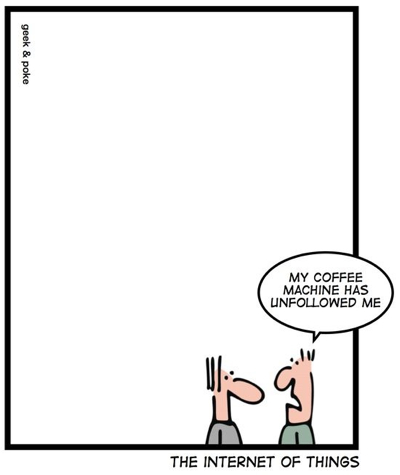
    IoT

    (via)

    until next time, objectifying social 🙂

    P.S. I was reminded of a term coined much earlier – social objects. In that context, it was anything that could be a conversation starter, and the focus was more on its ability to connect people around a subject of common interest. Social products have the ability to take that connection and give it a platform where even people who are not in the same time and place can be part of the conversation. This is beyond its ‘utility’ not just as a product but also as a device that talks to other devices and makes itself more useful. I’m actually thinking of that ‘bottle of memories’ I mentioned in an earlier post, probably in a smarter avatar – like this or this – but also ‘tagged’ (say, using an augmented reality app) with the people who are part of the stories associated with it. Now, at some point, when I see the bottle, and get particularly nostalgic, I could use the same app to see what those people are up to, and quickly ping them to start a conversation about the good old times. In the collaborative and sharing economy, think of the possibilities! (If you’re interested in this sort of thing, you should like this post) When I think about it, what we probably need to accelerate this is a browser (what it does for the web) equivalent.

  • Brands and the Personal API

    Lifestreaming and I go way back, at least 5 years. 2008 was when I wrote about it first, though the experiments had started earlier. Most of the services I’ve mentioned in the post are now defunct, but my interest in the subject never waned. From the perspectives of memories mentioned in that post to speciation to brands using their lifestreams to build communities around it, I have had several thoughts on the subject. That’s why I found this post at GigaOm, which was about Foursquare co-founder Naveen Selvadurai sharing data logs from his life (weight, sleep, activities) and hoping developers would hack his ‘personal API‘, very very interesting. There have been stories about people and the tons of lifestreaming data they have amassed, but I had never heard of an API, and therefore consider it pioneering work.

    Pioneering, less because of the novelty, and more because I think it has the potential to become mainstream, and even, the default paradigm of creation and consumption. Since the engagement @ scale framework refuses to let go of me, I immediately thought of the personal API in that context. With technological advances, I think it’ll become easier to create one’s own APIs and you can see several companies mentioned in the GigaOm post that are working on it. So I’d hope that its evolution is as fast as (or faster than) that of self publishing (on the web) which about a decade back was a relatively complex thing to do. So, in essence, we’re talking about huge amounts of data that are being generated and captured by individual users, and this is only going to be accelerated thanks to phenomena like wearable technology.

    The current way of looking at Big Data is to synthesise actionable insights from processed and unprocessed information from touch points related or unrelated to the enterprise. As I’d mentioned in my presentation (on engagement @ scale) this is then used to target users better or drive more efficiencies.  They don’t really operate at the higher levels of community/meaning/purpose. Now think of the personal API and the data it holds. What if we looked at this individual streams of ‘Big Data’ not from the enterprise’ perspective but from the user perspective? What if brands created platforms that  would allow people to upload data that they choose to so that the brands could solve their needs better? Like I wrote in my ‘maker’ post, with massive technology leaps happening in areas like 3 D printing, there are tremendous opportunities for co-creation. Brands could even aggregate data from these individual streams to find need gaps and package that for a larger market. In fact, I’d say that this is probably what Nike+ is doing already.

    But the real story is that these personal APIs could give great insights into the individual’s purpose in life, his priorities – in short, his life’s narrative. It gives brands the window to latch on to the narrative that they can identify with, and create value and meaning in the individual’s life. I think that’s what brands originally strove to do!

    Update: Thanks MJ, for pointing me to the Nike+ Accelerator!

    until next time, AP”I”

    PS: Over at Soylent, they’re creating the nutritional equivalent of water, an ubiquitous ‘meal’ that is customised for body types. Funding? Kickstarter of course! 🙂

  • Deconstructing a viral

    Google’s Project Glass demo was the best product demo I’d ever seen. The sheer possibilities with such a device was amazing, but in essence, it was the theatrics that impressed. Everyone I shared it with shared it on.

    It made me think of the concept of a viral. From many murmurs I have heard around me, “Let’s make a viral” has only evolved, not died. The question of what makes a content viral is also asked when 2 or more marketers/social media practitioners are present. I find it a bit ironic that sometimes when ‘virals’ are named, I can’t recollect them. I first thought this was just me, until I figured out otherwise from other blank looks. But that’s not surprising, considering our increasingly fragmented consumption patterns across media platforms.

    I realised lately that if reach were the only parameter, then every TVC/newspaper ad, by sheer consumption, is a ‘viral’. So, a necessary caveat is that the reach has to be through peer sharing. But what good is an eminently enjoyable creative if it does zilch for the business? The viral is thus walking that exact balance between entertainment and brand objective. But would our current definition of a viral deem the Project Glass demo a candidate? I don’t think so. Nor would flipping on the Open Graph on a website and allowing multiple contextual actions to go across newsfeeds and Timelines.

    And that’s where the evolution is interesting – because technology is slowly moving from being an ‘enabler’ (euphemism for cheap means of distribution – YouTube/Facebook, I always felt) to being the best tool to weave in the brand story, and an inherent part of the experience. It goes beyond just social platforms and into Augmented Reality, NFC and other legacy/new technologies. I saw quite a few examples (via) – Buy the World a Coke, Red Tomato Pizza’s fridge magnet, even Amex-Twitter and one of my favourites for quite a while now – Nike+. Would we call these virals? I don’t know, but they were shared, seen, and tied in neatly with the brand experience. So probably what needs to evolve now is the marketer’s mindset on what he/she defines as a viral. The opportunity and the challenge is that when everyone’s a publisher, the marketer’s real job is to make it more share-worthy – conceptually and practically. That hasn’t changed. 🙂

    Since we’re on arguable territory here, do chime in.

    until next time, viral ‘producting’ as opposed to viral marketing?

  • Brands & Niche Networks

    For a while now, I have believed that one of the inevitable consequences of the sprawling social networks we see around today, would be niche networks. This is not something we don't see around already – in fact, most of the networks or users address it in their own ways – groups/pages on Facebook, LinkedIn, lists and cliques on Twitter.

    But I see niche networks as an evolutionary phase because currently, the popular networks seem to have been designed for mass, with features evolving when there was a demand – from the users or clients for more segregation. Users, because, sometimes even for the infovores, (apparently the term was the title of a book by Tyler Cowen – HT @uglybutbearable) the deluge of information without efficient filters meant that they were losing out on information they'd have liked to have, and businesses, because without more customisation options, social would just be another media/distribution platform. But social and mass seem to go intuitively together, so the usual way is to aggregate and then segregate.

    (Bonus: Great read on filtering by JP Rangaswami on his blog)

    However, there are many manifestations of niche networks that I can already see emerging. Ashton Kutcher, whom I'd consider a personality brand, has built his own custom Twitter app with the help of Ubermedia

    . A new service called MyCube, still in private beta, is offering users the ability to monetise their information. (via) Raptr, a social networking service for gamers is customising users' news streams extremely well using the information it has on its users. (via)

    The only commonality here is that all these seem to be moving away from a mass design to one that's meant for smaller/more specific user sets. Of course, the existing large networks can always figure a way for users themselves to be filters and recommend appropriate things to their own network, (eg. Facebook's new feature) but that's a rewiring.

    But I believe that the rise of the niche networks provides an excellent opportunity for brands to get into the thick of things and 'own' the domains they operate in. Nike+ has always been a favourite. I also think Toyota's approach to social networking, built with help from Salesforce is a good first step. The challenge, as always, will be to find ways of how a user need can be satisfied with a new offering that is synced enough with his familiar territory (existing networks) for his experience to be as frictionless as possible. If brands can do that well, they will have built something that's not utterly dependent on the vagaries of current and emerging media platforms.

    until next time, admoniche 🙂

    zp8497586rq
  • Plead Blue

    <context> I missed the Twitter debate, but it was still interesting to see the two perspectives shared by Karthik and L.Bhat on Nike’s ‘Bleed Blue’ campaign. Bhat’s initial post was a good summing up of the campaign, and what made it work. Karthik’s contention was that Nike did not deserve credit primarily because it was “tightly associated with the team’s performance” – an external occurrence. There were other reasons too, but I gathered that this was the crux of it. The contrasting example was Pepsi’s Hoo Haa – Blue Billion effort during the 2006 Champions Trophy. In a second post, Bhat also acknowledged a correlation (between the campaign’s and India’s success) and rightly (IMO) stated that the campaign’s intent centred around ‘garnering support for Team India….’ and ‘portraying a positive, confident attitude about Team India…’ Also, as he points out, it stayed away from any ‘player superhero’ association or a ‘we will win the cup’ stance. </context>

    This debate was also interesting from the perspective of what I wrote last week – brand identity and real time. But before we get there, my 2 cents on the debate. I would also credit Nike for the same reasons Bhat stated – strategy, product integration and ease of participation (execution). That is what separates it from say a ‘Pallu scoop’, which is fun and pure recall, or a ‘Get Idea’, which still hasn’t given me an idea of how it’s keeping cricket clean.  [yes, they aren’t apples, but they were the other hugely visible campaigns]

    Big ticket result-based events (including movies, which Karthik has mentioned) is a risk-reward game because there really isn’t any data that allows you to place sure-shot bets. But the way I see it, you can place a successful bet, and still not gain enough mileage (bad erm, ideas, bad execution etc). Nike got it right, and there was some hard work involved.

    Come to think of it, I wonder if there’s any other approach Nike could’ve taken, especially since they were the official apparel sponsors. Look at the competition – Adidas had a Tendulkar ad and Reebok had nothing. It was a ‘once in 4 years’ opportunity and they seized it. India winning the cup was a key factor in the campaign’s success, but not the only one. Also, I don’t know if they had a back up plan – a “we’ll be back in 2015”, “thank you for giving it your best shot”, “bled to death”. Ok, not the last one, but you get the idea. Maybe they did and would’ve come out smelling like roses anyway. In any case, the efficacy of the campaign is probably best decided after it ends. In this case, it made Nike the buzz brand with other heavyweights in the fray, including the mighty Zoozoos. (Loved them though)

    Meanwhile, by design or not, Nike’s approach was also quite a “Just Do it” one. (hindsight/retrofit) From the last post’s perspective, I wonder how much/whether that identity played a part in the design and success of the campaign. But on big events, celebrity endorsements etc, going forward, real time management of campaigns will increasingly become a requirement, thanks to the instant feedback tools that exist. Perhaps brands should formulate ‘what if scenarios’ and corresponding approaches when they plan large scale campaigns, especially when it’s linked to events that don’t offer much support in the form of data. The other way is to scale after the relevant data comes in, but that would involve quite an execution effort.

    until next time, blue positive 🙂

    PS: Nike, next time, stadium checkins and a Bleed Blue 4sq badge too please 🙂