
Tag: Newspaper

  • Making it Really Simple

    Forrester has a new study ‘What’s holding RSS back?’ According to the report, RSS usage is at 11%, and most people don’t use it because they can’t see its relevance in their lives. You can get some good snapshots of the report here.

    Now, I realise that because of the contents of this blog, a lot of readers (at least about 40 odd ) understand RSS. For those who don’t I’ll attempt a bit of evangelism, at the end of this post. Meanwhile, Mashable has an interesting take on the report. While I agree that the usage might be much higher and that most sites have it in some form or the other, they don’t necessarily have the user consciously utilising it. Facebook’s news feed is a typical example. So, I would side with this view on the geekiness of RSS. I started subscribing to feeds only about a year back, and gave an RSS feed for my blog much later. So, I can identify with the intimidation some might feel with regards to feeds and RSS and subscribing… On an aside, if you asked people in India about RSS, we’d most likely have strong opinions on it, but that’s only because there’s a Hindu nationalist party by that name. 😉

    However, the best tangential take on this report that I read happens to be here. In addition to a take on the entire subject, this post points out that newspapers could have a great role in making RSS mainstream. This is because newspapers have always been aggregators and have learnt the art of packaging the commodity called ‘news’. The packaging results from an understanding of the consumer’s needs. This is all the more interesting since a new PWC study says that traditional media has about 5 years left, before the death clock kicks in (varies for different markets) I’m wondering though, whether this role would be  equally applicable to other traditional media – radio and TV. While newspapers might start out as favourites, increasing fragmentation could redefine media preferences. TV, for example, could provide all that the newspaper’s online version does, and add a visual angle to it. The difference between reading about Chandrayaan (India’s lunar mission) and watching it. Do you think that once news becomes a commodity (as it has online) TV has a competitive advantage over newspapers? (among traditional media players) Or is it going to be a pure play new media player like say, Instablogs, who will steal their thunder?

    until next time, subscribe 🙂

    and now, for some

    RSS Evangelism

    Why would you need RSS?

    When you started browsing around the net, you would have liked a few sites and you could track them daily to see if there was something interesting. Over time, the number of favourites grew and sometimes you’re missing on good content because you forgot to check. Even if you didn’t forget, it would be a pain to keep checking all the while. What if you could have a tool that would alert you when your favourite site was updated?

    Yeah?

    Yeah. These tools are called readers. It can be web based or desktop based. For now, I’ll stick to the web based type. There are several sites which offer this service (its for free). Pageflakes, Yahoo, and the example I’m going to use – Google Reader.

    So how do we start?

    Click on this link which will open a new window – Google Reader. If you have an existing GMail account, you can use that, else you’d have to create a Google account first. Once you login for the first time, Google has a fairly good tutorial on how to use it. But I’ll still do a bit of explanation. How does Google know which are the sites you need to get updates about? You have to connect your fave sites with Google, so that it picks up the updates from there. This is called subscription.

    How do you do that?

    On the left panel of your Reader page, you’ll see a button ‘Add Subscription’. Here’s where you need to enter the url of your favourite site. Shameless that I am, I shall use the example of this blog. The url is www.manuscrypts.com/brants . Once you type it and press enter, the ‘feed’ of this blog gets added to your reader. You can see it on the left. And the next time you log in, it will have the number of  new updates in brackets.

    Sometimes you would come across a blog, like it, but would be too lazy to log in to the reader or remember the site. Most sites now would have a button that looks like this or a variation of this (like the button on top of this page), or even this . Click on the button, and then you would see an ‘Add to Google’, ‘Subscribe with Google’ or Click on this, and it would take you to a page that gives you a choice between Homepage and Reader. Since we’ve set this up on Reader, click that and you’ll be asked to log in. See, it pays not to be lazy 😉   So, keep adding sites and checking your Reader regularly. You can do many things lime sharing some items with your GMail friends (using the share button at the end of each post) , organising your favorite sites into folders like say, Personal Blogs’,  ‘brands’, ‘social media’ etc.  It might look like a big deal or a difficult thing to do now, but trust me, it will add a whole new dimension to your browsing and time management. In case you get stuck, shoot me a mail – manuscrypts @ gmail dot com, and I’ll help you out. 🙂
  • In the news

    Sometime back, I’d written about the need for newspapers to give the digital medium a bit more consideration in their strategy. While India claims to buck the trend of falling newspaper subscriptions, I wonder how many economies have a thriving newspaper ‘raddi‘ market, the process through which the Indian household gains money by selling old newspapers as scrap.

    A few days back, Google announced its efforts to bring old newspapers onto the internet. The Google News Archive is being expanded and will let you search newspaper archives from decades back. I did a few searches, and for now it only has the already digitized versions of newspapers (in India), its a long and arduous task, but well worthwhile for Google. Over time, they plan to blend these into Google search results also. 

    Meanwhile, the latest group to join the anti Google-Yahoo bandwagon happen to be WAN (World Association of Newspapers) Their concern is that advertisers will increasingly migrate to Google from Yahoo when they see diminishing price advantages on the latter. (via Startup Meme) So the deal will give Google ‘super powers’ and weaken the competition in the search-ad market, since the two players had so far forced each other to give the best possible terms to publishers, like newspapers who offer display and search ads on their websites – a consortium of 200 US newspapers run Yahoo ads. 

    So newspapers are afraid that their revenue from third party ads served by Google/Yahoo would reduce? To me, it looks like if they had developed better ways of selling their own ad space, maybe they wouldn’t be looking like a bunch of whining kids. It adds to my belief that newspapers refuse to treat the online medium with the respect it deserves, and only react when their turf/revenue gets affected. I recently read this post, which explains how, many newspapers and magazines employ their regular ‘interruption advertising model’ even on their websites. 

    However, some top newspapers, are showing exactly why they are where they are. The NYT has an offer of a ‘print ad free with an online ad’. A daring reversal, that is perhaps aimed at switching the relative positions of print and digital, from a revenue perspective? The WSJ, has changed its design recently, and that includes adding a social network, the big deviation from normal procedure being that this one has paid access. While this might be considered not-so-smart in the era of free Facebook and LinkedIn networks, I think Mashable’s argument in favor of WSJ’s move has merit. The Time article also states that this might become available to non paying users as well, and there are plans to integrate it with existing social networks.  I think that if WSJ can back this move with some really good content that is flitered for its elite paying subscribers, this could be a long term winner.

    And while all that’s been happening across the seas, Google’s relationship with local newspapers is different. It has come up with Google News in Malayalam, which indexes news from almost all leading offline and online sources, with Malayala Manorama conspicuous by its absence. Other languages are coming soon. (via Medianama

    With digitising newspaers and local language news Google seems to be pushing from different directions. But, as these sites have shown in search, it is possible to best Google. For newspapers, its not just Google, there are different threats. For example, GateHouse Media is starting an online-only daily in Batavia, NY. They see tremendous opportunity for a local news and community site, since the leading local newspaper does not have content on its website. (via Publishing 2.0) This opportunity could exist in any place with good internet penetration and where the local newspaper hasn’t capitalised on that. On a sidenote, here’s a good post on how the traditional syndication means used by newspapers might expect a reversal soon. 

    Newspapers really need to pull up their socks and figure out how the digital media figure in their strategy. Now, though I might get lynched for this, already Web18’s consolidated reach has beaten that of the Times Group (India’s largest media entity), on the internet. And in.com, the portal which I think would be their flagship property on the internet, is still in beta. Why is the Times Group, with the #1 selling English daily, #1 finance daily, several language dailies, TV channels, radio stations etc not India’s #1 website. I think its a mindset issue.  

    I wonder, whether, with rising newsprint costs, and environmental concerns ( trees geting cut for newsprint), it might be a good idea for newspapers to start work on a Kindle like thing to distribute content, especially after I read this recent story on Kindle.

    until next time, print this?

  • Virtual Fourth Estate

    A few articles that have to do with newspapers caught my attention in the last couple of weeks. One was the fact that Instablogs, is doing something I desperately wished it would do – opening the network for external blogs. I personally consider Instablogs a good benchmark for what online news sources should be,  going forward. If you haven’t checked out Instablogs yet, now would be about time!!

    The second was an article on whether we need editors anymore. That question would be quite controversial in any case, but it helps when The Guardian asks this. It is quite a compelling read, and makes some telling points, on how editors should evolve in the digital era. I think that it also points to a mindset change in the newsroom and the presentation of news, because the way news is consumed is also changing. “Reporting becomes a process more than a product” and thats a fundamental shift in the way newspapers approach the business. Here’s a great read on the subject. It is sad to see how newspapers, with some of the best resources, are not able to channel it to better use on the internet. This is a perfect example for what I’m trying to say. Now, once you’ve thought about all this, check out Instablogs’ tour. It might explain why I find the site awesome.

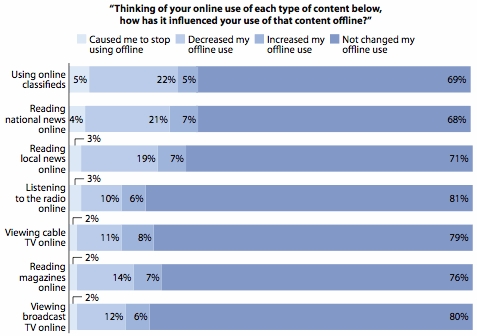
    Why is it important for newspapers to address the digital mindset issue? This data, (via here) though pertaining to the US shows how blogs and the online medium in general is making inroads into what was till now, the newspapers’ domain.

    While, with a 4.5% penetration, newspapers aren’t exactly on a ‘near-death spiral’ in India, I believe it still might be just a matter of ‘when’ rather than ‘if’. Speaking of which, the last article I wanted to discuss was one on WATBlog about Indiatimes’ launch of Hotklix, a Digg like service. Like I commented there, it would’ve been a great way for TOI, ET and all the publications of the Times Group to showcase the loads of content that they possess. How about seeding articles on a daily basis? Where is the integration of the TOI, ET websites with Hotklix, where I can bookmark an article immediately after I read it?

    On an aside, there are traditional news networks doing some pretty cool things on the web. CNN, for example, is allowing users to embed videos in blogs social media etc. No, that’s not a newspaper, I know, but it does come under ‘traditional media’. But even CNN received some flak a couple of weeks back. CNN is present on Twitter, and I happened to see this article, where a few users got pissed off with them for spoiling their Olympic fun. But that doesn’t stop the mashups. Take a look at Dialogg, their collaborative effort with Digg.

    Given that newsprint costs are rising, all over the world, and people are increasingly raising an uproar over cutting down of trees, I think its about time that newspapers took a long hard look at how the digital medium is transforming the content landscape. After all, we even have sanskrit newspapers going online. By digital, I don’t mean just the web, it could be the mobile too. 9.22 million subscribers have been added this month. I would like to compare it with the circulation additions for newspapers. Meanwhile, just read about an effort – MeraMobi, by the Dainik Bhaskar group in association with Pitroda Group LLC.

    Traditional media, especially newspapers, world over, have painstakingly created an equity and trust factor that’s extremely relevant in a transparency and trust led digital era, it would be sad to see it wasted. After all, with increasing global warming fears, newspapers might soon occupy the space that furs occupy now, so it might make sense to hunt for some virtual fourth estate.

    until next time, read….online? 😉

  • Local Portals

    I came across this today – a local site for Kolkata – I Love Kolkata.com, powered by the ABP group. The site for Kolkata Mirror had been launched a while back, though the paper itself has not been launched in the market. The first two pages of a google search threw up only one other contender for a complete city portal – that was Calcutta Web.

    As far as design goes, ILK is quite ahead of the other two. I also liked the ILK usage, which also means ‘people of a specific kind’, in addition to being an acronym for ‘I Love Kolkata’. The site has the regular news coverage, and blogs as well as city info. In comparison, the KM site does look a bit haphazard, but as per the WAT article, this is only a ‘primitive avatar’. The Calcutta Web site is way down on the design parameter, and is an aggregator of news from all the city’s newspapers and has city info.

    But wait, this is not about design. What i want to discuss is the content. While its a given that a newspaper site should have the news stories it carries in its print edition, does it always have to try to be a city portal and a blog platform. In its print version, the newspaper is a one stop shop for most readers and their first source of info on most things to do with the city. For the newspaper too, classifieds are a big source of revenue. But, will a net user rely or expect the news site to carry information like say listings or dine out options, or will he rely on a vertical like eventsbangalore or burrp for that? Yes, it does dependent on the maturity level of the user, but thats a dynamic thing.

    User generated content. Will only discuss blogs for now. Will an existing blogger switch to a newspaper blogging platform? Will the new user stick on to it after he discovers that there are platforms for whom constant improvement of services is a competency, unlike newspaper sites that lets you create blogs. The other point to note before taking a decision on this is an informal but very informative research done here. While the figures are the result of a lot of mashups, and may not be spot on, the fundamental logic is right. According to this, the percentage of creators is a dismal 4%. India seems to be a country of spectators. At this stage of the internet in India, is is wise to waste pixel space on a non core competency?

    Yes, in evolved internet landscapes, it is possible to have excellent user blogs like this, on a newspaper based site, or even something as ‘adventurous’ as this. But in india, is it better for media websites to stick to a CNN IBN model? That would give some exclusive content, with a built in quality control. Once the net evolves, UGC can be scaled up accordingly. For now, isn’t it better to use the web as a base to build solid equity and credibility on a digital platform and figure out ways to use the interactivity factor that the net provides to showcase different perspectives on existing content?

    Now, you might say that in a news overloaded internet space, why would anyone want to visit a newspaper site for news. I guess, traditional media still rides on a credibility factor.

    until next time, click to print, no its the other way 🙂

    PS. Saw another local portal in the making for Bangalore – mybangalore.com