
Tag: new media

  • Data: Growing up

    The Facebook story might be facing rough weather, but that hasn’t stopped the social network from pushing out new and interesting things. It launched “Page Post Targeting Enhanced” – features that make it a media platform offering sharper slices to marketers (easily) by allowing filters based on gender, interests, relationship status etc. It has also rolled out Facebook Stories that highlights “people using Facebook in extraordinary ways”. Venture Beat has a very smart take on how this can be the future of news by intersecting two of the most interesting contexts – location and interest. As a media platform, one can imagine the advertising potential.

    Twitter already has local (city specific) trends, though, from experience, many people seem to think that they’re viewing national trends when Twitter is actually showing them local trends. Twitter already has Promoted Tweets and is enhancing features that allow better targeting.

    Media buying in the age of traditional media consisted of a plan being prepared (and negotiated) after evaluating the reach, cost and other parameters of various options across platforms – print, OOH, TV, Radio etc. The (reach) data has always been contested, and the (post) measurement is more of a myth than reality. New media platforms, on the other hand, are significantly better in terms of transparency and in addition, have better native and 3rd party tools for self publishing, distributing and measuring. The data is one click away from the marketer. After a certain tipping point of reach that these media achieve, traditional media would be forced to provide this level of accessibility, and then, IMO, the value provided by media agencies would be reduced significantly, as tools would make it easier for the marketer to plan real time and measure too, across platforms.

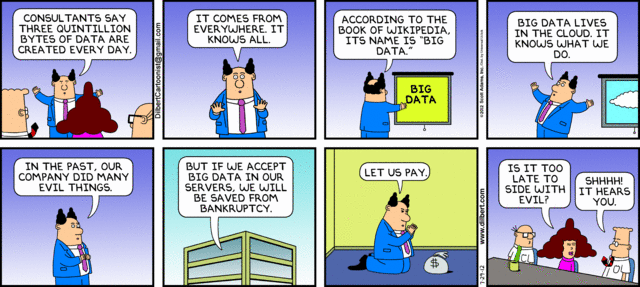
    In essence, data that the marketer needs, to make informed choices on the why/what/how/when of platforms, is easily becoming available.  The data that really needs to be converted into information is now flowing in the reverse direction – from the consumer and his actions across platforms to ______. And this data is not just for marketing, its use is across the board and affects product, customer care, operations, technology and so on. It is Big Data, the players are evolving, and the next stage in this ever changing game has begun.
    until next time, don’t worry, it’s already a buzzword. 😉

  • New media indeed

    When I wrote this in last week’s post – “‘social’ as it relates to friends and followers’ overrules ‘social’ as a relationship between brand and consumer”, in the context of how brands use social media, I also became  more conscious that despite me relating to Facebook and Twitter as a means to connect with friends, the platforms themselves were clearly seen as a media by the world at large. Even LinkedIn now apparently has a news aggregator.

    It is true that I consume large amounts of content via (or on) Facebook and Twitter, but I have always seen it as content shared by friends, not as media like a newspapers or TV channels. It is probably because I have always associated media with information and entertainment and never social. But that’s only a personalised view, I realise. The larger picture shows a content delivery platform – media. I guess when social scaled it didn’t know what else to do but become media. Interesting how the new media platforms worked from social connection towards utility and the old media are trying to make the journey from info and entertainment to social.

    And thus when I saw a few recent Facebook developments, I viewed it through the prism of FB as media. Facebook launched Sponsored Stories a while back, using friends’ actions as an ‘advertisement’. It updated Pages giving functionalities that helped brands interact more. Now it has completely knocked off the ‘Share’ button and replaced it with an omnipotent ‘Like’ button that will transmit a story blurb complete with thumbnail instead of the earlier single line in ‘Recent Activity’. (details) Publishers won’t complain since content will be more visible now. Facebook’s comment box plugin also got revamped with better moderation, social algorithms to surface the comments that will be most interesting to you (indicated by social signals from friends) and better distribution – now, when a user utilises the “Post to Facebook” button on a site with FB comments enabled, it can be replied to on FB and will automatically be reflected on the original website as well. If the publisher has a Page on FB, it can respond to the comment and include the people who have ‘Liked’ the page into the conversation. (details) That’s a first from FB – allowing conversations to go out. Wonder what they’re after – interest graph, a perpetually signed-in user, sole web identity provider, all of the above? But in essence, a new media platform that connects publishers with users. And in this age, brands are after all content creators too, eh?

    I would think the progression is obvious – first build a user base with awesome features, then focus on publishers  (including brands) who will make it a distribution channel, and the next step would be to make the advertisers spend more.

    While Google is busy dealing with content farms in search results, I realise that we have very little means to stay away from the Facebook way of throwing content at us. Watch your newsfeed as Facebook uses you and the content publisher to make itself more indispensable as a platform. Like I tweeted, the hope is that in trying to be everything – mailbox, location, photo storage, for everyone, Facebook might lose itself. The effect all this will have on ‘trust’ in networks, I’ll leave for another post.

    Media has always been aggregating audiences by providing information..+entertainment..+social connections… and then leasing it to brands. (advertisers) With advances in technology, it’s perhaps time for brands to create their own direct lines to consumers, outside of the new media barons. Otherwise, in their immediate comfort state of using yet another platform as media, the way they’re accustomed to, it is possible that they will continue to be at the mercy of a third party and have to play by their rules, sometimes at the risk of antagonising the end user.

    until next time, mediators = media + dictators? 😉

  • The new media owners

    A few days back, I read a very interesting piece by Jeff Jarvis on ‘The Great Restructuring’, in which he talked about fundamental changes happening in the economy and society. He also talked of an economy (at least in part) built on the abundance of knowledge, which then led to the subject of replanting business models.

    It took me back to a discussion I once had with a friend on the role of newspapers, and the new forms of media. The role of newspapers, and ‘tangible media’ in general was a hot topic of discussion then. Steve Rubel had the “The End of Tangible Media is Clearly in Sight” post which put 2014 as the year of demise (in the US), and got quite a few responses, including some folk who disagreed with it, and some who agreed a bit but disagreed mostly. There wasn’t much of disagreement on the subject of newspapers, and it was generally agreed that Digital was indeed a great disrupter. Newspapers have  been accused of trying to replant their offline model on their web. Perhaps rightly so, since it clearly doesn’t seem to be working.

    In that conversation, we’d used ‘new media’ a little differently from the platform based (internet and mobile) approach. We discussed three forms of ‘new media’ –

    • some entities about whom the media writes about – people and  organisations . The net population already shares a lot of the content they produce on the web platform – via blogs, social networks, platforms like YouTube, Flickr etc, and lots of organisations are using the web as a broadcast medium – Marketing as media
    • social networks and other services which consolidate a lot of the content generated above in one location, and web only news sites (anything from Rediff to Instablogs and niche news sites)
    • some entities who’re already in the communication/network business – these could be companies like Nokia (handset manufacturers who are an access point to the web), telecom operators like Vodafone (who also act as an access point), or even companies like Cisco, who I think will go further than just provide media solutions

    While there’ve been a few setbacks – Nokia shutting down Mosh, its content sharing service as a result of dubious content posted, Vodafone playing bully to opt-in-SMS service MyToday and various lawsuits against Google (YouTube) on copyrighted content, I’m hoping these are nothing more than teething problems of a radical overhaul.

    Depending on various factors, like socio economic conditions, technology penetration, to name a few, ‘The  Great Restructuring’ would happen differently in different places. Like other restructurings before, some parts of the population would remain unaffected.

    Meanwhile, as mentioned in the post, it indeed is a time of opportunity, and definitely for newspapers too, at least in this part of the world. It only depends on how much they’re willing to shed their old ways of doing business (especially when it isn’t making the revenue it used to be) and how willing they are to listen to the collective consciousness. Even with the ‘new media’ and the proliferation of content producers, newspapers could still find ways of delivering value. (excellent debate happening here)

    Earlier, everyone read a newspaper and therefore it was the place for a product to be seen by its potential consumers. Since the first part changed, the second has too. If increasing media fragmentation is the future, then what newspapers could be doing wrong is seeing their product/s as the only media/destination. Instead, they should perhaps (at least) listen to the Chaos Scenarioexplore a few options, utilise their resources to be preferred content choices in as many fragments as possible, irrespective of the platform, and fight battles in each fragment separately. This would also mean that basis the dynamics of each fragment, different revenue models might evolve for each fragment.

    until next time, for now its Calvinball rules 🙂

    PS. Must Read – IBM’s study – Beyond Advertising

  • Brand new media

    While reading up on the original premise of this blog – brands, I came across a couple of interesting articles that spanned both my interest areas – brands and social media. The first was on Brand Accretion. Accretion is defined as “An increase by natural growth or addition”. Now, in this instant age, this would be considered a ridiculous thought. But to me, I’d prefer to take it as one more argument against the ‘only large campaigns’ approach that I see many brands take. You can read an earlier rant here. A couple of tangential by products of an accretion approach could be brands being able to tackle the long tail more effectively, and being able to espouse causes with a long term vision, like environment-conscious efforts for example; in essence, a flexibility to scale up based on a dynamic business environment, and one that would help brands deliver their promise better, which will be critical, as we go along.

    The other interesting post I read was one that distinguished between new and social media. Now, quite honestly, they were very interchangeable terms to me, but I tend to agree with the post, and the way it distinguishes the two. The simple example would be this – a blog is new media, it becomes a social medium when there are comments and conversations that happen around a post.

    Both new and social media bring out a lot of creativity, simply because of the innumerable sources it throws up. It acts as a perfect background to riff. Here are a few interesting ones I saw recently.

    This one, by Idea is about a month old, and is here in case anyone missed it. Its called Rapchick Mumbaiyya test, and was a smart way to connect to the city, during the brand launch.

    Google did a cool marketing activity to to takeover the Email and chat infrastructure of various education institutes in India. Read about it here.

    Warner Bros has been doing some interesting stuff too – their ad-supported video on demand online network site “features full episodes of defunct series that gained cult status over the last decade. The WB.com is a new digital destination built from the ground up for the same 16- to 34-year-old audience that embraced the WB when it was a television phenomenon”. It has Buffy, roswell etc, but the bad news is that its only available in the US. And i thought the web has no boundaries. 🙁 

    And if Medianama’s thread of thought is accurate, they might be doing some very cool stuff on Twitter, by creating The Joker there. But I’m not very sure of that one, since I also have the Riddler, Two Face and even Rachel Dawes following me now!!!

    The last one is from NIIT (via Alootechie) , which has created a character called Preeti Technani, who has an Orkut profile, a wordpress blog, who is positioned as a mentor, but manages to plug NIIT in between 😉 Lastly, here’s a clue on how not to use social media.

    While on the context of social media, here are two great reads – one is on getting people who don’t use social media to use it, and the other is on agencies of the future.

    until next time, be social