
Tag: morality

  • In considerate mode

    Delivery guys riding on the wrong side of the road, kids behind you kicking your seat on a flight, speaking on the phone loudly in a public space – these are a few of my favourite peeves. I am sure you have yours too. That’s why this post on LinkedIn caught my attention – “things pissing me off” in situations where people aren’t following rules is something I could relate to.

    Barring a few exceptions where I am absolutely not able to tolerate what I believe is ‘inconsiderate behaviour’, I don’t engage. But engage or not, these instances also reveal my snap judgements. e.g. what an inconsiderate idiot, speaking loudly during a movie. I judge myself the most, but also try to intellectually understand my motivations.

    That’s why I found this particular episode of The Knowledge Project – in which Shane Parrish speaks to Todd Herman – fascinating. Around the 49th min mark, Shane asks Todd if he has a hard time relating to average people, people who just didn’t want to be the best at what they do. I could relate to it in my professional context – another pet peeve. Todd admits how despite having matured, he still has to watch out as his ego still tries to stack them as ‘average’. Todd explains that he does this because he over-indexes what he personally finds important. e.g. a career-driven person might judge someone who prioritises being a parent.

    I battle my own bugbears – punctuality, work ethic, grammar and spelling errors etc. That image below is my team taking revenge on my birthday cake. Cheapos! 😂
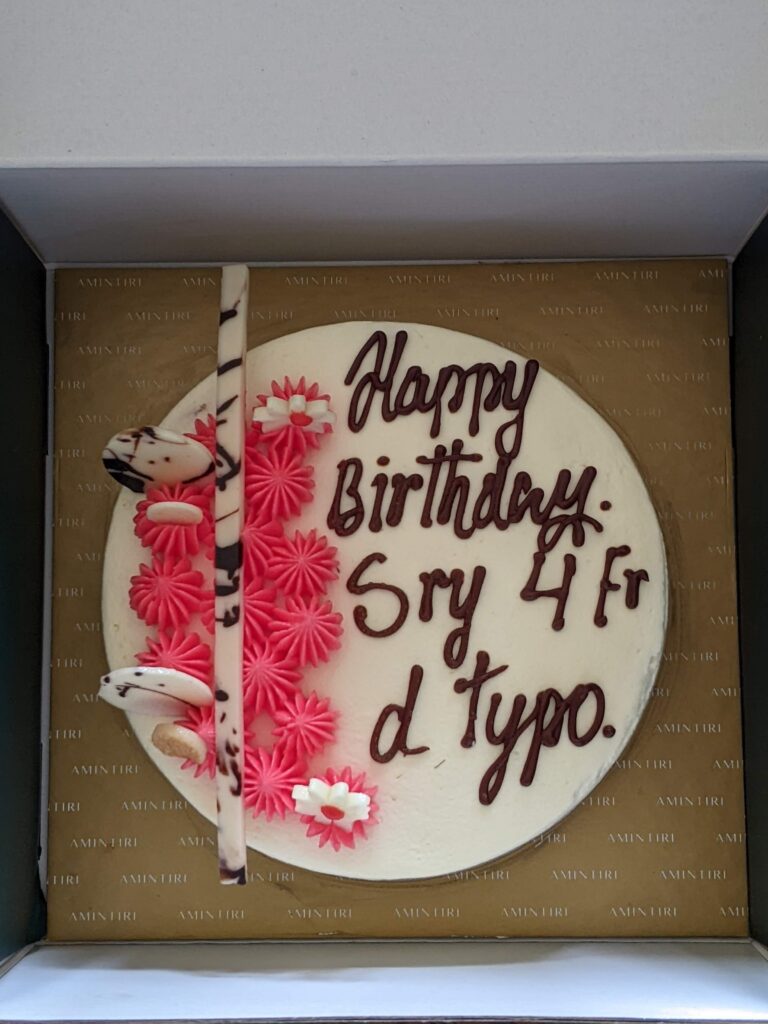
    The point is that others are not average/ inconsiderate people, they are at best average/inconsiderate in the thing I am over-indexing for! There are many contexts and reasons why they don’t behave in a way I think they should . As I commented on LinkedIn, I have realised that being able to afford consideration (or applying oneself) is a privilege.

    But that was level 1. When I dug deeper, I saw my real problem. When that ‘idiot’ is not following my worldview (‘ideology’) – whether it is ‘considerate behaviour’ or being conscious of spelling mistakes – it raises (in my own mind) doubts on the objective correctness of my ‘ideology’. Will Storr has a  brilliant insight – “for humans, ideology is territory”. We fight for ideas like animals fight for land.

    At this point, we have evolved to an extent where we hold hundreds of “shoulds” and “shouldn’ts” in our heads. And we expect the world to comply – from nationalism to having pets/kids to the usage of the Oxford comma and so on. Any deviation from our ‘ideology’ is treated as a judgement against us. No wonder every interaction has the potential for conflict. We are defenders of our own little faiths that make up our identity. What we could practice, when we have the privilege, is to step back and think about the little judgements we make, in work and life scenarios, and then react with empathy, because it is not a personal attack.

    There have been many posts on this blog about morality, and recently, I found two quotes that connect it to judgement and empathy.

    “The drug of morality poisons empathy” ~ Will Storr (again)
    “Compassion is the basis of morality.” ~ Arthur Schopenhauer

    I found these to be an educative lesson on how I look at my subjective morality, and how I behave with others in real life.

  • Moral Signs 2

    “It’s these times. Morality is a moving target”

    Robert Folger, Snowpiercer

    A ‘grandchild’ at work wants to move to an edtech. She is convinced it’s an ‘opportunity that she won’t get later’. I contest on both counts. She is immensely talented, and given her work ethic, it is easy to see that she will be an absolute star. I would like her to do well, but it is an organisation I have actively talked against – IRL and on Twitter – and there is enough proof of its misdeeds. She wasn’t aware of this, and is nonplussed, but doesn’t want to turn back now. I bring up our debates on how she felt Seagram’s “Men will be men” was legitimising misogyny, and furthering a regressive world view. That got us on to morality. I remembered the ‘professional’ version I had written a while ago and sent it to her. I also remembered that I had meant to write this personal version earlier.

    Morality and self image

    (from the previous version)

    “We’re living in an era of ‘woke’ capitalism, right? I’m Nike, I pretend to care about black people. You pretend to hate capitalism and buy my trainers.”

    “Industry” (BBC/HBO)

    This pretension helps us retain our self image while consuming the things and experiences. There is narrative cohesion while avoiding uncomfortable truths. And sometimes, even some virtue signalling. 

    In general, the world is hyper competitive, and the choices we make might not sit well with self image, especially when morality is also at play. In the post, I had brought up the point that having a moral compass means saying goodbye to what would be considered lucrative opportunities. Even more so in the last few years. Crypto, real money gaming, fintech, edtech – the big pillars of the recent startup boom – all have moral loopholes (generalising). Same goes for Big Tech. But now regulation and external factors are catching up.

    The self image is gloating with “the arc of the moral universe is long, but it bends toward justice.” (Dr. Martin Luther King Jr.) But everything is a cycle.

    Let’s go beyond work and take say, entertainment. Recently, I tweeted

    You can catch many discussions on Saudi blood money around the web. If one were absolutely moral, one should immediately stop watching these sports. I don’t watch any of these, but that’s largely because I am uninterested.

    And anyway, I can make similar cases against movies and every other general consumption – apparel, on-demand deliveries, house help, and practically every daily touchpoint. It isn’t easy for me to slither out of everything.

    As you can see, being very objective about one’s own morality is dangerous for self image, and thus sanity. Maybe that compromise is the origin story of cancel culture (canceling on Twitter only, not in life). While I can see how that helps self image, I also do believe there is a limit to not being objective about oneself.

    Morality is plastic

    The Activa is being sold to the husband of one of the housekeeping staff at the apartment. He comes by on a Saturday evening, after his daily labours, and shows me his Aadhar card on a taped-up plastic-covered mobile phone. He doesn’t know how to forward it, so he’d give me a photocopy, he says. He also insists that I count the cash. He seems very particular that I treat the entire transaction with the dignity it deserves, including our price negotiation. It furthers my own narrative about why I shouldn’t give it to him for free, but hey, I am watching me. I know that an equal reason is that this amount is part payment for something I have been eyeing. Something I don’t need but would like to have. I tell myself that he and his family will be rid of a few commute problems at a lower cost. That it’s a net positive.

    There is an intense discussion happening in the apartment WhatsApp group – a couple of street hawkers (no, not fancy bikers) have set up shop on the pavement and the residents are worried about the area becoming a hub, and thus creating bigger problems. I see the case for shooing them away though I won’t voice it. I also won’t voice the contrarian view – D and I didn’t want to trigger a WhatsApp war. I see one of the hawkers when D and I go for a stroll after dinner. He is selling plastic items, and is using one of his buckets as the seat. It is around 9PM on a Saturday night. He is older than I am, and I begin to think about my conversation in office about how our chairs aren’t ergonomic enough.

    A moral operating system

    I used to judge myself by the only morality is action, but I couldn’t handle all the trade-off. I also realise that this entire conversation is from a position of privilege. And that my estimation of how easy that makes it, is woefully lowballing it. I remind myself that there is no morality in nature, only causality (Jonathan Haidt). Maybe we need to evolve a lot more if we need morality and practicality to co-exist. And maybe that won’t happen.

    So what can I do? I can stretch myself and do the right thing even if it takes me away from my comforts. I can recognise the limits, and stop being judgmental of self and others.

    Yesterday I was clever, so I wanted to change the world. Today I am wise, so I am changing myself.

    Rumi
  • Default in our stars

    The thought first occurred to me a couple of years ago, when I realised that thanks to outsourcing and automation, we would struggle today to do many things that were once life skills. We also lost a little more than that – learning.

    Sometimes directly, and sometimes, through the interactions with the world, they facilitated a learning experience that taught one how to navigate the world and the different kinds of folks that made up its systems. 

    Regression Planning

    It was continued with a bit more specificity in a subsequent post.

    Instagram, Facebook, Tinder, Spotify, Netflix, Amazon – everything is a feed of recommendations, whether it be social interactions, music, content or shopping! Once upon a time, these were conscious choices we made. These choices, new discoveries, their outcomes, the feedback loop, and the memories we store of them, all worked towards developing intuition. 

    Intelligence, intuition and instincts. The journeys in the first two are what have gotten the third hardwired into our biology and chemistry. When we cut off the pipeline to the first two, what happens to the third, and where does it leave our species?

    AI: Artificial Instincts
    (more…)
  • Brands, Activism & Morality

    A while back, someone had joked on Twitter that by 2025, babies will be born outraged. But in 2020, the joke, at least in Indian advertising, is that when the Tanishq brand manager begins to think of a campaign, #BoycottTanishq starts trending. When I was writing the article on brands and empathy for Business Insider, I realised it would need a lot of effort for brands to go beyond signalling.

    However, with inequities becoming even more of a pressing topic, and the expectation from brands to be active participants in society – activism to action, is there an inevitable movement that we will see? And hence, this post on brands through the prism of activism and morality, from the perspectives of a consumer and a brand marketer, and the safety of an armchair.

    We are living in an era of woke capitalism in which companies pretend to care about social justice to sell products to people who pretend to hate capitalism.

    Clay Routledge
    (more…)
  • Micro Singularity & Ethics

    The Guardian long read on “How algorithms rule our working lives” was a fantastic though distressing read, about employers using algorithms to filter out candidates based on reasons ranging from mental health to race to neighbourhoods to income. This in itself has massive implications on creating and expanding class divides and closing access to folks based on biases that are arguably unfair and lacking nuance.

    If we zoom out beyond work and jobs, it’s fairly easy to see that algorithms are having an increasing impact on our consumption and life in general. The biggest services in play – Facebook, (M, newsfeed items) Google, (search results, Google Now) Amazon, (Echo, recommended products) Apple (Siri) – all heavily have algorithms in play. And that brings us to biases in algorithms. Factor Daily had a couple of posts on teaching bots ‘good values‘. Slate had a great read on the subject too – on how Amazon’s computerized decision-making can also deliver a strong dose of discrimination. Both offer perspectives on how biases, both intentional and unintentional, creep into the algorithms, and the Slate article also brings out some excellent nuances on the expectation from algorithms, and how offline retail chains (selection of store locations, for instance) and human decisions compare to algorithms.  (more…)