Tag: moral code

  • A republic of convenience

    Masala Republic is a Malayalam movie I watched recently. First, my sympathies with those who attempted the heroic task of watching it in a theatre, but to be fair, it did give me some food for thought. No, not about my choice of movies, but things slightly more important in the scheme of things. It talked, for instance, of issues that needed a voice – the changing socio-political and economic dynamics of Kerala caused by a huge influx of people, mostly low wage workers from Bengal and the North East.

    The movie begins with the disruption brought about in the life of these folks by a ban imposed on Gutka, which apparently is part of their staple diet! This reminded me of the (real) scenario I witnessed when the liquor ban was announced in Kerala. Almost overnight, I saw an ecosystem disbanded – small shops around bars, auto-rickshaws that ferried drunk guys home, to name a few components.

    Notwithstanding the political play that brought about this ban, I was forced to ask – isn’t alcohol consumption an individual’s choice? One might cite domestic violence, decrease in productivity, drunken driving etc, but unlike say, smoking, it does not automatically cause damage to the larger society. Isn’t a blanket ban a bit like banning automobiles because of road accidents? If the justification is that individual choice must bow before collective progress, then can we really condemn Sanjay Gandhi for the infamous sterilisation programme? After all, population control would, at least arguably, have meant progress. What we are debating therefore, (I think) is the means. And means is exactly what an alcohol ban is. Does society really have the moral right to take such a decision? Who decides society’s collective moral compass and what can resist such selective applications of morality?

    Clipboard01

    (via)

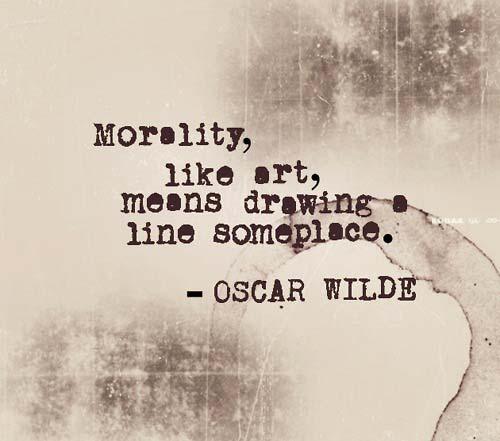
    Who decides where the line is?

    P.S. Would be glad if you could point out whether I am missing some relevant piece of information or logic here.

  • Artificial Morality

    It wasn’t my intention, but the title did make me think of the morality we impose on ourselves, and that perhaps has some amount of implication on the subject of this post too. The post is about this – we seemed to have moved from debating artificial intelligence to the arguably more complex area of morality in robots!  When I first read about robots and ethical choices, (did they mean moral?) my reaction was this


    It’s probably a good time to discuss this, since a robot has recently become a Board member in a VC firm as well. Ah, well, in the Foundation series, R. Daneel Olivaw pretty much influenced the mental state of others and controlled the universe. That seems to be one direction where we are headed. The Verge article mentions funding for an in-depth survey to analyze what people think about when they make a moral choice. The researchers will then attempt to simulate that reasoning in a robot. They plan to start with studying moral development in infants.

    Thanks to this article, I learned that there were different kinds of morality – operational morality, functional morality, and full moral agency. This is all fascinating stuff and my mind was racing in multiple directions. For one, did morality develop because living in groups was more advantageous from a survival perspective and to live in groups, there had to be some rules that governed this coexistence? Did this ethics then evolve into an acceptable moral framework? These may or may not be in line with our individual instincts. Does that explain why each of us have a different moral code? If that is so, can we ever develop a uniform code for robots? To be noted that ethics are a tad more objective than morals, so they might be relatively more easier to ‘code’.

    I also began to think if the augmented human would serve as the bridge between humans and AI and as he develops, will find ways to transfer moral intelligence to AI. Or maybe it would just be logic. Alternately if, as per this awesome post on what increasing AI in our midst would mean, if we do start focusing on human endeavours beyond functional (and driven by money alone) maybe our moral quotient will also evolve and become a homogeneous concept.

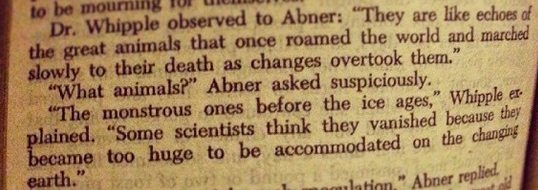
    In Michener’s Hawaii, one man of science and spirituality discusses dinosaurs with a man of spirituality. I shared this on Instagram, wondering if humanity will be talked about in this manner.

    Hawaii

    The changes could be the ones we’re causing nature to make and ‘huge’ could be our gluttonous consumption of resources. In the context of robotics and morality, I immediately thought of Asimov’s Zeroth Law “A robot may not harm humanity, or, by inaction, allow humanity to come to harm.” What would happen when one set of humans begin to do something that might harm humanity? What would a robot do?

    The answers, are evolving. It’s a good time to be human, and to be able to experience wonder.

    until next time, moral science

    P.S. On a  related note – Bicentennial Man – RIP Robin Williams :'(

  • Mirror Images

    I came across this passage while reading Kiran Desai’s “The Inheritance of Loss”. The context is of a young girl, who, because of a new found romance suddenly becomes conscious of herself.

    “But how did she appear? She searched in the stainless-steel pots, in the polished gompa butter lamps, in the merchants’ vessels in the bazaar, in the images proffered by the spoons and knives on the dining table, in the green surface of the pond. Round and fat she was in the spoons, long and thin in the knives, pocked by insects and tiddlers in the pond; golden in one light, ashen in another; back then to the mirror; but the mirror, fickle as ever, showed one thing, then another and left her, as usual, without an answer.”

    I found that I could also identify with it in the context of our encounters with the social platforms around – Orkut, Twitter, Facebook, LinkedIn.. and how slowly the ‘Like’ and RTs seem to be defining the interactions and affecting even perceptions and understanding of the self. Its not as though people and comments never existed before, but the sheer mass of people we come into contact with, thanks to the social platforms is unprecedented. Through the conversations and responses, we see a bit of ourselves, a self colored by the other person’s perceptions. As the voices around us continue to increase, at some point, is there a danger of losing touch with what we really are? Yes, you could ignore or be selective, but then we’d just get back to an objectivity argument.

    “The biggest danger, that of losing oneself, can pass off as quietly as if it were nothing; every other loss, an arm, a leg, five dollars, a wife, etc. is bound to be noticed.”

    I read that, thanks to @aanteadda‘s share on Twitter – an excellent take on the Ramayana,(do read it) and in a completely different context – that of dharma, it happened to arrive around the same place. Rama, having lived his entire life by what he considered his dharma, is distressed by what he must do with Sita after the end of the war with Ravana, irrespective of what he personally wants. The author thinks that this is Rama’s tragedy, and that of every person who lives by ‘impartial and abstract principles’, which don’t take into account ‘individuals as persons,’ and can’t see the difference between a situation and a personal situation’, and it can only lead to the destruction of the self.

    And so I wondered, whether its people, or a moral code that one follows, whatever dictates what we do, is there really a difference – between the reflections from others and ourselves? Is there one right answer for what should define us and the way we live. I think not.

    We must prioritise, I guess, based on what we think will give us happiness, and just like this neat article on addiction (the internet in particular) ends, “we will increasingly be defined by what we say no to”, all thanks to an abundance of choices, from within and without.

    until next time, you always have a choice, but do you always want a choice?

  • Characteristics

    There are nearly seven billion people on this planet. Each one unique, different. What are the chances of that? And why? Is it simply biology, physiology that determines this diversity? A collection of thoughts, memories, experiences that carve out our own special place? Or is it something more than this? Perhaps there’s a master plan that drives the randomness of creation, something unknowable that dwells in the soul, and presents each one of us with a unique set of challenges, that will help us discover who we really are.

    We are all connected, joined together by an invisible thread, infinite in its potential and fragile in its design. Yet while connected, we are also merely individuals, empty vessels to be filled with infinite possibilities, an assortment of thoughts, beliefs, a collection of disjointed memories and experiences… Can I be me without these? Can you be you?

    And if this invisible thread that holds us together were to sever, to cease, what then? What would become of billions of lone, disconnected souls? Therein lies the great quest of our lives, to find, to connect, to hold on. For when our hearts are pure, and our thoughts in line, we are all truly one, capable of repairing our fragile world, and creating a universe of infinite possibilities.

    Thus spake Mohinder Suresh in”An Invisible Thread”, the season finale of ‘Heroes’.

    And as if on cue, a large number of conversations and experiences popped up as conversations inside my head. Yes, those nice voices in the head. 🙂

    I remembered the conversations that Mo and i keep having on the subject of identity, purpose, character and other stuff that she completely gets. Okay i get too, but muddled up. 🙂 I remembered how, when I was reading Archer’s ‘Sons of Fortune’..again, I suddenly figured out why he is my favourite author. In addition to that amazing gift of story telling he has got, its his characters, and their character. Good or bad, they seem to have a moral code. They are noble – noble heroes and noble villains. (remember that word, shall come back to it in a while) Even when they come in contact with their character’s grey areas, they have a rationale they can apply to the situation. They make you aspire for such clarity in thought and deed, in being true to themselves and their character.

    Meanwhile, I see around me, a lot of young people eager to emulate – even things that I hoped would question and better. And as i keep a watch on that, I sense that they do it to belong, at any cost. They are willing to take their lessons from second hand accounts – not accounts of mistakes, which could be argued as a good thing, but enriching experiences that would shape their character. Of course, not every young person I know is like that. I also come across quite a few who have more character and maturity than many people double their age. But I do see more of the first kind. It is a different kind of conforming than what i was have seen earlier – a  need to fit into their peer group’s collective terms.

    On twitter and Facebook and all the services which connect us, I see this set, and more coming in every day to add to their number. And in this collective consciousness, I glimpse the desperation in the need to belong at any cost – even  at the cost of a character that is still being formed. A shared identity and a strong character, can it co exist? I wonder, if in this age of possibilities, they will be satisfied with this belonging, I also hope that they will not wake up, one day, years later and rue this conformity that they created for themselves.

    And then, I remember what a smart young lady from that age group once told me “Manu, this is so archaic. Only you could use the word ‘noble’ in conversation”. So, I wonder whether there is something in this connectedness that I don’t understand, whether the ‘plan’ requires all kinds of characters – with or without a strong character, to maintain the balance,  or whether the kind of disconnectedness that I’m feeling now is one that characterises that thing we all do – ageing. 🙂

    until next time, time for adages?