Tag: moral absolutism

  • Happiness: The End

    A while ago, in Happiness and Compassion, I had written about what Fahadh Fasil described as the biggest lesson he learnt from failure – he said it made him decide that he would only do things that made him happy. The more I read, the more I think, and the more I live, the more I start relating to what Fahadh is doing, and what Aristotle said, “Happiness is the meaning and the purpose of life, the whole aim and end of human existence.” Everything else – fame, power, money, compassion, detachment etc – is probably just the means we create.

    The thing though is, even if happiness were indeed the purpose, I can see at least a couple of challenges. In this excellent read “10 truths you will learn before you find happiness“, the first point is “It is impossible for anyone else to define YOU”. This echoed my first challenge – a difficulty in defining what happiness is to me. At the next level, I felt that the paths to happiness are confusing and have many things going against them. For instance, fame – “..other people’s heads are a wretched place to be the home of a man’s true happiness.” (Schopenhauer) Or compassion/pity (not kindness, which I regard as a more active expression, though the following might apply to it as well) – “There is a certain indelicacy and intrusiveness in pity; ‘visiting the sick’ is an orgasm of superiority in the contemplation of our neighbour’s helplessness” (Nietzsche) As you can see, it isn’t difficult to bring each down.

    (more…)

  • I, the responsible

    …and the poor poor girl died earlier in the day I wrote this. Given the delay between my writing posts, and them getting published here, we should have collectively moved on from the issue by now, at least in terms of mind space and media space- mainstream as well as trending topics.

    Much, much has been written about the issue – the male/female/Indian/ NRI/feminist/opportunist/armchair activist/ weekend activist/ ‘I was there to protest’ perspective, and these were only some examples – slice and dice any way you like and you’d find a voice that spoke on behalf of the piece you carved. Like this.

    Much as I abhor what happened, I see it (rape) only as one symptom of the disease we all have – our own malformed sense of justice. Probably one of the worst symptoms, but not the only one. Injustice is injustice, and it varies by degrees only on the basis of our own perspectives of right and wrong. It happens everyday – talking on the mobile phone while driving/riding, fudging tax forms, making the maid plead for a salary raise, bribing a cop, drinking and driving because you have assured yourself that you are still in control… ask your conscience, you’ll come up with many more. No, I’m not really confusing it with breaking the law – here’s an example. Five hundred times you speak on the phone while driving and nothing happens, but nothing stops the five hundred and first time being the instance that maims someone for life, and leaving him/her bereft of limbs, and perhaps dignity. Ask that person which is a larger crime – what happened to him or a gang rape – the answer should not be surprising. Every action/inaction that affects the dignity of another person, that shows another person that one can get away with breaking the law, that walks the grey area between absolute right and wrong in however minute a way, is injustice in some form.  And in this daily, casual, personal #theekhai attitude to justice lie the seeds of every horrible act of injustice. Any kid watching this today and seeing the perpetrator walk away scot free will imagine he can get away with a bigger crime. And so it grows, and morphs into multi-thousand crore scams and gang rapes further down the chain. A bit like the broken windows theory.

    Granted that an elected government has among its duties the responsibility of ensuring the protection of its citizens. Should we protest if they do not? Of course, but that does not absolve me of my obligation, nor does it free me of the nagging thought that as a race, our notion of justice is based on convenience. Sometimes I wonder if the birth of laws in society was a response to the slow death of justice within human beings.

    So yes, I am the privileged who can update my Facebook status, and move on with my life. I am responsible and there’s nothing I can do about it. Before I casually judge others, I have to wonder if I have the moral authority to do so. After all, I only vary by degrees.
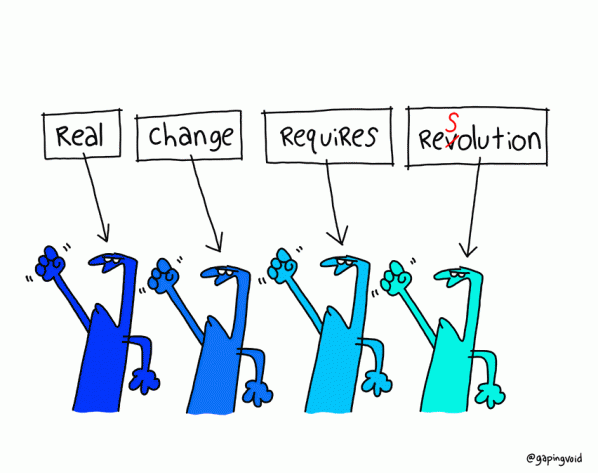
    (image via gaping void)

    until next time, </justice>

  • Integral Calculations

    The reasonable man adapts himself to the world; the unreasonable one persists in trying to adapt the world to himself. Therefore all progress depends on the unreasonable man. ~ George Bernard Shaw, Man and Superman (1903) “Maxims for Revolutionists”

    Now, I guess if i stretched that to Charlie Sheen, especially the last sentence you’ll think I have been swiggingTiger Blood” too. 😀 But I did have this notion after I read Scott Adams’ post on him.

    Imagine if you stopped filtering everything you said and did. ….just try to imagine yourself living without self-censorship. Wouldn’t you sound crazy?…. Imagine you are so unafraid of consequences and the opinions of other people that you start sentences before you have a plan for how they will end……I think Charlie is fascinating because he’s living without fear. That translates into a disturbing degree of honesty……But I also think that a total lack of fear would look like insanity to the casual observer. And perhaps it is. But it’s a strangely great kind of crazy.

    When I read up about moral absolutism, I wondered what/who would decide the absolutes one would stand by, and were they really absolutes? After reading all of that, I guess moral integrity towards the self better explains what I had in mind.

    So, if Mr. Sheen has decided that no-self-censorship and no-fear are the integral parts of his self from now on, and lives the rest of his life by it, we might consider it bizarre by civil society standards, but he just might be in a better space than we are in terms of moral integrity. (not hinting at a goddesses irony 🙂 ) The alternate consensus that this is just the drugs talking is not as comforting as it should be, when I think of it from this perspective.

    Does our general dissatisfaction stem from our willingness to conform to society’s norms of moral integrity, and the lack of courage to show society the middle finger whenever warranted? The individual consciousness against the urge to belong? I’m still thinking.

    until next time, integration and differentiation 🙂

    P.S This is not sheenfluence

  • Roleplay

    Jagathy Sreekumar, in my opinion, is one of the finest comedians actors to grace the screen. Probably THE finest. Since he’s acted only in Malayalam movies (over 1000 of them), he’s relatively lesser known to non Keralites. But you don’t have to go away, this is not about him or even Malayalam movies or even movies.

    Contrary to his usual on-screen characters, he’s a very serious person in his media interviews. He was once asked why he accepted all the roles that came to him, and why he wasn’t more choosy, especially since he could afford to. Pat came the reply “I’m a professional. Do you think a doctor should be allowed to choose which patients to accept?”The interviewer predictably moved on to easier pastures.

    This was sometime back, but I was reminded of it during the debate on Tendulkar ‘walking’.  (he walked away despite the umpire signaling ‘not out’) Both Jayawardene and Ponting were clear that they’d walk only after they were declared out. Though I have not always been a Tendulkar fan, I have been an ardent admirer for quite a while now, of the player on the field and the person off it.

    So it was quite a difficult question – the morality of a professional (?) ‘walking’ without considering his responsibilities to the team. (forget the expectations of a nation for now) Was he being selfish – keeping his ‘fair play’ image intact? (though Ganguly claimed Sachin hasn’t always ‘walked’)

    While the moral question lingers, I thought I got an insight into Sachin’s behaviour from this amazing article I read thanks to Roshni. It says that Sachin is a bridge, between two eras of cricket, and he realises the responsibility. As a sport, today’s cricket, both on and off the field, is vastly different from what it used to be, and yes, it is no longer just a sport. As the author quotes “The team’s rabid popularity, is a reflection of rising national ambition, of pride in national achievement.” Maybe Sachin realises a bit beyond this too, and is doing his bit to ensure that in the pursuit of success, a right set of ethos is also kept in mind. Playing the game to win, and playing it fair.

    Jagathy, legendary though he is, perhaps has it easier. There are bigger stars around him who are expected to be role models. He can get away with moral absolutism.  Tendulkar probably has the tougher job – as he charts new territories in terms of matches played, runs scored, centuries made, he also has to navigate new grounds in moral integrity, balancing his own stance with the expectations of a team, a nation and still ensuring that he’s a worthy icon in all respects.

    until next time, Godlike

  • Comics and moral signs

    Though many claim that most comic book – movie adaptations completely spoil the original work, I still find them fascinating, simply because of discovery. Many a time, I have realised that comics are an amazing representation of culture, whether it’s popular, alternate, counter or even imaginary (eg. different renditions of myths, accommodating the changing ethos), either overtly or through subtext. So they work like a time portal for me, giving me a vicarious experience of a different era. (just like some books, music, cooking, smells etc)

    I’d never have known about Watchmen if not for the movie. Since I don’t want to miss out on references and subtext, I always try to read up on the characters and original work before watching the movie. And that’s how I came across the concept of moral absolutism, while reading about Rorschach, an amazing character, made more so by a class performance by Jackie Earle Haley. Wikipedia defines moral absolutism as the ethical view that certain actions are absolutely right or wrong, regardless of other contexts such as their consequences or the intentions behind them.

    I’ve wondered many a time about the concept, without knowing about the existence of a term, so it’s good to find it and read up more. With morality in a constant state of flux, who would be objective enough to give an absolute perspective, and would it matter at all? I guess not. So maybe, in some later rendition of Rorschach, his moral absolutism might shift to consequentialism, (holds that the morality of an act depends on the consequences or the context of the act) and a future reader would get a sense of how the times have changed.

    Late night. Red Signal. No vehicle or human in sight. Stop or Proceed? 🙂

    until next time, moral abdication