Back in 2012, in my first post on institutional realignment, I’d written this – “…my biggest hope is that the current currency of our lives – money – will have a better successor, one that will be better connected with our unique identities, and weave in contexts better.” In the two years since, this movement has not only begun, but is also figuring out its own dynamics. I had expected, or wanted, a disruption of money, but it will most likely be a transition. At this stage, I see at least three broad areas to frame this movement -the democratisation of finance, alternate currencies and marketplaces for value exchange.
Democratisation of finance: This is probably where it began, because the internet has a reputation for removing intermediaries who do not add value in this case, financial institutions. From projects in Kickstarter, Indiegogo, and GoFundMe to social investments like RangDe and Milaap, there are now many ways to mobilise funds for me and you from people like me and you, according to personal passions, interests and belief systems. I’ll add more to this in the ‘marketplace’ section.
Alternate currencies: Arguably, money as an institution has built a network involving processes, dependencies and establishments keeping in mind the dynamics of an earlier era. A civilisation connected by the www may find these tedious and irrelevant, and thus it’s only natural that it builds its own institutions. Bitcoin (a good introductory guide) is the one that made this phenomenon (relatively) mainstream, to the point that it even has ATMs. Bitcoin may or may not survive, it is probably the Napster in its domain, it has changed the game irretrievably. While on the subject, do read this fantastic tongue-in-cheek take on how it’d be if the roles were reversed – a cash based mechanism replacing digital currency. Meanwhile, there are other currencies similar to Bitcoin, and then there are completely different thoughts – for example, Pay With a Tweet. Which leads us to the various payment mechanisms that are being built.
Marketplaces & Value Exchange: While the other two are the dynamics, this is where the mechanics play a part as well. In the ‘democratisation’ section, I had referred to several platforms that aid both discovery and action. There are many more stories in this line – from AgreeIt, an app that allows crowdfunding from friends on Facebook to crowdsourcing for emotional advice, ideas and so on to selling one’s reservation at a restaurant/spot in a line through Shout to a ‘new media company’ Ideapod that wants to “amplify the ideas that shape our world, create genuine and enduring dialogue around ideas and spread ideas that matter through new and traditional media channels.” to ordering food from neighbours, (Eatro in London and Imli – a startup I mentor at the Microsoft Accelerator- closer to home) there are various models of value exchange that are shaping themselves. In fact, the entire ‘social commerce via collaborative consumption‘ route is based on these marketplaces. (a few good perspectives and stats on its drivers here)
But, irrespective of the currency, every transaction requires (another) key element – trust. The social web is also building its own mechanics for this – from relatively generic clout mechanisms (Klout, Kred and the likes) to more context specific ones like LinkedIn or GitHub or even Wiki and review mechanisms. (from Amazon to TripAdvisor to Foursquare to GoodReads to Zomato) We earn trust through our knowledge and actions in these mechanisms. We earn social currency. That brings me to the final portion – how does all of this impact brands and what would be their role?
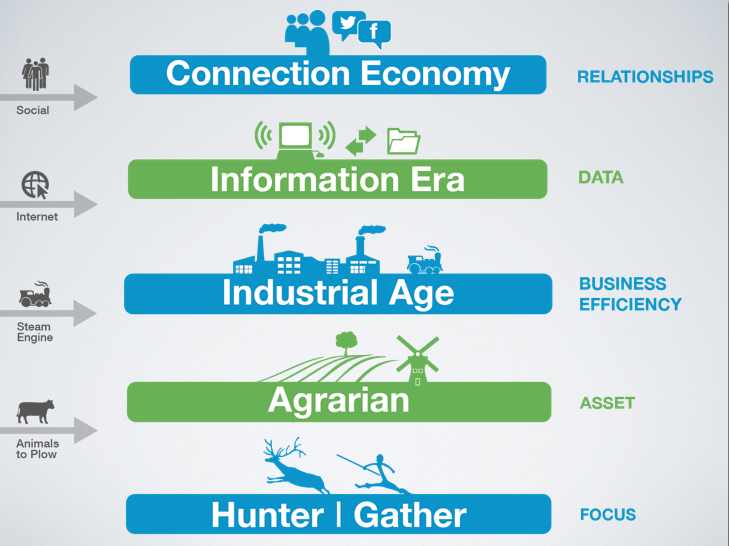
Brands & the trust economy: Across the ages, corporations have been built on competitive advantages pertinent to the economies they operated in. I found a fantastic illustration in this context here

I think relationships are indeed going to be the major competitive advantage in the future, and if so, the currency that would play a bigger role than money would be trust. As in many other developments prior to this, there are opportunities here for brands to weave themselves into the consumer’s narratives and go beyond transactional relationships, and to earn social currency. Many of them are already on it, finding ways to earn consumer trust and helping him/her develop and change perspectives about various currencies and relationships between them. Since we’re talking of finance, let’s use an example in that domain. Fidor bank helps its consumers discover crowd sourcing options, staying true a bank’s generic commitment of excellent wealth management. Yes, it’s still money, but it understands that it can be deployed beyond traditional options. In the process, it also helps the consumer to belong to a community.
Brands actually have an option to join in wherever there is consumer spending. Nike+, as usual, did something back in 2012 – they allowed runners to trade in (running) mileage for Nike goods (I had shared the video in the institutional realignment post too) While this ties in beautifully with Nike’s business purpose, maybe some brands would have to lean a little more towards the consumer side and get into relatively unrelated narratives, and a relationship, before connecting it back to the business purpose. For example, airBaltic’s loyalty program Baltic Miles rewards frequent fliers who jog enough to burn off the same number of calories as miles they’ve flown. One of the aspects of agile marketing would be to enable identification of opportunities early. For example, imagine Coke getting into the act in Beijing’s first reverse vending machines that pay subway credits in exchange for returned containers.
In what might seem like a ‘changing of goalposts’, just as brands are beginning to vaguely realise that their currencies of engagement with consumers need to change, the consumer’s relationship with the common currency of transaction – money – is also changing. The two are very related, and brands need to tackle both to have meaning and relevance in a consumer’s life, because if (as Godin says) “money is a story“, we’re probably nearing a plot twist.
until next time, the end of money’s monopoly
P.S. For another detailed look at the subject, you’d want to read Gauravonomics’ post on ‘The Future of Money‘.