
Tag: media fragmentation

  • Project Lead

    My earlier post on media consumption fragmentation also made me think of the other side – the creation perspective. Despite the hubbub of “integrated campaigns”, some platform, more often than not, plays the lead. In earlier eras, choices were easier – until televisions came into the picture, it was limited to newspapers, events, radio; even after TV made its inroads, things like objectives, costs, geographical reach of the brand etc could be used to make decisions. In general, I’ve seen TV trumping print more and more as time passes, taking on the role of project lead.

    After the advent of social, and despite the low internet penetration, the above parameters have increasingly started working in favour of social ‘media’. Of course, there’s always the beginning of the curve when everyone wants in because of the shiny new object syndrome, but I do believe we are crossing that stage now. I still see “let’s do this on social media too” (after the entire campaign has been conceived and produced) or the single slide on social rampant, but that’s also part of the learning curve. As always, some brands are moving faster than others.

    We already have brands, internationally, that are experimenting (and successfully) with ideas that are inherently social, and using traditional media for say, additional reach. Just as TV took over from newspapers, it is possible that social will take the seat at the head of the table at some point. It is also possible that it would go the way of digital – relegated to performance campaigns, and belying its potential. That is even more so if social is measured in the same ways as the media before it. However, I think this time the story would be played out differently. But then again, I also think there will be a fragmentation of the brand story, understanding each platform’s nuances, using its inherent strengths, making frameworks that have tailored measurement indices, and in the process, providing a cohesive perspective to the consumer, and cohesive metrics for the brand.

    until next time, leaderboards 😉
  • Of trending on twitter and media fragmentation…

    A couple of weeks back, I’d written about the increasing broadcast tendencies on social platforms. Some events last week reminded me of something I’d tweeted a while back –

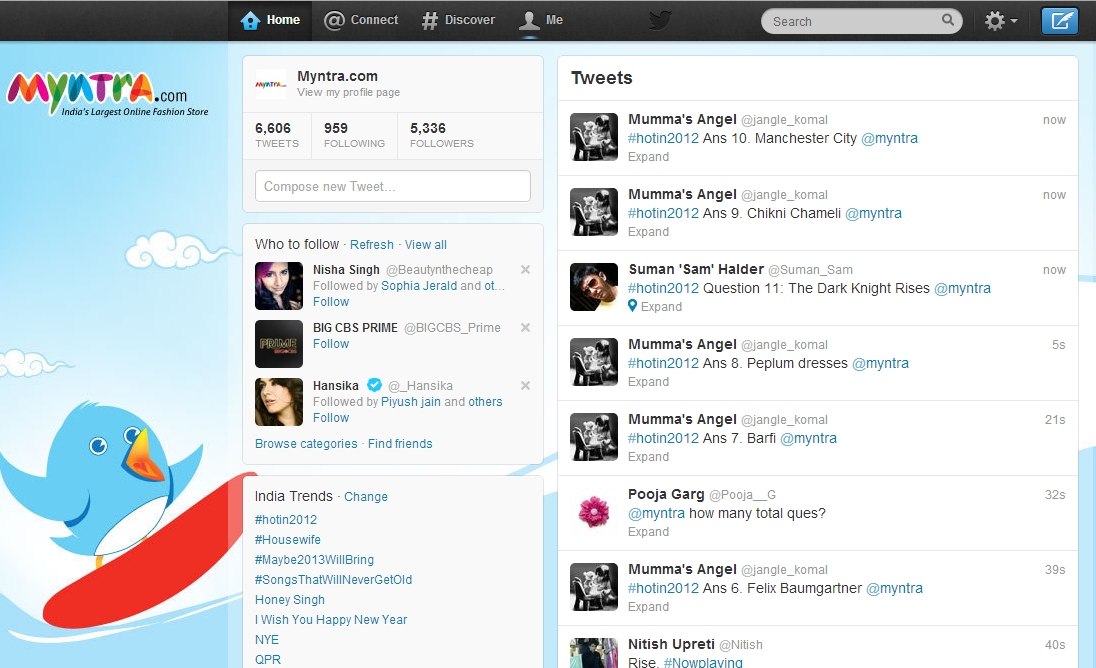
    It is, for better or worse, an item in the social marketer’s checklist. So unless it’s a day on which we’re outraging on multiple issues, you can easily see ‘branded’ trending topics. At Myntra.com, we’ve been playing with hashtags for quite a while now – #bachpanstyle was one such experiment. As we practiced more, the patterns started becoming more evident. Late last month, we started the #hotindecember hashtag in response to a business objective – creating more awareness about the similarly titled promotion at Myntra.com – and had constructed it around the promo TVC. It resulted in the hashtag trending on twitter. Just to check the lessons learned, we ran a #hotin2012 hashtag on 31st Dec, and ended the year as the #1 trending topic in India.

    Considering that there was a much more serious issue taking up everyone’s attention, this should be surprising, but it’s not, and that’s what we have learned of Twitter’s trending algorithm.

    That was about a brand using social as media. Like I mentioned earlier, the first hashtag was based on the TVC, something that had gotten us positive feedback on Twitter. After the Delhi incident however, the ad was considered by a few as ‘projecting women in poor light’. (worthwhile mentioning that Lisa Haydon, who starred in the TVC, had tweeted about the TVC being a lot of fun) Users, who also utilise social as media, are bound to have their opinions and will air them. The interesting part was that all this (hashtags and criticism) was happening in the same timeframe – 27-31st December.

    Why do I find it interesting? Let’s take a step back. It was only when TV stations started competing with the rabbit population that we started contemplating the fragmentation of media as we then knew it. Add to that the increasing web (+mobile) penetration and things became more complicated as time progressed. Brands (in general) still haven’t figured how to handle this, so fragmentation within a social media channel and its impact is small fry, except this is probably an indication of the future.

    This time, we chose not to react to the criticism – given the circumstances, it would have probably led to a nasty debate. Thankfully it died down. But what if a few twitter heavyweights had gotten into the act and made it trend for all the wrong reasons? We’d not have had the luxury. We’d have to refer to Crisis Management 101. In a worst-case scenario, we’d probably have to consider taking the TVC off air.

    In essence, when an interactive medium is added to the mix, fragmentation takes on a completely different meaning. It no longer means isolated compartments which don’t talk to each other, the events on one affect another. As a media buyer, a brand can choose not to be present on some media, but when a channel talks back, the brand’s choices suddenly dwindle. I think this will manifest itself much more in 2013, the learning curve is going to be very steep!

    until next time, user generated brand virals!

    Disclaimer: The perspectives above are personal, and does not reflect the thoughts or actions of the organisation mentioned. 

  • Building Brand Frameworks

    It was an interesting coincidence that a couple of weeks back, around the time I posted on brand building and the effects of instant gratification (largely in the context of social media), I also got into a minor debate with a colleague on brand communication – tonality, voice etc. This is a topic I constantly think about – brand building in the social era- and on this blog, that is manifested in the form of posts from ‘flawsome‘ to ‘consistency and cohesion‘ to larger canvasses like brand identity and the definition of ‘brand’.

    Thanks to an ever changing social landscape, the questions and the answers are extremely dynamic. Different brands face different challenges as per their category, (pricing, demographic, ‘conscious’ly purchased or not) how long they have been around, their internal processes, structures and culture, and so on. But the earlier eras also had challenges and yet, we managed to define certain basic frameworks of brand building, which could be adapted across product categories, geographic locations and so on.

    Social has indeed disrupted everything because unlike say, television, which probably took over from print, it fundamentally changed the linear narrative by making ‘media’ a two way street, with side lanes opened up by consumers. It is probably because of this, that (for example) a Leo Burnett’s Human Brands concept (this post, for context) goes beyond adapting current frameworks and into the purpose of the brand itself.

    Brands that have built themselves in the ‘traditional media’ era are trying to adapt themselves, and that brings its own set of challenges. But what about brands being built now? Ignore the tech brands for now please – Facebook, Google, Twitter etc, what would your framework be if you had to build a brand starting now, in this age of massively fragmented media and user presence? Would you design the brand identity and adapt it to different media platforms or would you go with a bare minimum checklist and allow it to evolve with consumers adding context across various touch points – real and virtual? I’d really love to hear some perspectives!

    until next time, frames per second…