Tag: Mahabharata

  • Parva

    S. L. Bhyrappa

    Like many good books, this one too made its way into my list in a random fashion. A friend saw the different Mahabharata versions on my shelf and asked me if I had read this one. I hadn’t even heard of it! I initially thought I’d skip because I thought it was part of the recent glut of (IMO) ridiculous books being written from different perspectives, which were quickly reaching a stage where even the view of the elephant named Ashwatthama would become a book! But this was published around the time I was born, and the hope was that perspective would therefore be (ironically) fresh. And indeed it was. The best part of it is its overall outlook, which makes it seem contemporary, in a good way. 

    (more…)
  • The Palace of Illusions

    Chitra Banerjee Divakaruni

    Like I’ve said before, what does it say of a story when countless people, centuries later, can continue to render it in their unique way? It’s comforting to know that I’m not the only one who’s completely enthralled by the phenomenon that is The Mahabharata. It’s even more heartening when renditions are such that they do justice to the epic.

    This is the Mahabharata told from the viewpoint of Draupadi, and as a reader, I could easily believe this to be indeed her autobiography. I could sense the changes in Draupadi with time, not just in her behaviour, but also in her perspectives and even the words she uses. It is almost as though the author walked in her shoes! It is difficult to bring anything new to the table with regards to the basic story itself, but the author manages it with the help of at least three devices – the role of Karna in Draupadi’s life, the perspectives of a female protagonist and finally, the interpretations Draupadi draws of and from the events that happen around her. There is a fourth too, that lends a uniqueness to this retelling – the Palace of Illusions, and what it does to Draupadi’s own perspectives. (more…)

  • The legacy need

    The last two books I read had only a faint connection. One was historical fiction and the other was a memoir. The first – “A Spoke in the wheel” by Amita Kanekar – is a take on Buddha and his teachings by a monk three hundred years after the Buddha’s death when his teachings have begun their journey into religion, the emperor Asoka being the key catalyst. The second – “City of Djinns” By William Dalrymple is his discovery of Delhi – past and present – in a year that he spent in the city in the early 90s. The connection, as you might have guessed, is historical narrative.

    It is natural to think that there is a huge difference in a work of fiction and a more research and experience led memoir, but the point of the post is that with time, it is difficult to establish that. In the book on the Buddha, the monk chronicling his life and teachings is irritated by the supernatural abilities being attributed to him. But we do know that many people believe in it now and even consider him as one among the avatars of Vishnu. On a related note, William Dalrymple delivered a body blow to my notions of the Mahabharata era when his conversation with an archaeologist constituted a distinct possibility that the war was fought with sticks and stones and probably a bit of metal! (the proof being excavations around what is considered one of the earliest versions of Delhi – Indraprastha) I am a huge fan of Hindu mythology and it has fascinated me from as long as I can remember. I truly believed that they had happened in some form, but the archaeologist is clear that most descriptions in the epic would fall under ‘poetic license’!

    It made me wonder if there would be any difference between the two books say, a hundred years from now. It is possible they might exchange roles. It is also possible that they both are treated as fiction, or as factual pieces of work. I think all scenarios are possible because at the time of chronicling something, we believe that its factuality would be transmitted across time. And yet, we could debate the Mahabharata’s historical authenticity and Buddha’s superpowers both ways! So think about it, the same thing could happen to the information we store now as well. Thanks to digitisation, more data is being created in this world than ever before and (arguably) every point made has a counterpoint. There are no objective annotations because even the original construction is a product of biases, interpretations, perspectives and so on.

    That brings me to legacy, something a lot of us care about. From children to business empires to art to helping others, there are many avenues. However, I think that unless there is documentation, the chances of a legacy lasting beyond a few generations is questionable. For example, Dalrymple finds the last line of direct Mughal descendants and their knowledge of their ancestors is limited to a few generations before them. The futurist in me does fantasise about a global neural network and consciousness that connects all of humanity and has sufficient storage to instantly collect, catalog and annotate all ‘memories’  in as objective a state as possible for later generations to study them.

    But meanwhile, even as I dissect my baggage of the past, I am now forced to consider my need for leaving a legacy – something behind that will represent me when I’m gone.  After all of the above, how relevant is that need? Isn’t it just a demand made by the ego, a story we create for ourselves? Something to continue the narrative of our lives? We do talk a lot about letting go of the baggage of the past, but isn’t legacy also a baggage? A baggage of our future? If we let go of that, how different would our thoughts and deeds be? Understanding that is probably the key to living in the moment. I could easily twist my favourite cricketer-gentleman’s words for this context- He’s not concerned about his legacy, he’s concerned about what actually makes him come alive in the first place, which is that love of life, the desire to live completely.

    recite-15416-48543400-hiy6v5

    until next time, present participant
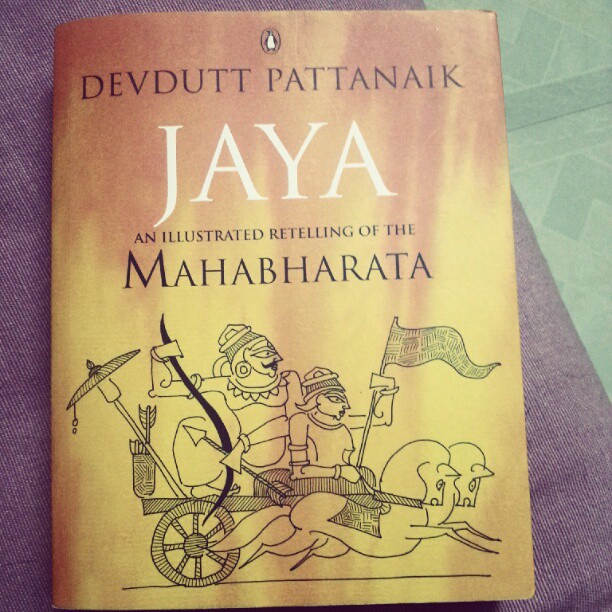
  • Jaya: An Illustrated Retelling of the Mahabharata

    Devdutt Pattanaik 

    I consider myself more well-versed with the Mahabharata than the average person, because of my interest in Hindu mythology and the amount of reading I’ve done on the subject. But I’m really glad I read Jaya, not just because of the small details I learned about (I counted 6 things I hadn’t known about – Sahadeva’s precognition gained by eating Pandu’s flesh, Draupadi cursing dogs to copulate in public for stealing Yudhishtira’s slippers, Vibhishana being present at Draupadi’s swayamwar, a couple of stories on why Krishna stepped in to protect Draupadi when Dusshasana tried to disrobe her, why Shakuni did his best to ensure the destruction of the Kuru clan, Draupadi’s regret over Karna and at least a couple more interesting tidbits) but because of the wonderful lessons it provides. The author also mentions several variations of the tale, regional renditions and folk variations adding layers to the original story. Even as one feels the familiarity thanks to the places (which still exist) mentioned and can identify with the experiences and tribulations of the mortal characters, there is also an awe created by the elements of divinity.

    Jaya’s excellent illustrations and the simple yet elegant and evocative storytelling took me back to a time when I first started hearing these stories – childhood. So vivid is the prose that one can easily create visualisations of the events. The explanation of events are done on many planes – rational, metaphysical, spiritual, bringing a lot of clarity to the complex tale. The concepts of dharma and justice are explained beautifully and even as the Pandavas grow their perspective during their exile and their pride, anger etc get tempered before and after the war, there is tremendous learning for the reader too. It is easy to understand why this is indeed considered the greatest story ever told, and continues to be relevant through ages. The original tale is epic, and so is the narration in Jaya. Very highly recommended.

    Jaya

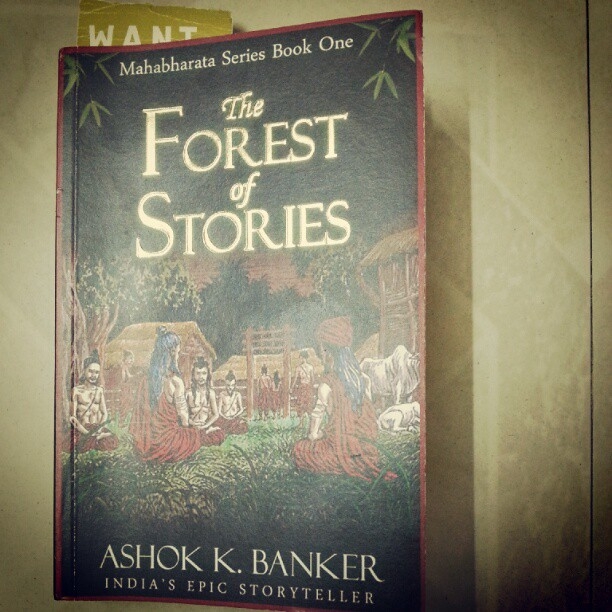
  • The Forest of Stories

    Ashok Banker

    Book 1 of Ashok Banker’s Mahabharata, MBA if you will. It is an exact rendition of the saga written by Krishna Dweipayana Vyasa. The narrative begins in Naimisha-sharanya, where Ugrasrava, son of Lomarsana and better known as Sauti, arrives to convey the news of Vyasa’s transcendence to the next life, and to narrate the grandest tale ever created.

    The tale begins long before the descendants of Kuru faced each other on the battlefield at Kurukshetra. Kurukshetra, famous long before as Samantapanchaka where Parasurama created five lakes of blood from the decimation of kshatriyas, and famous long after as the venue for the sarpa satra conducted by Janamajaya, descendant of the Pandavas.

    Sauti explains how Jaya, the original tale swelled from 8800 slokas to 24000, named Bharata and then over several narrations, to Mahabharata, made of one hundred thousand slokas. A narration that Sauti himself was the recipient of, from Vaisampayana, as well as Vyasa himself, at the satra.

    The narrative is anything but linear, like a tree with a multitude of branches, and does stick to Vyasa’s original work. It flits from story to story, occasionally coming back to what can be loosely described as central narrative, in this case, a sort of index built by questions being asked to Sauti during his narration. Thanks to this, from creation of the world and the origin of different species to the reason for the Mahabharata war and the stories of many antecedents of the Pandavas and Kauravas, there are stories and stories. This book ends with the introduction to Bharata – the emperor, son of Dushyanta and Shakuntala, after whom the country is named.

    As someone deeply interested in mythology, this is a very interesting read, despite the elaborate prose, but what you will get from it completely depends on your level of interest in the epic.

    Clipboard01