Tag: LinkedIn

  • Linking learning & labour

    I’m a huge Asimov fan, and am constantly amazed at how he was able to have a perspective of the future on multiple fronts. I was reminded of two of those recently thanks to their application (of sorts) in contemporary scenarios.

    First, Hari Seldon‘s (pretty much the foundation of Asimov’s Foundation series) psychohistory, which was able to make general predictions on the future behaviour of large populations using history, sociology and statistics. The easy contemporary connection is big data and predictive analytics.

    Second, a short story written by him called ‘Profession‘, (do read) in which every person’s profession is based on an analysis of his/her brain, and no choice is given to the person in this matter! In India, we seem to be already there even without the analysis!

    Collectively, these two made me think of employment, and on a related note, education. The thought was that with so much of data available on education and employment, we should be able to create ‘tests’ to compute the interest and aptitude of individuals at a very early age. What this would aim to do is to eliminate the herd education that currently exists. Instead, children would learn things that help them in a profession for which they have the intent and interest, using say, a combination of traditional classrooms and MOOCs. Also, this would no longer be one part of a life cycle, but a continuous process – helping the individual thrive in a dynamic environment.

    If you remember, LinkedIn was my representative for ‘L’ in the ‘change imperative‘ deck. That was because I felt that it had the data and the vision to be the catalyst for this kind of a change. I was very happy when it underscored this faith with the fantastic ‘future self‘ experiment, in which they identified the future professional self (5 year time frame) of LinkedIn user Kurt Wagner – another user Mussarat Bata – using various data points!

    LinkedIn hasn’t really built this as a public tool, but just imagine the possibilities! A platform that shows people the possibilities which take them closer to their ‘purpose’. (remember ‘The Evolution of Work and the Workplace‘?) I sincerely hope to see this in my lifetime. 🙂

    until next time, live and learn
    Clipboard01

  • A new medium

    I haven’t taken you outside of the blog in a while, but here goes.

    LinkedIn recently opened up its publishing platform, and since it’s a contextually relevant platform to publish my ‘work’ posts, I was immediately interested. Thanks to Gautam, I discovered this link, applied, and soon got publishing rights. It was a harder task to write something though! I have finally managed something that is a differently framed version of concepts that I have written on the blog already. Do take a look here.

  • Can media become social enough?

    A few days back, it was reported that Facebook now had a million active advertisers, and that LinkedIn has 3 million company pages. I’ll let that sink in, in case you hadn’t heard. Despite all the social-ness, I realised it’s impossible not to call it media. The wiki definition for media is “tools used to store and deliver information or data” That, for me, is a smartphone now! I also wondered how many media behemoths could boast of a million active advertisers. And that’s when it really struck me how much the traditional media we were used to have been sidelined – yes, they still get advertising revenue, but from a sheer reach perspective. Google, Facebook, YouTube and many more platforms get anywhere between a few million to a few hundred million visitors every day.  To put it all in perspective, TOI – the world’s largest English daily has a readership of over 7 million.

    Media and advertising have had a very intertwined life, unless of course the publication/channel has been on solely a subscription based model. I think the magic of Facebook (and Google, before it) and those that followed is that they have democratised advertising by not just making it something any small business could spend on according to their means, but also giving them the ability to advertise according to contexts – intent, interest, social etc.  Though Google, Facebook etc are still intermediaries, they never flashed their powers, though the latter has begun to, recently. As brands move away from a one-size-fits-all mode of advertising, these platforms give them more options of form and function, and changing the face of advertising. (Google’s exploits are known, here’s a pertinent read on Facebook)

    In such a scenario, what really does a traditional media channel have to offer to its consumers and clients? I’m not saying that they’re all going bankrupt next Sunday, but it’s clear which way the wind is blowing. One way, of course, is to use their brand value, and replicate (and grow) their audience on devices and platforms which better serve advertising interests. They can hone their value offerings by offering various contexts and their combinations – local, social, interests, and so on, and build business models for each. The early movers are already making big deals. But that is the red ocean that everyone is fighting for. How really can a player differentiate?

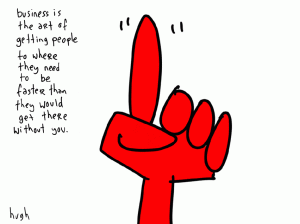
    Biz_Is_The_ArtI had a vague thought. Media’s original strength was its relationship with users and the trust involved. In the social media era, how can that be leveraged? Flipboard has already allowed users to become curators and create their own magazines. Is that the future, along with shared revenue on advertising? What if users can also curate the advertising their ‘subscribers’ can see? After all advertising is also news/information and has a certain value depending on the source. Traditionally, media  has been the middle man between advertisers and users, but what happens when everyone is media? Can media start aggregating influencers in every domain, including niches, provide them the material for curation, negotiate on their behalf to relevant advertisers, and share the revenue? Perhaps the next  disruption will be the platform that can handle the complexities involved. What do you think?

    until next time, mediator

  • Weekly Top 5

    [scribd id=79355855 key=key-2bakq016harbyf7n8bvf mode=list]

  • Social Media Fatigue – an opportunity?

    One of the interesting conversations happening on the web these days is on ‘social media fatigue’. As a user of many platforms, I can admit to having experienced this many a time in the near past. But it’s strange – fatigue for the networks we created. So I asked myself – what really causes it? Is it the overwhelming ‘pressure’ to be on top of everything that happens in one’s ‘social circles’? Or is it the other end -the boredom of seeing the same people having the same kind of discussions day after day?

    As we first explore new networks, I have noticed that we often hunt for familiarity – either in terms of features, or people. For the purpose of this post, let’s stick to the latter. From personal experience, I have always wondered whether people (including me), in their efforts to be ‘always on’ and across multiple platforms miss out on broadening their world view, and exploring content beyond their natural haunts. A direct result of this is the paucity of topics beyond the day’s hot topic or #outrage or say, a done to death humour hashtag. All of the above are generalisations, since I’ve also been part of several interesting discussions on Facebook/Twitter/LinkedIn. Google+ actually works better for me these days, probably because it’s a new flavour. However, none of the networks have really nailed it in terms of connecting the user to new people who might be able to broaden our ‘scope’. On the contrary, most networks try to use a ‘people like you’ approach. And then probably, familiarity breeds contempt.

    Also, as I’d mentioned earlier in the context of Google+ usage, people rarely make the effort to produce or even share different or differently packaged content for various networks. This means that, especially in new platforms, where networks start small, you are hit by the same content. After a while, familiar content can also breed contempt, I guess.

    To minimise the fatigue, the hard work for now, given platform limitations, has to be carried out by the users – in production, distribution and consumption. It’s only recently that I started defining my relationship with the platforms – by answering the basic why, what, who, where, when questions. That has resulted in a comfort relationship, but I’ll be the first one to say that it’s not really optimised, which would also explain my continued experiments with various platforms.

    For some time, I thought Google+ Circles, used in conjunction with Sparks, would make excellent ‘interest based’ communities, but then realised it was difficult to scale because Circles aren’t opt in i.e. someone has to add you to a circle, you cannot add yourself. Which leads me to the final point.

    Thanks to this line of thought, I wondered whether brands could play a role in diminishing social media fatigue. The ‘constantly on top of news’ would require platform solutions, but there are two other opportunities. One, connecting users whose only link to each other would be the ‘stories’ associated with their brand/category. This link could then spawn new layers and associations between them. Two, sharing content that provides the user more perspective in his domain of interest. Obviously, the users to target here are the ones whose interest area overlaps with the brand’s own category. In both cases, there is a lot of data to be unearthed before working out a specific content/community strategy. So, if brands can ply their trade a little more smartly, life on on social networks could probably be a lot better. What say?

    until next time, post fatigue? 😉