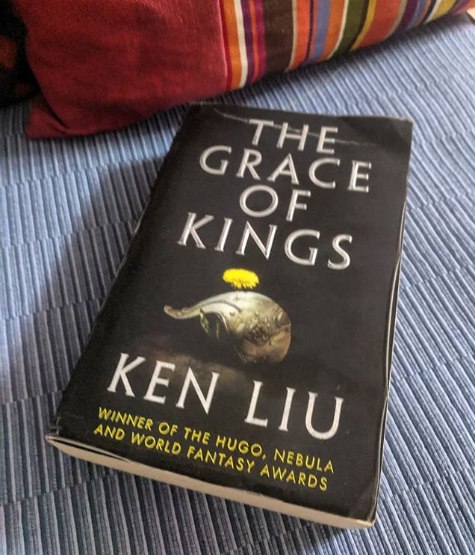
Ken Liu
The Grace of Kings is the first part of a trilogy named The Dandelion Dynasty. I really liked The Paper Menagerie & Other Stories (by the same author), so I bought this book soon as I came to know of its existence.
Inspired by the Han dynasty, this is “silkpunk”‘s answer to the Game of Thrones! There is an emperor, there are palace intrigues, there are rebellions, and contenders vying for the throne. But that’s probably too broad a stroke, and is unfair to the differences.
The main contenders are polar opposites – one is a sly wastrel who becomes a bandit and has an innate charisma and goodness that wins the hearts of the people, the other is a noble brought up in exile who believes in winning battles through sheer valour in the battlefield and has very clear ideas of right and wrong. They cross paths, become brothers in arms and rebel against the emperor. The metaphor of dandelion vs chrysanthemum is the philosophical underpinning of the book, and causes the clash of ideals. Also pertinent is how the gods of the realm have their own champions and do not shy away from meddling in the affairs of mortals.
The book has a bunch of many interesting characters and though the pages devoted to them might not be many, the roles and their significance in the story arcs are very well defined. Between a narrative pace that is unflagging, and the twists that never end, the book creates a momentum that is hard to resist! That ensures that the few grammatical errors and the seeming ease with which main characters overcome obstacles, can be ignored.