
Tag: Jared Diamond

  • Collapse

    Jared Diamond

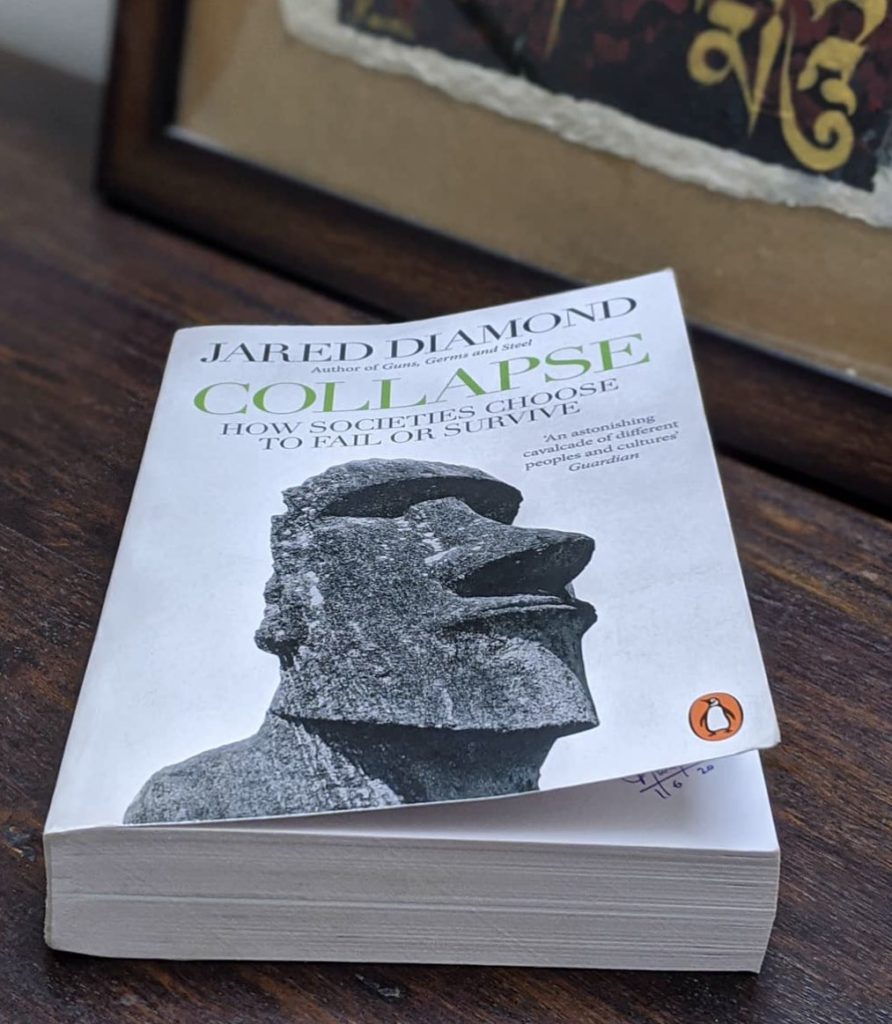
    Jared Diamond’s Guns, Germs & Steel ranks among my favourites. Insightful and full of perspectives. While that book was about how and why civilisations unfolded differently around the globe, this one is on why many of them collapsed. The author defines collapse as a”a drastic decrease in human population size and/or political/economic/social complexity, over a considerable area, for an extended time.” He then uses a five point framework to analyse multiple examples, spanning time and geography. The five points are environmental changes, climate changes, hostile neighbours, decrease in trading partners, and finally, society’s response to the above. 

    The author starts with contemporary farms in Montana and then moves on to the Mayans in South America, the Easter Islands natives, the various Viking communities across continents, and the Native American Anasazi to apply the five point framework and understand the causes of their downfall, and sometimes survival. He then examines modern societies and their challenges – Rwanda, China, Australia, and the interesting case of neighbouring countries that went in opposite directions – The Dominican Republic and Haiti. Strangely, this is despite both countries having a history of dictators. 

    The last portion of the book delves into what caused societies to make disastrous decisions, and the impact of big businesses on the environment. The latter is not always a negative, and there are some excellent examples of large corporations realising that doing good can actually help the bottomline. There is also a very interesting section on the responsibility of individual consumers.

    While we still may not know exactly what happened, there is a fair amount of convincing logic in the author’s hypotheses on how and why civilisations collapsed. And it gets more interesting when we look at the problems we are facing now. On one hand, the scale of the problems are indeed much higher. But on the other, there have been technological advances that can aid us. How much of a counterbalance is one for the other? And as one of his students asks, what was the islander who cut down the last tree on Easter Island thinking as he was doing it? Are we too, frogs in boiling water? Do we have landscape amnesia which prevents us from seeing the changes around us? 

    The book is not easy though, and sometimes one wonders whether the depth of research shared in the book takes away from the narrative flow. However, if the subject is interesting to you, it’s a read that will enlighten.
  • Guns Germs & Steel

    Jared Diamond

    One of my favourite books in recent times has been Sapiens – it did a fantastic job of showing how the species ascended to the apex position in evolutionary biology. A vertical journey, so to speak. But why didn’t all humans, spread across various continents, develop equally in terms of civilisation and technology? To use the book’s blurb, “why has human history unfolded so differently across the globe?” In the modern world, why does an Africa or even a large part of Asia have to work hard to catch up with the western world? That’s what the book seeks to answer.

    It does that by asking very interesting questions. For instance, why is it that the Spanish conquered South American empires, and not the other way? The book doesn’t stop at the proximate answers – horses, weapons, germs etc- but keeps asking a series of questions for the answers that come up. Even beyond the time that recorded human history begins. To when the species first made their appearance on the planet – in Africa- and how slowly they made their way to different parts of the globe.

    Primarily, four factors have ultimately caused the disparity in the fortunes of various peoples- how early they started, the difference in the environment and biogeography of the areas they populated (what plants and animals there could be domesticated to scale up food production and create the surplus needed for new skills and ideas to develop), the spread of ideas (the fascinating aspect of how the axis of the continent – except for Eurasia, all continents have a north south axis – plays a large role in why a large number of major civilisations and developments occurred in this part of the world), and the densities of population that allowed competing societies within continents to come up with radical ideas.

    In addition, there are also related interesting ideas. For example, how invention is actually the mother of necessity (examples of how some inventions had been made before, but are credited to the person/s who made the right tweak at the right time for others to adopt it in large numbers) and how some non-intuitive solutions have endured (e.g. the QWERTY keyboard).

    All of this make for a fascinating, if not easy read. Even though it was published a couple of decades ago, I think it is an important book for this time because it shows how evolutionary determinism is not just about genes, but the environment as well.

    P.S. I do wish he had spent some pages on how the British could conquer India. The only clue he does drop is how India’s environment might have created a caste system which prevented the creation and proliferation of ideas it otherwise might have had.