Tag: Isaac Asimov

  • Of Digital Breadcrumbs and Black Swans

    I don’t remember where I first heard ‘Digital breadcrumbs’, but I thought it nailed this blog’s raison d’être. Pages from a human being’s existence on this planet, to be read by himself later in time, and if humanity does get desperate, maybe even by a sociologist later. 😀 I came across the phrase recently again in this superb post on Farnam Street blog titled  “Big Data as a Lens on Human Culture.”

    To quote from it, (originally from the book Uncharted: Big Data as a Lens on Human Culture) “At its core, this big data revolution is about how humans create and preserve a historical record of their activities. Its consequences will transform how we look at ourselves. It will enable the creation of new scopes that make it possible for our society to more effectively probe its own nature.” Indeed, GMail, Facebook, Twitter all have ‘permanent’ records of our conversations and activities. (more…)

  • Artificial Morality

    It wasn’t my intention, but the title did make me think of the morality we impose on ourselves, and that perhaps has some amount of implication on the subject of this post too. The post is about this – we seemed to have moved from debating artificial intelligence to the arguably more complex area of morality in robots!  When I first read about robots and ethical choices, (did they mean moral?) my reaction was this


    It’s probably a good time to discuss this, since a robot has recently become a Board member in a VC firm as well. Ah, well, in the Foundation series, R. Daneel Olivaw pretty much influenced the mental state of others and controlled the universe. That seems to be one direction where we are headed. The Verge article mentions funding for an in-depth survey to analyze what people think about when they make a moral choice. The researchers will then attempt to simulate that reasoning in a robot. They plan to start with studying moral development in infants.

    Thanks to this article, I learned that there were different kinds of morality – operational morality, functional morality, and full moral agency. This is all fascinating stuff and my mind was racing in multiple directions. For one, did morality develop because living in groups was more advantageous from a survival perspective and to live in groups, there had to be some rules that governed this coexistence? Did this ethics then evolve into an acceptable moral framework? These may or may not be in line with our individual instincts. Does that explain why each of us have a different moral code? If that is so, can we ever develop a uniform code for robots? To be noted that ethics are a tad more objective than morals, so they might be relatively more easier to ‘code’.

    I also began to think if the augmented human would serve as the bridge between humans and AI and as he develops, will find ways to transfer moral intelligence to AI. Or maybe it would just be logic. Alternately if, as per this awesome post on what increasing AI in our midst would mean, if we do start focusing on human endeavours beyond functional (and driven by money alone) maybe our moral quotient will also evolve and become a homogeneous concept.

    In Michener’s Hawaii, one man of science and spirituality discusses dinosaurs with a man of spirituality. I shared this on Instagram, wondering if humanity will be talked about in this manner.
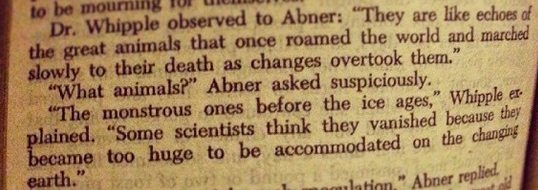
    Hawaii

    The changes could be the ones we’re causing nature to make and ‘huge’ could be our gluttonous consumption of resources. In the context of robotics and morality, I immediately thought of Asimov’s Zeroth Law “A robot may not harm humanity, or, by inaction, allow humanity to come to harm.” What would happen when one set of humans begin to do something that might harm humanity? What would a robot do?

    The answers, are evolving. It’s a good time to be human, and to be able to experience wonder.

    until next time, moral science

    P.S. On a  related note – Bicentennial Man – RIP Robin Williams :'(

  • Mammoth Book of Short Science Fiction Novels

    The book consists of 13 science fiction novellas all written between 1950 and 1980. At the outset, I am a bit disappointed that I didn’t like the book as much as I thought I would. The start was fantastic, with Isaac Asimov’s “Profession”, where he manages to narrate a story that’s universal and timeless. I wasn’t particularly impressed with John Campbell’s piece, though it was made into comics and movies. Lester Del Ray’s “For I am Jealous People” has an intriguing plot in which God abandons the human race and sides with aliens.

    “The Mortal and the Monster” by Gordon Dickson also proved too slow for my liking, and though well paced David Drake’s “Time Safari” seems jaded now that we are inundated with Jurassic monsters regularly on the screen. Phyllis Eisenstein’s “In the Western Tradition” is an interesting plot but from just a human angle.

    “The Alley Man” by Philip Jose Farmer was too convoluted and slow for me, but I found the concept of John Jakes’ The sellers of the dream” very intriguing. Donald Kingsbury’s “The Moon Goddess and the Son” was another extended work and I gave up on Barry Longyear’s “Enemy Mine” after a few pages. Larry Niven’s “Flash Crowd” had teleportation which I have always found interesting and it helped that it was a fast moving plot. Frederik Pohl’s “In the Problem Pit” was also just barely there but the book ended reasonably well with Robert Silverberg’s “The Desert of Stolen Dreams”.

    There were indeed many stories which I would rate as good science fiction, but there were too many universal human condition stories which were science fiction only because of a setting which then faded into insignificance. There were also a couple of fantasy works which seemed to be masquerading as science fiction. I would say that the “Science Fiction Treasury” edited by Isaac Asimov is a much better read. But it’s still amazing to see many of the concepts spread between what is now reality, or aspirational or still science fiction.

  • More on the Uncertainty Principles

    Ok, so it’s not long back that I wrote about uncertainty, but in this real time world, I can’t blame myself for thinking of it on a regular basis. I wonder if it also has to do with the macro environment I grew up in – the typical 80s kid in India, whose ‘options’ across the board – from movie heroes to restaurants to soaps and television channels usually boiled down to one. (remember?)

    From my own experiences, I know it is possible even now, but it’s a choice and a very difficult one at that, and one that might be difficult to reverse later. An extended trip to Kerala sometime back- home, made me realise that there are those who have made that choice, or rather, have for some reason remained in a lifestyle with minimum choices. Belonging to an earlier generation, but who have refused to let the ever changing world rock their boat. It isn’t that the boat isn’t rocked regularly in their ‘small’ world, but the rocking seems to happen within a framework – as though there is some tacit understanding with the cosmos, a reward for not adding to the cosmos’ complications.

    Uncertainty has a permanent live-in arrangement with most of us, and now dictates the relationship so much that we take it as a given. I am not a comfortable partner, but for various reasons, can’t do much about it. I wondered what the future would hold. As is becoming a practice with me, I found interesting perspectives in the book I was reading – ‘The Mammoth Book of Short Science Fiction Novels’.

    Asimov’s “Profession” had a world where a person’s station in life, and life itself is dictated by certain tests he undergoes at 2-3 points in life – Reading Day, Education Day and every individual is slotted basis the result of these tests. (not exams, mental examinations which figure out the natural aptitude of the individual’s brain) John Jakes’ “The Sellers of the Dream” has a world where companies sell a ‘fashion’ for a season, which includes physical and mental changes done to an individual and changes his/her personality. But in Larry Niven’s “Flash Crowd”, one of my favourites, I sensed the best summation of our current status “For each human being, there is an optimum ratio between change and stasis. Too little change, he grows bored. Too little stability, he panics and loses his ability to adapt.”

    I wonder if this is timeless, and am not too certain that the last sentence on losing the ability to adapt is very encouraging.

    until next time, certain tees I can’t live without