Tag: iPhone

  • Weekly Top 5

    This week's updates include iPhone's 4 years of existence, Skype's announcement of an iPad app, Fring's video chat on iPad, Apple suing Samsung; Twitter's Promoted Tweets in the stream, Twitter for Newsrooms, the Obvious Corporation; Facebook's growth, Winklevoss d

    isputes, new designs and ad formats, LivingSocial's acquisitions, market share and IPO, Yelp's new features, Facebook Deals rollout; Google's Transparency Report, wdyl, Swiffy, Google+, Google Health and PowerMeter shutdown, and the roll out of +1.
    [scribd id=59098367 key=key-iblblh8x1kp4k0k6xp3 mode=list]

    zp8497586rq
  • Weekly Top 5

    This week’s stories include Twitter’s Local Trends, expansion and plans to acquire Tweetdeck, Living Social’s and Groupon’s moves in the Deals space, Foursquare Day statistics and Loopt’s Q’s, Google’s quarter results, GMail features, and some Apple news.

    [scribd id=53596043 key=key-mgn8qcsutn18ez3wvb3 mode=list]

  • Weekly Top 5

    [scribd id=51588949 key=key-46fgvef6f50df3m562g mode=list]

  • Content, Media, Distribution

    I read an interesting post at Social Media Explorer titled ‘Is content marketing the new advertising‘. More than the specific subject itself, which I write about occasionally, it made me wonder about the various entities that seem to be vying for the marketer’s attention. So even if we do limit ourselves to the thought that brands (and businesses) would create their own content, how does the distribution work?

    I remember writing about this a few weeks back, and asking whether content is merely a titular king and distribution is the real power. Its ironic because much of the power of the web’s second wave is in the ability to create content and distribute it fast. But over a period of time, the platforms we use for sharing have undergone a consolidation. The presence of traditional media outlets and brands on these platforms validate this.

    Now if we zoom out further and consider the various other things that are making their presence felt – social gaming, location based services (check out the Foursquare-Pepsi and SCNGR-Coke deals, and the new contexts of advertising they’re creating), group buying; apps on iPhone/ iPad (Murdoch and Branson are making a newspaper/magazine specifically for iPad) and Android. (do add on) This is in addition to the terrains that the incumbents – Google, Facebook, Apple, Twitter will discover and develop at least for some more time, and the technological possibilities that will arise. (eg. Augmented Reality, and the return of QR codes) Each of them are building their own distribution systems, and its difficult to bundle all the ‘content’ that appears on them under one umbrella. And that’s only the digital world.

    All of this also makes me think of destination sites. I can count mine on one hand. Every other consumption is via Reader/Twitter/Facebook and occasionally email. When the web (and its consumption) is rebuilt around people and their connections, what value does a destination site (belonging to a brand) add? How does the brand deal with fragmentation? The good news for the brands is that there are many more options than ever before. Not every campaign needs to be a TVC, radio spot, newspaper ad, site banner. There are smaller, more scalable and more flexible options. The challenge is to find them, and develop things that enable them to connect with the consumers. We live in interesting times indeed.

    until next time, many kings and many thrones

  • Beyond run-of-the-mill

    ..and I took a look at the last few posts and realised, that the excitement of the Facebook -Google- Twitter three way fight was making me obsessed, and I figured you guys would like a break from that too. Thankfully, I came across two activities, that I thought showed a fundamental way of approaching the internet as a medium.

    At a basic level, the internet (and mobile) differ from say, print, OOH, television and even radio (in spite of call ins) simply because it allows two way expression. And if we go meta on that, even the internet, like other media, is after all a tool, as far as brands go. Its just that in many cases, its a much better enabler than the others because of its features. So, Facebook, Twitter etc are only tools – I have to keep reminding myself of that. The two examples below have shown how to use the web to increase the utility and value they are offering consumers. I liked these two all the more, because while they have presence on the usual suspects, these activities do not use the services.

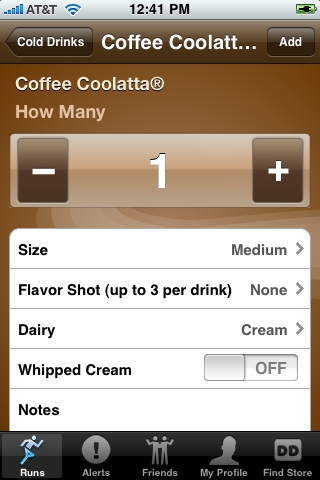
    Some of you would’ve read about the Dunkin’ Run iPhone app and website by now. For those who haven’t here’s the gist. Going out for coffee? Want to get your friends something too, but can’t be bothered to remember their order? You become the ‘Runner’, and use the app/website to initiate a group order. Your friends/colleagues ( a list you’ve made, and you can make different ones) get an interactive alert, and they can place the order online/app. If they’re registered users, they can even pick from their favourites/ previous orders. Once the list is made, take a print out/show it on the phone. Oh, okay, you can display the run status on facebook too. This is how the app looks on the phone

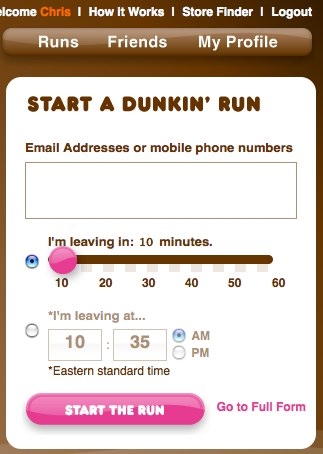
    dunkin dunkin1

    (Thank you, Chris Brogan, Mashable)

    ‘Run’ seems to be the operative word since the second example is to do with a product and activity right in that space. Nike. On Wired, I read about this excellent service called Nike+, which is now helping users track personal metrics and thus adding value. By using a sensor, and syncing an iPod to the website, (after the run) users can now track distance run, time taken, calories burned, weight lost etc and over a time period. These are displayed visually, on their profile, and it can be shared, and for extra motivation, users can even take up a challenge or set individual goals, and if that’s not enough, you can even create a list of people who could motivate you for completing it. They are updated about your progress. When i visited the India site, I could see a ticker that showed updates about various runners.

    According to Wired, “Nike has attracted the largest community of runners ever assembled—more than 1.2 million runners who have collectively tracked more than 130 million miles and burned more than 13 billion calories.” It has not only helped the users, but think about all that data Nike has, which it can use to provide even more value for customers and build better products. Amazing, I think I just might end up doing this stuff!!  Oh, okay, there’s a twitter app too – Twiike.

    Two ideas, which use the concept of sharing without needing the tools that I keep discussing here. A good reminder that while the tools race for users, and web domination, brands can quietly use the philosophy of web 2.0 and build communities around users through simple ideas and wonderful execution.

    until next time, Just Donut it 😉