
Tag: internet

  • We, the storytellers

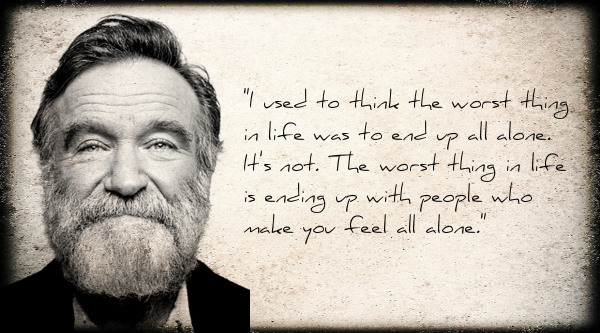
    The day after Robin Williams died, I had posted this on Facebook

    https://www.facebook.com/manu.prasad/posts/10152632582841798

    This was a man whom (I thought) no one could have any ill feeling towards. He made so many people forget their worries, for at least a while, through his roles. When you saw him, you couldn’t but smile. How could such a man have any troubles? But somewhere inside him, a story was being told, one that would end his life. In a tangential way, I had related it to “Everyone you meet is fighting a battle you know nothing about. Be kind” from the ‘One off a kind rating‘ post in which I had written of self perception, and compassion vs kindness.

    Once upon a time, I used to be very judgmental of people who chose suicide, but I realised over time that people are different. Some have the strength to deal with things, others don’t. But I still wonder about one facet of this decision. Barring the ones who end their life simply because they feel they have nothing/no one left worth living for, do people take this decision because they can’t live with something they have done/not done, or they are afraid of how people would judge them for this? In both cases, the common factor is the perception people have about themselves, and how it would change.

    That makes me think – how much of this self perception is built based on cues from others? I think this is very relevant in the era of social platforms, because these cues could come from a variety of people. Arguably, Facebook is already affecting our thinking and behaviour, in a warped version of the Hawthorne Effect. (a phenomenon whereby workers improve or modify an aspect of their behavior in response to the fact of change in their environment, rather than in response to the nature of the change itself. ) That’s probably why we largely see only happy stories on Facebook – because people know they’re being watched, and judged. How soon before this becomes the guiding principle in lives, their only cue for creating self perception? It can be argued that this was happening even before social platforms, but I think there is a difference in scale. If entire generations are spending more time on social platforms, their behaviour offline would probably soon start reflecting that. To stretch it, their sense of identity would be built online before being taken offline.

    When you connect this to the fact that the internet is also home to the kind of taunting and trolling that can radically alter one’s perception of the self, and one’s feeling of self worth, I see a problem. In the aftermath of Robin Williams’ death, the collective trolling power of the internet forced his daughter off several social platforms, at least for a while. Paul Carr wrote about a generation – born before the 90s – that should count itself lucky to remember a time before such acts became the norm. I think the power each one of us has to influence the stories others tell themselves is massively magnified now, if only we could use that to be less judgmental and more compassionate. Maybe that will also affect the stories we tell ourselves.
    Clipboard1


  • The narratives of our lives

    This wonderful post at Ribbonfarm got me thinking about places as narratives. Specifically, it reminded of something I wrote a few years ago on the subject – Watermark. The conclusion of the post that got me thinking was this – The space we inhabit is more topological than ever as we locate our positions within networks instead of maps and this may be the most true narrative about the present age: No matter where in the networked world we’re coming from or traveling to, we’re already there.

    Indeed, places were probably the earliest narrative that existed – in our early days as a species, we probably didn’t move away much from the place we were born. As civilisation evolved, I think many more institutional narratives were added – religion, nation, culture, and so on. In the era of consumption, even brands (media and otherwise) have attempted to invade the space. For example, in our own lives, there are many narratives that we consciously or otherwise become part of – the kind of books we read, the music we listen to, the movies we watch – in short, popular culture. Each generation has its own set – from Ramayan on TV to Facebook.

    Sometime back, I had written about the internet being the zeroth place – the one that supersedes all the other places, including the physical ones, in our life. Especially with a social layer, it has the capability to accommodate all our narratives – individual and societal. The Ribbonfarm post talks about how the default nature of the digitised era is to store, and no matter how much data our society manages to produce, we’re even better at finding places to keep it. In that sense, it isn’t just geography that the internet seems to have removed as a driver, but time itself. The other day, when I was reading The Confusion, I happened to read a post from 2005 which summed up how I felt about The Baroque Cycle in general. Yes, I tweeted about it. 🙂 But I still can’t be sure about the evolution, and wonder if the abundance of storage might drive us to consciously seek out ways where the information will not be stored. eg. the rise of Snapchat.

    I have always felt that narratives are a way to fulfill our sense of belonging. Across time, this role has been played by several entities. The internet has made it possible for even the smallest of niches to have its own narrative. Where does it go from here?

    until next time, comment on the narration? 🙂

  • Brands – real and virtual frontiers

    A few months back, I had written about the Balkanisation of the internet, in which I had asked how a  brand could deal with the surge of not just new services, but new platforms too. A few days back, I thought of this from a (slightly oblique) user point of view and remembered incidents spread across years – a few years back, one morning, when I was thankful on seeing a CCD in Colva, Goa while I was hunting for breakfast options because I knew exactly what to expect in a CCD menu; last year, when I visited a mall in Cochin, and realised that I could more or less predict the brands that would be present there; on television, the increasing popularity of US TV shows and how channels seem to be working to sync a global audience in terms of seasons; (forget torrents for now) and how, a meme on Twitter or Facebook is many a time global in appeal and interesting apps on iPhone/Android platforms are discussion points across geographies and in general, an increasingly growing population is 'in touch' and having similar sensibilities.

    The themes here from the real world experiences to virtual ones are homogeneity, and of a user's preference (in many cases) for familiarity. Which makes me turn back the question on balkanisation

    lectronic Repair Information'>Electronic Repair Information

    . Despite the balkanisation, do new platforms accelerate a homogeneity within a certain demographic?  The rate of upward mobility notwithstanding, do you think, at some point, popular culture and preferences will become homogenous globally? eg. say Angry Birds, Dexter, Bieber hatred…

    Meanwhile, since the time I switched to Android – a few months ago, I have noticed that services like Facebook, Twitter, 4sq and the Google range, are working hard to ensure that users can move seamlessly across different platforms – web, mobile web, apps, tablets. While that doesn't absolve the brands from having to understand the workings of different platforms, consumption patterns and how they could provide the user an interesting experience in these contexts, it does provide some relief.

    Few brands have been known to get regional nuances right in communication. Now, along with location and location based marketing becoming center-stage, there is an added challenge. Not only do they have to get the nuances right in their communication, but they also have to provide consistency in the value offering (not the same as being static) in experiences across platforms. That is a long stretch from blasting messages across traditional media platforms.

    until next time, brand-owned platforms?

    zp8497586rq
    zp8497586rq