Tag: Instablogs

  • Broken News models

    The Iran crisis once again brought the present day tools of news gathering into the limelight, even while highlighting the inadequacies of traditional media. From real time tools like PicBrk to spoof ads and stories, the tools became the focal point of the protests. It was as much about changes in news gathering as it was about the ability to share, both in real time, a skill that traditional is yet to pick up, in spite of ‘breaking news’ on television. The significance of Twitter’s contribution can be gauged from the fact that the US government asked Twitter to postpone its scheduled maintenance so as not to disrupt the flow of news from Iran. The inability of traditional news gathering and distribution systems to come to terms with real time media consumption, and their usage of social media as yet another broadcast medium was highlighted at the 140 Characters Conference (#140conf). All this makes me consider, yet again, the future of traditional media systems and conglomerates, especially newspapers.

    A few days back, I read about the Associated Press issuing social media guidelines to its staff – not to show political affiliations, or post views on contentious issues among other things. The ‘best’ part is that they also have to monitor their profile to ensure that comments by others do not violate AP standards!! Ahmadinejad Press? Here’s the policy in its awesome entirety.

    It’s been quite a fun week, with a speech by Dow Jones Chief Executive Les Hinton – also the publisher of the WSJ, adding to the amazing show of perspective. He described Google as a giant vampire that was sucking the blood of the newspaper industry. Now, I have reasons enough of my own to be cross with the omnipotent Google, but  even assuming that it is a vampire, who showed them the “X – blood here” sign in the first place? While Google states that its mission is to give readers more perspective by aggregating news from different sources, and even directs clicks to the newspaper sites. Newspapers argue that these clicks are nowhere near to the visits (and revenue) that they’d have gained if people came directly to their websites. They also have a problem with ads appearing on the side when people search for news. (Source) I have actually not come across those, and Google News definitely doesnt have them anyway.

    That is context enough for an interesting article I saw on Adage – ” Why ‘Going Galt’ isn’t the solution for newspapers”. The article is in light of the digital startegy of The Newport Daily News in Rhode Island, that’s closing its ad supported site and selling digital subscription only. John Galt, meanwhile, doesn’t need introduction for Ayn Rand readers, but if you are asking “Who is John Galt”, catch up here. In this context, it means that newspapers stop creating content for aggregators to pick up and make money. As the article points out, its chances of success is only when it deals with news that’s not commodity – could be specific locality/genre where there aren’t competitors. Its quite easy for newspapers to stop Google from taking its content – a 2 line code, as has been pointed out regularly.

    Cody Brown has an excellent article which shows the inherent differences between print and online, in terms of how news is processed. To summarise, print uses batch processing, where news and rumours are sifted through, verified and reverified and the crux is the final output and the credibility of the publication. The web, uses real time processing, it works like a gigantic wiki, everyone contributes, the crowd corrects, and the final output is of relatively less importance. The flaws of one become the benefits of the other. Batch processing finds few takers in the age of real time, and as this article points out so correctly, Twitter is the fastest way to get informed, or misinformed. This explains why I see stuff on my networks, and immediately move to a rediff/Google News to immediately verify from a trusted source.

    So newspapers face a double whammy. On one hand, its news creation is facing obsolescence in the face of changing media consumption habits, and on the other hand, it cannot find ways to make enough revenue out of the content that it ‘painstakingly’ produces. There are of course, traditional players who are bucking this, but as this article makes a case for, there can only be one Apple, who is an un-Google. I am still trying to fit in this understanding with the David – Goliath model. Apple operates so differently from Google, that it would be easy to summarily dismiss them as non-competitors, but there’s more to it. That’s for later, but the idea seems to be not to be a better Goliath, but to be the best David and play by rules that would take Goliath enough time to figure out, for David to finish the game.

    A small note on the Indian scene.  We are perhaps a few years away from the mess that US newspapers are in,   But consider, a Galt stance would’ve been possible a few years back, but with players as diverse as Rediff and Instablogs having a mechanism of reporting, it would be a folly to even try now. Rediff has built services and business models that doesn’t leave them to the mercy of making money out of news. Instablogs is also figuring out revenue models, at obviously lesser costs. Technology and faster news delivery platforms will appear, its inevitable. Newspapers in india  need to replicate their real world credibility online very fast, understand ‘real time’ game rules, and evolve radically new business models if they don’t want to repeat the US scenario. For ““News doesn’t break, it tweets”, the TC article credits Paul Saffo as saying.

    until next time, notice how many newspapers have ‘Times’ in their name? Real time? 😉

  • News..yes. Papers?

    Rupert Murdoch recently stated that the doomsayers predicting the end of the newspaper industry are off the mark. According to him, online readers also need news form a source that they can trust, and that’s what newspapers have always been doing. He agreed though, that newspapers would have to change from the ‘one size fits all’ approach to cater to readers’ demands. He mentioned his plans for WSJ, to offer three tiers of online content: free news, a subscriber-level service, and a third “premium service” of reader-customizable “high-end financial news and analysis.”

    The newspaper, or a very close electronic cousin, will always be around. It may not be thrown on your front doorstep the way it is today.

    On the whole, I tend to agree with him. However, I also feel that newspapers would be missing the point,  if they see this as just a change of platform. Its a mindset change, not just in terms of news delivery, but also in the way they approach business. After all, even the biggest names, like NYT , Gannett (publisher of USA Today) , are not in the pink of financial health.

    Before we get to that, a few varied ‘heritage media’ (print) trends. On one hand, we have publications like Christian Science Monitor and PC Magazine and many others switching to a primarily online only presence. On the other hand, the NYT opened up a couple of APIs, releases an AIR based news reader, the Guardian buys PaidContent, and offers full text RSS feeds, the Financial Times’ new site design resembles a blog, and some magazines are even rolling out Instant Messaging functionality. Over to India, Live Mint and Business Standard have recently launched podcasting (via WATBlog), India Today added Cosmopolitan to their existing list of digital properties and Business Standard has launched a branded Instant Messenger – BS Buddy (via Medianama). In essence, newspapers and magazines seem to be looking a bit more seriously at making the transformation from real to virtual.

    So this is a good question to ask – what’s the next step for news? To start with, they could take a good look at this list of 10 things that every Newspaper/Magazine site must do. This itself would be completely against a few things that they’d consider sacred – most notably, link sharing and responding to comments. Broadly, I’d imagine it to be a two pronged approach

    • figure out how to deliver their content on digital platforms, and that might even lead to changes in the kind of content they gather, and the way they gather it.
    • figure out a business model that can leverage the content they have – subscription/ advertising/ both.

    First the content aspect. A lot of publications have been experimenting with citizen journalism. They’d do well to check out tools like CoverItLive. Instead of randomly adding a ‘blog’ section to the website, make it work. Get enthusiastic journalists to blog. Get regular bloggers to do guest columns on specific topics of their interest. Promote them and the content they add to the site. This would help them being aggregators who also serve niche interest communities. What is equally important is to bring about a systemic approach to making journalists regard their story as just a start, and getting them to take ownership of making it a conversation. There are advantages in it for them – new story ideas as well as a better understanding of their readers. Yes, Twitter can help in the conversations too. These changes in news gathering techniques might very well change the quantity and quality of newsroom staff. This makes a great case study.

    The business aspect. I read a a very insightful article on how the entry of print publications into the digital medium will change the balance of power and wealth in the link economy. This process has already started. But before that, I think they have to see themselves as news sources, rather than just the newspaper on the web. This would influence how and where they position their ads, and would help them deliver better value to advertisers, as well as readers. While on this subject, I think online ad networks that include newspapers (with various editions and publications) along with independent blog/ blog networks that complement/add on to their content, might make sense. I remember NYT making a sort of conglomerate in association with 3 other newspapers, sometime back. There are other business models too. For example, there are community funded reporting services like Spot.us. (via RWW) Do check out this link for a very radical approach.

    Though readership of dailies (with very few exceptions) continue to drop, I don’t think newspapers are in their death throes in India. But should they wait for that? A good brand takes some time to build. There’s a reason why more people in India visit Rediff and Yahoo and even the web 18 properties than Indiatimes/ Times of India group properties. I’m hoping to see something like Instablogs join the big league soon. Brand loyalty in the real world need not translate into brand loyalty in the virtual world, especially when you’re dealing with a (by now) commodity called news. And as newspapers would know from their real experiences, once readers are used to a certain way of consuming content, it’s difficult for a competitor to sneak in. It would pay well to learn from mistakes – of those aborad who might have waited too long to transform. After all, what doesn’t kill you doesn’t necessarily have to make you stronger. And I’m not sure if newspapers would like to be part of the thin end of the long tail of news consumption, with pure play web entities occupying the head.

    until next time, save paper, save the environment 🙂

  • Making it Really Simple

    Forrester has a new study ‘What’s holding RSS back?’ According to the report, RSS usage is at 11%, and most people don’t use it because they can’t see its relevance in their lives. You can get some good snapshots of the report here.

    Now, I realise that because of the contents of this blog, a lot of readers (at least about 40 odd ) understand RSS. For those who don’t I’ll attempt a bit of evangelism, at the end of this post. Meanwhile, Mashable has an interesting take on the report. While I agree that the usage might be much higher and that most sites have it in some form or the other, they don’t necessarily have the user consciously utilising it. Facebook’s news feed is a typical example. So, I would side with this view on the geekiness of RSS. I started subscribing to feeds only about a year back, and gave an RSS feed for my blog much later. So, I can identify with the intimidation some might feel with regards to feeds and RSS and subscribing… On an aside, if you asked people in India about RSS, we’d most likely have strong opinions on it, but that’s only because there’s a Hindu nationalist party by that name. 😉

    However, the best tangential take on this report that I read happens to be here. In addition to a take on the entire subject, this post points out that newspapers could have a great role in making RSS mainstream. This is because newspapers have always been aggregators and have learnt the art of packaging the commodity called ‘news’. The packaging results from an understanding of the consumer’s needs. This is all the more interesting since a new PWC study says that traditional media has about 5 years left, before the death clock kicks in (varies for different markets) I’m wondering though, whether this role would be  equally applicable to other traditional media – radio and TV. While newspapers might start out as favourites, increasing fragmentation could redefine media preferences. TV, for example, could provide all that the newspaper’s online version does, and add a visual angle to it. The difference between reading about Chandrayaan (India’s lunar mission) and watching it. Do you think that once news becomes a commodity (as it has online) TV has a competitive advantage over newspapers? (among traditional media players) Or is it going to be a pure play new media player like say, Instablogs, who will steal their thunder?

    until next time, subscribe 🙂

    and now, for some

    RSS Evangelism

    Why would you need RSS?

    When you started browsing around the net, you would have liked a few sites and you could track them daily to see if there was something interesting. Over time, the number of favourites grew and sometimes you’re missing on good content because you forgot to check. Even if you didn’t forget, it would be a pain to keep checking all the while. What if you could have a tool that would alert you when your favourite site was updated?

    Yeah?

    Yeah. These tools are called readers. It can be web based or desktop based. For now, I’ll stick to the web based type. There are several sites which offer this service (its for free). Pageflakes, Yahoo, and the example I’m going to use – Google Reader.

    So how do we start?

    Click on this link which will open a new window – Google Reader. If you have an existing GMail account, you can use that, else you’d have to create a Google account first. Once you login for the first time, Google has a fairly good tutorial on how to use it. But I’ll still do a bit of explanation. How does Google know which are the sites you need to get updates about? You have to connect your fave sites with Google, so that it picks up the updates from there. This is called subscription.

    How do you do that?

    On the left panel of your Reader page, you’ll see a button ‘Add Subscription’. Here’s where you need to enter the url of your favourite site. Shameless that I am, I shall use the example of this blog. The url is www.manuscrypts.com/brants . Once you type it and press enter, the ‘feed’ of this blog gets added to your reader. You can see it on the left. And the next time you log in, it will have the number of  new updates in brackets.

    Sometimes you would come across a blog, like it, but would be too lazy to log in to the reader or remember the site. Most sites now would have a button that looks like this or a variation of this (like the button on top of this page), or even this . Click on the button, and then you would see an ‘Add to Google’, ‘Subscribe with Google’ or Click on this, and it would take you to a page that gives you a choice between Homepage and Reader. Since we’ve set this up on Reader, click that and you’ll be asked to log in. See, it pays not to be lazy 😉   So, keep adding sites and checking your Reader regularly. You can do many things lime sharing some items with your GMail friends (using the share button at the end of each post) , organising your favorite sites into folders like say, Personal Blogs’,  ‘brands’, ‘social media’ etc.  It might look like a big deal or a difficult thing to do now, but trust me, it will add a whole new dimension to your browsing and time management. In case you get stuck, shoot me a mail – manuscrypts @ gmail dot com, and I’ll help you out. 🙂

  • Virtual Fourth Estate

    A few articles that have to do with newspapers caught my attention in the last couple of weeks. One was the fact that Instablogs, is doing something I desperately wished it would do – opening the network for external blogs. I personally consider Instablogs a good benchmark for what online news sources should be,  going forward. If you haven’t checked out Instablogs yet, now would be about time!!

    The second was an article on whether we need editors anymore. That question would be quite controversial in any case, but it helps when The Guardian asks this. It is quite a compelling read, and makes some telling points, on how editors should evolve in the digital era. I think that it also points to a mindset change in the newsroom and the presentation of news, because the way news is consumed is also changing. “Reporting becomes a process more than a product” and thats a fundamental shift in the way newspapers approach the business. Here’s a great read on the subject. It is sad to see how newspapers, with some of the best resources, are not able to channel it to better use on the internet. This is a perfect example for what I’m trying to say. Now, once you’ve thought about all this, check out Instablogs’ tour. It might explain why I find the site awesome.

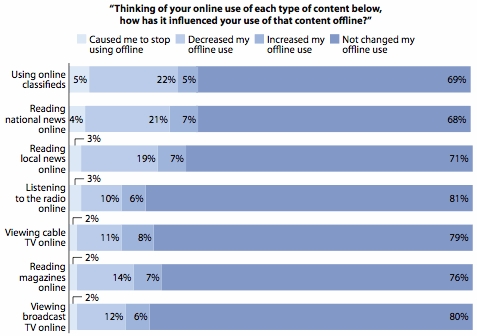
    Why is it important for newspapers to address the digital mindset issue? This data, (via here) though pertaining to the US shows how blogs and the online medium in general is making inroads into what was till now, the newspapers’ domain.

    While, with a 4.5% penetration, newspapers aren’t exactly on a ‘near-death spiral’ in India, I believe it still might be just a matter of ‘when’ rather than ‘if’. Speaking of which, the last article I wanted to discuss was one on WATBlog about Indiatimes’ launch of Hotklix, a Digg like service. Like I commented there, it would’ve been a great way for TOI, ET and all the publications of the Times Group to showcase the loads of content that they possess. How about seeding articles on a daily basis? Where is the integration of the TOI, ET websites with Hotklix, where I can bookmark an article immediately after I read it?

    On an aside, there are traditional news networks doing some pretty cool things on the web. CNN, for example, is allowing users to embed videos in blogs social media etc. No, that’s not a newspaper, I know, but it does come under ‘traditional media’. But even CNN received some flak a couple of weeks back. CNN is present on Twitter, and I happened to see this article, where a few users got pissed off with them for spoiling their Olympic fun. But that doesn’t stop the mashups. Take a look at Dialogg, their collaborative effort with Digg.

    Given that newsprint costs are rising, all over the world, and people are increasingly raising an uproar over cutting down of trees, I think its about time that newspapers took a long hard look at how the digital medium is transforming the content landscape. After all, we even have sanskrit newspapers going online. By digital, I don’t mean just the web, it could be the mobile too. 9.22 million subscribers have been added this month. I would like to compare it with the circulation additions for newspapers. Meanwhile, just read about an effort – MeraMobi, by the Dainik Bhaskar group in association with Pitroda Group LLC.

    Traditional media, especially newspapers, world over, have painstakingly created an equity and trust factor that’s extremely relevant in a transparency and trust led digital era, it would be sad to see it wasted. After all, with increasing global warming fears, newspapers might soon occupy the space that furs occupy now, so it might make sense to hunt for some virtual fourth estate.

    until next time, read….online? 😉

  • Marching to different beats

    I read an article today on LiveMint, which deals with creating UGC for TV and Radio. Well, for starters, I think its already being done. The polls, the debates etc on news channels, and more importantly, the reality shows, are all user generated content. Of course, the packaging differs because unlike the net, time is also a factor on these platforms. 24 hours vs what content to put there.

    It also took me back this post, where I’d talked about the relevance of mass media to pure play internet entities. In a warped sense, I’d agree with the article that in a true convergence era, a medium like the internet, which has already absorbed user participation as one of its tenets, would play a larger role in shaping media consumption. So much so, that going forward, I’d bet heavily on an entity like Instablogs, which would find it easier to adopt to platforms like the television or radio. Yes, they got funded too, isn’t that just awesome?

    Which also brings me to another layer of thought, something I’ve touched upon earlier, if mass media entities want to test out the wild wild web and the currently hot social media scene, and what it could do for them, what is the better way of doing it – creating their own scene or leveraging existing popular platforms. I came across examples of both kinds today.

    While NYT is perhaps the best newspaper website in the world, it also plays a bit on social media (check out this facebook app). And today I read about the partnership it had entered into with LinkedIn. LinkedIn users will now get their industry related news from the relevant sections of the NYT site, and these news will have a share option. I think that’s an absolutely great way for LinkedIn to give a good value add to its users, and also stimulate conversations and for NYT, it creates a lot of relevance to the user, and will increase the website’s pull. That’s NYT’s way of leveraging a relevant social business network.

    The other thing that I came across is Radio City’s new website. (thanks to @thej) I haven’t done a complete tour yet, but it seems like they are primarily aiming at build communities there – a section called ‘Friends of Music’ has blogging, groups, finding colleagues(?!) and catching up with others attending gigs. In fact, the profile is also very orkut/facebook, and shows options for picking friends based on geography/music taste/school/workplace. Yes, i cringed at the last two too! It also has a calendar with some events already updated, and even has a karaoke section.  There is also an option to upload videos (upto 20MB) In addition, it attempts a Yahoo Launch by allowing you to create your own station by adding tracks. But I think it is also a way to take ownership of the music space – there is a musicopedia, a lyrics finder, a music news reporter and so on, which aims at making this the one stop resource for music in India. Yes, you can also listen to popular tracks, and stations created by users/ pre packaged ones (eg. KK, Alka Yagnik, though the content in this is limted, as of now). In essence, a decent effort, for trying the music ownership strategy, though from a new media perspective, I’d have liked more focus and efforts on podcasts (like Big FM), a talk show platform, better forums etc, instead of all that work on the orkut style social networking.(classmates and colleagues)

    While I’d usually go with leveraging existing social media, i think  a part of Radio City’s route does have its benefits, given the popularity of music and Bollywood in India, and its potential for creating communities especially with the context that Radio City offers. What they do beyond this would be the really interesting part.

    until next time, tuned in