
Tag: innovation

  • A culture of innovation

    More than four years ago, I’d written a post juxtaposing product and consumer life cycles wondering how products could evolve, yet be relevant to users at various stages of their usage maturity. Personalisation as a theme has advanced much since then, and web based services are definitely closer to cracking this. I also got a perspective from Jeff Bezos in this post All businesses need to be young forever. If your customer base ages with you, you’re Woolworth’s” though I’d take it with a pinch of context.

    But when disruption is the norm and technologies like 3D Printing and themes like the Collaborative Economy (and others) are poised to have an impact on an increasing number of business models, how does a brand pace its innovation? Branding Strategy Insider asked a relevant question on this premise – Can brands innovate too soon? The post quotes Michael Schrage in providing a good perspective “Your own rate of change is determined less by the quality or price/performance of your offerings than the measurable readiness of your customers and clients … Their inertia matters more than your momentum.

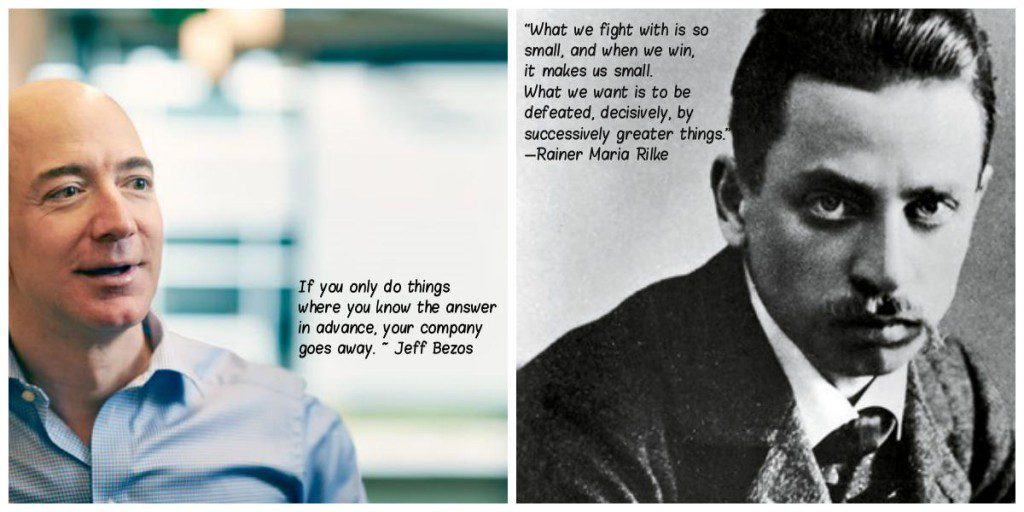
    This post I came across cites a research by Forrester which points out that most innovations remain incremental in impact, rather than being radical innovation..Companies often ‘innovate’ things customers don’t even want. The post suggests a simple cyclical framework of Learn (strategy) – Make (technology) – Test. (design) A more nuanced view (and framework) of innovation can be found at Digital Tonto. Bezos once again has a take on it “We innovate by starting with the customer and working backwards. That becomes the touchstone for how we invent.

    Social technologies provide multiple ways for an organisation to simulate scenarios and structure their innovation pathways in ways that will optimise customer benefits and business objectives. In fact, I believe that the responsive organisation (via) will soon become a strategic imperative. As quoted in that post “If the rate of change on the outside exceeds the rate of change on the inside, the end is near.” I also think that the biggest challenge in this entire movement is a mindset-culture lag. In a sense, all the so-termed disruptions happen because incumbents were not agile enough to adapt to a rapidly changing environment. There is some wonderful learning from the founder of Sonar in this post titled “Postmortem of a Venture-backed Startup” One of may favourites is “Think of culture as a cofounder that is present when you are not.” The thing is, it can work both ways! A cultural mindset to experiment, fail, pick yourself up and work harder, and win is probably what will define the winning institutions of the future.
    collage1

    until next time, “It is not the strongest of the species that survives, nor the most intelligent, but the one most responsive to change.” ~ Charles Darwin

  • Thatva

    Thatva’s objective is to create a systematic process and a structured framework that would help innovators grow their ideas into innovations. In conversation with co-founder Sridhar DP

    [scribd id=124527521 key=key-1kq3e9qdc8xv0ihljp6a mode=scroll]

  • All hands on deck

    Since tis still the season of predictions and ‘looking forward to in 2011’, and because I brought up the subject of brand agencies reshaping themselves for the future, I thought I’d share with you three of my favourite decks of insights from the many that I managed to scan in the last few weeks.

    We’ll begin with JWT’s ‘100 Things to Watch in 2011’. (via Surekha on Reader) While there are many things in this that you might already think is a trend, what I liked about it is its thinking outside of any specific prisms – brands, technology etc, but still managing to capture the  essence of trends in human behaviour, culture, consumption, the shifts happening therein, and thus, a good reckoner for marketers.

    The second one I’d like to share is Edelman’s ‘Digital Trends to Watch in 2011’. Though there are a few commonalities with the JWT deck, this seems more focused. While this is definitely quite a sensible thing to do from a client perspective, I missed the “completely out of the blue, but damn, why didn’t I think of it?” moments that I usually associate with its creators. But that’s just a testament to my high regards for Armano and Rubel, more than anything else. What I liked most about this was the trend + best practice combining, that layering gives excellent perspective.

    The last one I’d like to share is Rohit Bhargava’s ’15 Marketing & Social Trends to watch in 2011′ (via Gauravonomics). There might be some overlap with the other two, but again, the idea of examples with each trend makes it a must-read, in addition to the overall quality of insights.

    While its easy to see that there are commonalities in these, I also noticed an interesting thread of thought that  resonated most with me.

    ‘There’s an app for everything everywhere’ is perhaps the underlying theme in #3 (Apps Beyond Mobile), #7 (Ubiquitous Social Computing, more specifically its best practice) and #9 (Appification of the web) in the JWT, Edelman and Rohit presentations. We then move on to ‘production of consumable content and experiences across platforms’  that connects #93 (Transmedia Producers – faint connection), #4 (Transmedia storytelling) in the JWT and Edelman presentations respectively. And at last, we move on to how it can scale which is brought out through #3 (Developer engagement) in Edelman’s presentation and #7 (Crowdsourced innovation) and #11 (Employees as heroes) in Rohit Bhargava’s presentation.

    While I may not endorse a brand strategy only basis tools, the ‘appification’ across platforms actually throws open the door for marketers to not just satisfy their ‘short head’ consumers in better ways, but explore the ways to reach the ‘long tail’. It allows them to blend or distribute their ‘story’ across platforms and if done well, raise the interest level of their consumers. And an agency or brand manager cannot do it alone. While the idea of crowdsourcing is looked down upon by many, there are enough examples to show that if targeted well and executed with clarity, it can deliver results. More importantly, here, the ‘crowd’ is not consumers, but developers who can re-create the brand’s experience on multiple platforms, and employees who can create a human story that will resonate with others.

    If these possibilities for 2011 don’t excite you, I’ll try again next week, but I really don’t have any more of these awesome presentations to back me up.

    until next time, slide rules!

  • Add Sense

    Read a very nice article today on rediff, about Google’s nine innovation rules. Coming from Marissa Mayer, VP of search products and user experience, it underlines why Google’s offering always strike a chord with the audience. While I’m one of those who’re becoming increasingly uncomfortable with Google and its (non) privacy, and its journey away from ” Don’t be evil”, it still manages to get my attention, inspite of all the old enemies (eg. Yahoo with Flickr, del.icio.us, Answers etc)and new upstarts (eg.Facebook) at various boundaries of its kingdom.

    More than random preaching on innovative practices one hears during sermons, she manages to link innovation to simple philosophies that should ideally be practised by all workplaces which consider itself to be ‘innovation practitioners’. The 20% time for pet projects, the sharing network between employees, the treatment of data as apolitical, the idea generation processes all speak of a system which thrives on experimenting and trying out new things, and that, i guess is the reason why Google has reached where it is in such a small timeframe.

    Meanwhile, i was also influenced by the very first principle, ‘innovation, not instant perfection’. Its a difficult lesson to learn, especially for perfectionists (and wannabes 🙂 ), but it just might be a better way in the long run.

    until next time, go ogle