
Tag: influence

  • Brand agencies redux

    One of the ways to measure brand communication is to view it through the prisms of effectiveness and efficiency. I sometimes get the feeling that with time, mass media became more of an efficiency game. Then social technologies came along and forced the marketer to acknowledge (the forgotten) effectiveness criterion. That would explain the resistance to adoption, since communication strategy would have to change to accommodate it.

    A brand manager would ideally like a balance of both though. Meanwhile, somewhere on planet Quora, I voted up our friend Gautam Ghosh’s answer on ‘influence’. Apparently, an old HBR article (2005) had defined influence as a factor of two aspects – visibility and credibility. Considering that a brand is also aiming for influence, I found the connection between visibility/credibility and efficiency/effectiveness very interesting.

    I think the ROI debates are also a manifestation of seeking efficiency, though very few distinguish between cost and investment (I). The good news is that once tools are developed to address this, (I hope) brand custodians will focus on effectiveness too. I was very happy to read Jason Falls’ post about tools that are beginning to address scale too. (Expion and other social media tools to manage franchisee operations) While these tools would most likely scale themselves to accommodate new platforms and technologies that arise later, the bad news is that effectiveness is still something that can be judged only by someone who understands the brand as well as the platform in question.

    A quick detour. I recently started playing ‘Restaurant City’ just to get a feel of social games, and found Coke doing a pretty decent branding exercise there, that integrated well with the game mechanics and experience. The entire social gaming arena is already exploding. Farmville is passe, and Cityville is king. And that’s just one platform. How does a brand manager keep himself in the loop on all this, and experience enough to have reasonably good perspectives? So the idea of filtering experiences in multiple platforms to get perspectives on effectiveness is something I think only an agency can scale. And the more I think of this, the more I feel that this is the opportunity area for agencies – both communication (PR, Advertising) and media buying. I will state the obvious by saying that this is not likely to happen in their current avatars though. Your thoughts?

    until next time, agents of change
  • Influence Cycles

    The term ‘influencer’ is a recurring one in social media. Mahendra had a tongue-in-click post last week on the subject, and Surekha and I ended up taking it on a tangent, and it reminded me once again of the way ‘influence’ is changing, for all parties concerned – influenced, influencer, the object that links them and the medium that connects them.

    It was relatively easy when the medium was one way – mass media. The number of influencers were limited and there was really no way to locate or measure the individuals who made up the long tail of influencers. Or at least few were interested in doing it. The web disrupted it. The influenced found an abundance of content, the influencer saw his power being diminished by millions of publishers. The object (including the service provider/brand/organisation/group etc) figured out that it wasn’t at the mercy of limited influencers, but discovered a huge list which had its own quirks, but had the power to influence a multitude. Yes, known stuff, just summing up for context.

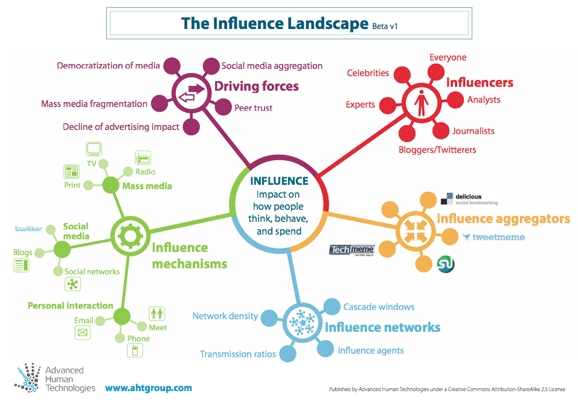
    I remember touching upon ‘social influencer relationship management’ (yes, there is actually a term for it) late last year, and the importance of trust. Influence, for me, has been a difficult thing to wrap my head around. There are so many factors erm, influencing it – time (specific and relative), context, trust (and objectivity) and the fast changing content platforms- each of which seems to add yet another layer. The complex structure has been well illustrated well in the chart below

    Influencer

    via ( a post similar to Mahendra’s, but more serious in tone 🙂 )

    At least in the medium term, I think its only going to get more complex, primarily because the platforms are only evolving – Quora, the service I mentioned in the comment to Mahendra’s post, for example, can help in establishing context specific expertise and therefore trust. Facebook, when its QnA service starts, will try to establish it within a known network. Twitter has already tried it too, but I agree with Surekha. I’ve noticed that with web platforms, after a certain scale is reached, the culture starts resembling that of mass (media) and the ‘influencers’ as well as ‘influenced’ begin a relationship that’s familiar from a mass media era. What also complicates is that the ‘object’ of the relationship sometimes discovers that it too has a voice or can hire a ‘voice’ and attempt influence. This is one of the ways it is trying to adapt to new platforms. But while there might be flaws in each approach, I do feel the direction is right.

    At this point in time, as a user, I’m still evolving in terms of the platforms I use to establish networks of trust. The tools available still don’t allow me the freedom to aggregate and disaggregate at will in different contexts. That’s probably something brands can identify with too, thanks to the plethora of platforms and influencers across networks. Its perhaps the difficult transition state when brands have to manage traditional communication outlets, new media barons, their own content management systems that need to evolve, and a long tail full of influencers. More importantly, brand processes (like advertising, PR etc) had evolved in a mass media milieu and a struggle to adapt to the disruptions brought around by a two way communication mechanism is what we see around now. We’ll keep that for another post, and quickly jump to an aspect that intrigues me from the four influence factors I mentioned earlier- that of time.

    Long back, I wondered how we could juxtapose product and consumer life cycles. Let me address it in this context. Different consumers will ‘reach’ the product/service at different points in its lifecycle. There is a ‘time divide’ that separates the different sets of users. The motivations of this set would differ and therefore , its influencers will also be different, as will their motivations. Brands (using it as a blanket term, includes services too) these days are constantly in the hunt for early influencers, which is why I found this article, which discusses why gadget manufacturers should target late adopters, very interesting. This could apply to platforms as well. I wonder how this thought can affect when and how brands try to influence on new media platforms. Does it make sense to wait till platforms evolve to an extent where they can work better for the brands or is technology moving way too fast and lifecycles of all concerned behaviours becoming too small to wait?

    Meanwhile, what if the millions who have never used Facebook are influenced by the movie? 😉

    until next time, in flux

    Bonus Read: I plan to riff on this soon, but in this context, you could check out pages 147-173 of this amazing document. (via Pluggd.in)