Tag: influence

  • Decrees of Influence

    ‘Influence’ as a subject has been popping up on this blog since 2010, the last post sometime in Feb 2014. In about half a dozen posts, I wrote about influence in the context of the landscape and complexities, visibility-credibility framing, the data driven approach and its challenges, ‘micro celebrity’ price tags, brands’ usage of influencers as media, and my talk on influence at #WIN14.

    Conceptually, I am all for “influencer marketing”. I know it can work in some contexts because of what we achieved with it in Myntra in 2012-13. But even further back, in 2010, thanks to a discussion on a post by Palsule, I realised that with web platforms, after a certain scale is reached, the culture starts resembling that of mass (media) and the ‘influencers’ as well as ‘influenced’ begin a relationship that’s familiar from a mass media era. (Influence Cycles(more…)

  • @ #WIN14

    BlogAdda and I go a long way back, practically to around the time they were born, and when I was asked to be a speaker at #WIN14, there really was no question of not going. The icing on the cake was being a part of this excellent list of speakers!

    My favourite talk of the day was delivered by one Kavi Arasu, who, first virtually and then really, has become a very good friend. As I tweeted

    Meanwhile, I was part of a session whose subject was ‘Influence of Blogging’ and my fellow speakers were Lakshmipathy Bhat and Anaggh! The areas I tried to cover in 15 minutes were the changing nature of influence, its effect on brands, how blogs can help in that context and how bloggers can create a market for themselves.  (does that explain the breathlessness? 😀 ) Do take a look and let me know your feedback.

    Shekhar Kapur made his presence felt in the second half by being his usual articulate self. His analogy of crests and troughs, and tsunamis, to explain media cycles, time, and social was just fantastic. He had the audience spellbound, and deservedly so.

    It was wonderful to meet people,  some of whom I knew online, but had never met – Anaggh, Maneesh, Kalyan, Ankita, Rakesh, and others whom I got acquainted with at the event   – Ravi Subramaniam, Ashwin Mushran, (what a fantastic compering role he played!) Anuradha Goyal, Amit Agarwal, Sampath Iyengar and Anil P.

    A big thanks to BlogAdda for putting together a great event (photos) and having me over, and to Courtyard by Marriott, who were great hosts!

  • Influence & Context

    Last week, I read two stories on influencers on sites that influence me. 😀 Since that’s a topic that has been seen here before (1,2,3) and it’s been a while since I’ve written about it, a couple of cents.

    YourStory’s post, I cheered, despite failing on their influencer scale, (of 5000 twitter followers) because it asked a very pertinent question – “Are brands being  held at ransom by Social Media Influencers?” I completely agree with Mekin’s tweet (cited there) on how it takes the twitterati only a few minutes to demolish years of hard work. Anyone who handles a brand account would relate to that. Expecting ‘influencers’ to mature and watch what they say is like expecting, say, a response from the nation’s leader. The other way to handle it is to be really good at what you do as a brand, be sure of yourself, be transparent, so that you can back up your tweets (no, not that kind of backup) with facts. (more)

    LHI’s post was about brands leveraging social influencers. Prasant (of LHI, but didn’t write this post) had commented in the YourStory post about contextual influence, and I quite agree with his views. In fact, my stance remains the same as when I wrote this. To sum it up, (in general, there are of course exceptions including whole domains) brands tend to treat influencers just as they treat traditional media. The more reach, the better, who cares about context? No offense meant, but I am not really influenced by the gentleman in the LHI story. Mercedes needn’t care about that because I’m not really their audience. But the entire episode makes a very good story, so if that was the intent, and not necessarily the person’s influence, opportunity well spotted, and a PR job well done!

    But if brands do treat influencers as media, how long will this party last, especially when people are already trying to correct their filter failure? (noise in the stream) Mass media’s  indisputable role in creating perception have been blunted in the web and social eras. Arguable, but I think, in a while, we’ll see a kind of flip. Folks would start figuring out their go-to people, when making consumption decisions. I already do that – in fact, I realised that with a few exceptions, everyone on this list is a go-to person for me! Not all of them have 5k followers, but in their domains, they’re #likeaboss. What has social contributed here – 90% of them were unknown to me before blogging/twitter, but if I am asked for a recommendation in their domains, I don’t have to think twice. I trust them, and this has been built over various interactions across time.

    In essence, using influencers would boil down to the intent of brands – mass reach or targeted reach (in this context) – for each activity. There are tons of ways to get reach on social media, in many ways it has already begun to resemble its media predecessors, but trusted sources remains a precious commodity. If brands earn and retain the trust of influencers in their domain – and they could only do that if they are really good at what they do – think of how it could help them when it comes to responding to those ransom calls.

    until next time, an affluence of followers 🙂

  • The price of influence

    Speaking of trust, between a corporation and consumers, one of the earliest controlled version of ‘outsourcing’ it was celebrity endorsements. I use ‘controlled’ because organic WOM is not really in the corporation’s control. Though it is still in vogue, the credibility is possibly dented thanks to abuse by the endorser, the endorsed and a media that creates more ways to make an a$$ of the end consumer. eg. passing off ads as content.

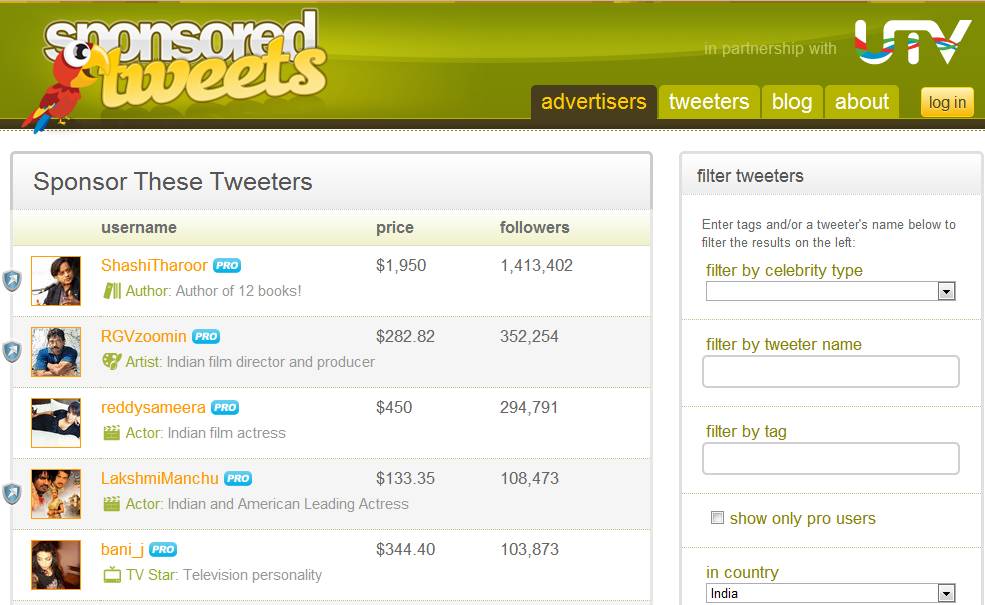
    In the era of social networks and lightweight interactions, the beneficiaries of this decline would be micro celebrities (MC from now) who have created their own circles of influence in specific domains. I remember writing about that – over 3 years back, and following it up later with influence cycles and the tool based influence calculations being used by brands for promotions. The platforms used by these celebrities could be any – twitter, blogs, Pinterest etc and it does allow the brand to customise their interactions basis the medium itself and with help from the MC, use the strengths of the medium to the hilt.

    I was hoping that it would evolve such that brands would identify MCs who would be connected to their own category and therefore would wield their influence among people interested in that category. But judging by the directions the platforms are taking, the equations seem to be becoming closer to the earlier forms of media, and ignoring the social aspect. When Vijay shared this and pinky-swore that he wasn’t playing an April Fool prank, I was even more convinced of the direction. Full circle. Hopefully the lessons will be fast, and the new cycle will begin soon. 🙂

    until next time, influenced?

  • Influence, Decision Making & Data

    It’s been just over a year since my last post on influence, but a couple of very interesting articles, and a few advances and observations makes this a good time to visit the subject. I am in touch with both the custodians of my influence these days – Klout and PeerIndex, and like to experiment with them. (the rise in Klout a few days back is the result of one such 🙂 ) They are obviously in early stages, which is probably why I think they can be gamed, despite their stout denials, and also why Klout considers me ‘influential’ on the topic of lottery. (thankfully Pakistan has been removed now)

    What I did find a bit disconcerting was the usage of these scores in brand strategy/promotions. (relevant link at the end of the post) The basic thought here is to identify ‘influencers’ and engage them for various purposes – from product design to communication, advocacy etc. Not a bad thought in itself, but I wonder if it is way too early in the evolution stage to try this out, because there are way too many variables, including trust, involved and many of them have probably not even been acknowledged, let alone tracked and measured.

    The consumer decision making process is itself undergoing massive shifts thanks to an ever increasing slew of communication platforms and services, which allow consumers to speak to brands, and other consumers, and has mechanisms for rapid and wide spread. For example, I saw an interesting perspective, which replaced the traditional funnel with a ‘consumer decision journey’ and discussed the need for changes in the brand’s approach so that different functions can be better aligned.

    For a different perspective, take a look at this presentation (via Vijay Sankaran)

    It makes a good case of why algorithms and ready made dashboards may not be the best solution possible to even finding the ‘right’ ‘influencers’. The way I see it, the current social platforms are only portion of the data, and there are going to be many more layers and sources. (earlier post ‘Data beyond Social‘)

    But even though many, including myself, would agree to the observations in the presentation, the ways to scale it are still blurred because I’d say the human component still has a major role. But that might be something that will change in the longer term. In the short-medium term, considering the $ spent on many a media blitz, a better allocation of $ resources – into collecting and then converting the data deluge to actionable information – is what is warranted.

    until next time, influence shell

    The promised link: Involver is a platform that has partnered with Klout to allow brands to “interact with and reward fans on Facebook based on their Klout score” (via)

    Bonus Reads: Resolving the Trust Paradox, and Prem’s post on ‘social’ in the buying process.

    zp8497586rq