Tag: India

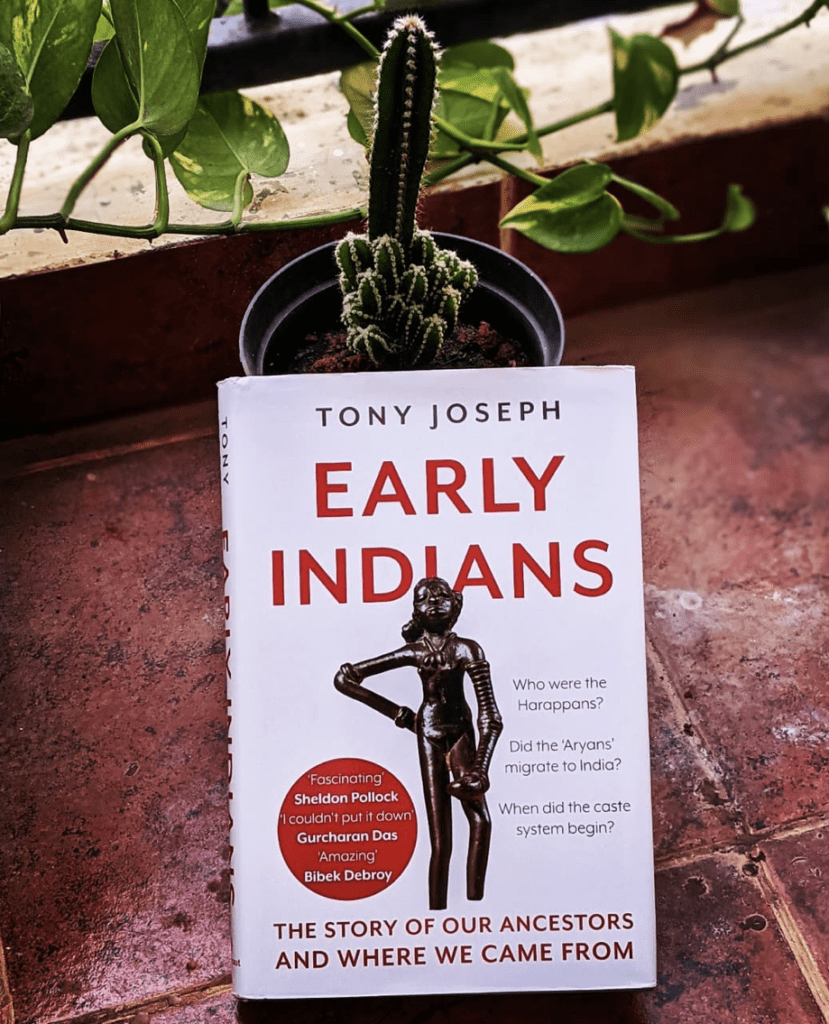
  • Early Indians

    Before I get to how wonderfully interesting this book is, I have to say I am surprised it hasn’t been banned yet! It easily, and scientifically I would add, dismantles all of the Indigenous Aryans and Out of India Aryan migration theories that have been doing its rounds on not just WhatsApp but larger forms of media, and encouraged by the current powers that be! 

    Tony Joseph starts right from the beginning to answer the questions, “Who are we Indians? Where did we come from?” The beginning is about 65ooo years ago, when Homo sapiens decided to venture out of Africa, and subsequently entered the Indian subcontinent. Although if you ask an archaeologist, the answer would be 120000 years! They are referring to the first group of modern humans who left behind archaeological evidence. The 65000 comes from the geneticists who are talking of humans who left behind a lineage that is still around. 

    The author uses the metaphor of a pizza to show how we got here. The First Indians, from the previous paragraph, forms the base. The story of the next layer – the sauce- begins in the Levant (West Asia), where approximately 20000 years ago, hunter-gatherers were being stressed by the glacial period that turned many areas uninhabitable. Many centuries of experiments on gathering and processing food later, when plant and animal domestication began to see success, some Zagrosian (region of Iran) herders reached Balochistan, around 7000 BCE, mixed with First Indians and formed the basis of the Harappan Civilisation. 

    I don’t think we appreciate the Harappans enough. They were really advanced for their time, in their unique practices and outlook, across multiple facets of what we call civilisation. Public infrastructure, weight standardisation, jewellery and pottery, they excelled at many things. They were around for over 6000 years, created the Dravidian languages and were the ancestors of all Indians. There are some word examples that show the connection between Elamite – an extinct language spoken in a region that is part of present day Iran – and Tamil, Malayalam, Telugu. The occurrence of places ending with vali/oli in Western and Southern India is because of the Proto-Dravidian language connection as (some of) the Harappans started moving southwards when their civilisation collapsed. Fascinating stuff! 

    Back to the pizza. The Aryans were the “cheese” who arrived from the Steppe around 2000 BCE. It was the Aryans who brought in the Indo-European languages. They originated in the Kazakh Steppe and moved across Southern Central Asia and then South Asia. And yes, the earliest Vedas postdates the Harappan civilisation. So it’s not as if the Harappans were the Aryans! The present day Indian population is a product of the intermingling of two sets. ANI [Ancestral North Indians – made up of Harappans (First Indians + Zagros agriculturalists) + Steppe pastoralists] and ASI [Ancestral South Indians – Harappans + First Indians (south)] In addition we have toppings in the form of Austroasiatic and Tibeto-Burman language speakers as well as Greeks, Huns, Sakas, Parsis, Mughals etc. 

    There are three distinct areas of science that have contributed to our understanding (even if it is not complete) of the answers to the two questions. Archaeology, genetics and linguistics. They have their “little” differences, but collectively, they have provided substantial scientific proof. 
    And now, after everything that happened from then until the present day, if we ask who is the best representation of Indians at this point, the answer is a tribal woman, because she carries the deepest rooted lineage. Adivasi (first inhabitant). How ironical given the way we treat them! Civilisation and progress! 

    A must-read if you are even remotely interested in history.
  • Mofussil Junction

    Ian Jack

    What a lovely read!

    Now that we have settled that, let me elaborate. Mofussil Junction is a collection of the author’s articles about India, written for various publications, over a time frame of more than 30 years. There are essays, profiles, and some wonderfully wistful travel writings. The book is divided into five parts – places, people, (the Nehru-Gandhi) dynasty, ‘Life and Death’, and ‘Fellow Travellers’.

    He had me hooked from the first chapter, when I learned that Bihar was the birthplace of George Orwell! There are vivid portraits of Bombay and Calcutta in the late 80s, but it is the tales of Serampur and McCluskiegunge (not to forget this chapter’s superb title) that truly amaze! (more…)

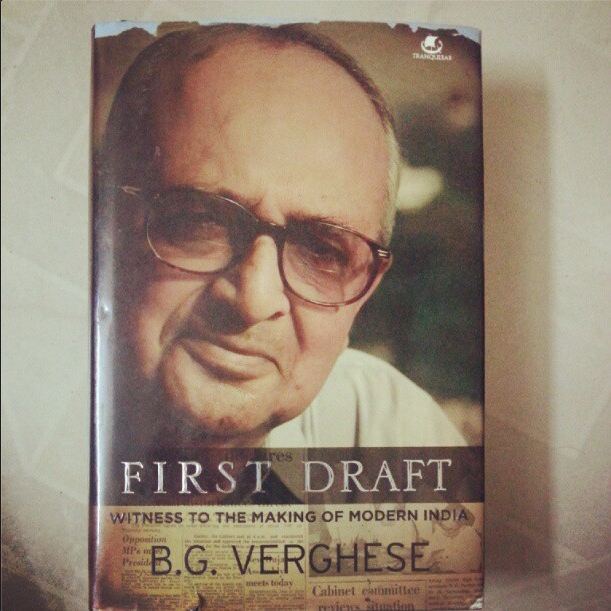
  • First Draft: Witness To The Making Of Modern India

    B.G. Verghese

    BG Verghese’ “First Draft” is part memoir, part history and covers many decades in its wide sweep. From the description of the Times on the day of his birth (21/06/1927) until his assessment of the challenges facing the nation in 2010, the book is his perspective on the events he has witnessed and many a time, been part of. Sometimes it is tinged with nostalgia – his description of the Doon School for instance, and at other times, it is an objective view of the various decisions and circumstances that have shaped India.

    From national milestones like the first elections (described so we get an idea of the herculean task it was in an era that didn’t have the communication infrastructure we see now) and the construction of the steel plants and dams and IITs,IIMs we see around now, to humanity’s collective achievements such as Neil Armstrong on the moon (even as a villager adamantly states that it is just impossible) we get a first hand view of things we now acknowledge as history and landmarks. Relationships with the US, USSR as well as neighbouring countries and the wars fought with the latter, including an analysis of the things we did right/wrong all appear, mostly in chronological order. Also adding texture to the narrative are anecdotes of Prime Ministers, most significantly Indira Gandhi. The formation of AIR and Doordarshan, nuclear tests, the political battles within the Congress, formation of other parties, JP’s work, the rise of Naxalism, Operation Bluestar, Sanjay Gandhi’s bizarre schemes, the Emergency, the death of Mrs.Gandhi, Rajiv Gandhi’s baby steps into politics and the paradigm shifts he kickstarted, communal riots, the formation of LTTE, the Bhopal tragedy, VP Singh and Mandal and Bofors, BJP and Ramjanmabhoomi, the chronic Kashmir issue all gives one a feel of time travel.

    There is massive ground covered – nuclear policy, social-economics, geo-political relationships, the functioning of media houses etc in addition to his views on public service broadcasting, policies for the North East, industrialisation, water and so on. As an editor and someone who has worked with the government, and as part of external agencies, fact finding committees and so on, the author is well placed to deliver an incisive view of history as it was being made and with the advantage of hindsight. (now) Barring a meagre few pats on the back and digressions, he does provide a decent and objective look. It is quite a humbling feeling to ‘watch’ as generations of politicians and institutions almost flash by and one finds some pattern in the fuzziness seen around – the reason for the way we are, as a country. It is also heartening to see that patriotism aside, the author feels that we are on an ascendant. Despite some patches that are specific in nature (towards the last 100 pages) and tend to be discourses, this is a great read for anyone interested in modern history.

    Clipboard02

  • Empires of the Indus: The Story of a River

    Alice Albinia 

    I am showing signs of travelogue addiction, and this is the kind of book that creates it! It’s not just the content of the book, which is marvelous and makes for a treasure trove of information, but the sheer tenacity and guts the author displays, that has made me a fan. Spanning four countries, this book is the story of the river Indus, from its source to its destination, though not in a linear way. What it succeeds in doing, like the best travelogues do, is to also allow us to travel through time, in this case, even to the time before man existed. From Hindu mythology to the Harappa civilisation to Partition and the Kargil conflict and China’s occupation of Tibet, the book is not just the story, but the history of a subcontinent (at least a part of it) and the civilisations that rose and fell.

    The preface gives us an idea of the expanse of the river through its various names, given across lands and by everyone from Greek soldiers to Sufi saints.

    There are nuggets everywhere right from the beginning – the comparison of the arrangements of the Quran and the Rig Veda, the integrity shown by a citizen in the early days of Pakistan’s formation, a modern day citizen blaming Jinnah for the country’s authoritarian culture, a nation’s search for identity, and the vision of its founder, who was only human. The first chapter ‘Ramzan in Karachi’ is a book in itself, and this can be said of all the chapters! ‘Conquering the classic river’ is a slice of the Company’s India exploits, ‘Ethiopia’s first fruit’ shows the amazing ‘presence’ of Africa in the subcontinent’s history and present, and the facets of their absorption into the mainstream. ‘River Saints’ is about Sufism and its modern day remnants who are not beyond politics, religious conflicts and feudalism.

    ‘Up the Khyber’ is about the exploits of Mahmud of Ghazni, the sexual preferences in the frontier province, and the beginning of the author’s more difficult challenges as she zigs and zags through Taliban and smuggler territory. ‘Buddha on the Silk Road’ is an awesome chapter on the meeting of 3 great religions – Hinduism, Islam and Buddhism and how they influence each other in the area, down to the destruction of the ancient Bamiyan statues more recently. In ‘Alexander at the outer ocean’, the author stubbornly walks, despite very serious hardships, the route that the Sikunder-e-azam took. ‘Indra’s Beverage’ takes us back to Rig Veda times, the Aryans and ancient Stonehenge like relics that survive to this day, along with the Kalash tribe, which follows a religion that goes back beyond Hinduism. Some areas, as the vivid prose describes them, seem to exist the same way they did in Rig Vedic times. The incredibly advanced Harappa civilisation is showcased in ‘Alluvial Cities’, though the reason for their fall is still contested. Kashmir’s archaeological treasures are the focus in ‘Huntress of the lithic’ and it’s interesting to see how the same ‘painting’ has been reinterpreted across time by various people to suit their needs. In the final chapter, the author captures the startling contrast of man’s attempts to conquer nature and at the other end of the scale, his ever decreasing ability to live in harmony. This chapter is also a testament to her commitment to the book, and the mentions of Kailash and the possibilities of Meru were extremely interesting to someone like me, who is interested in Hindu mythology. The book’s final words, which makes us wonder how long the river which spawned civilisations will be around, is a melancholic gaze into the future.

    At 300 odd pages, every page of this book is packed, and there is no respite. But it’s completely worth it!

  • No Full Stops in India

    Mark Tully

    No Full Stops in India was published in 1991, and so the best part about it is that it involves a fair amount of time travel. It’s a collection of 10 essays with an introduction and epilogue that could pass off as mini essays too! While all of the essays are commentaries, what adds that little flavour is the author’s own involvement in it, which he somehow manages to balance with a near objective view. The first essay, for instance, involves the marriage of his cook’s daughter, and his experience at the village. But it also is about how communities in villages have been solving their own problems even better than the land’s relatively new legal system. It thus serves as an example of how we, the ‘educated elite’ make a clamour for egalitarianism without understanding the positives of the caste system.

    Cultural imperialism is the theme of the next essay and is brought out through the carvings at Mahabalipuram, and the interaction and friction between British artists (sculptors) and their Indian counterparts, whom they rate slightly lesser- as craftsmen. The essay also touches upon Dalit Christians and how they are discriminated against even within the Church.

    The Kumbh Mela is what the third essay is about and is a vivid telling of the massive festival. The author spends time with VP Singh’s brother, and meets the various people who ply their trade in this enormous festival – the pandas and later, the akharas who look to recruit people or get donations. In this, there is a note of sarcasm that creeps in occasionally, but Tully still manages to capture the faith driven fervour superbly. He has also correctly predicted the potential rise of communal parties towards the end of the essay.

    One of the most interesting essays in No Full Stops in India is the fourth one, especially for my generation which grew up watching Ramanand Sagar’s Ramayan! The author reminded me of the impact of this mega serial long before we had reality TV and TRPs – taxi drivers who knocked on the author’s door asking for permission to watch it in his house, cabinet swearing in postponed so everyone could watch it, and so on. He spends 2 days with the Sagars while they’re shooting the Uttararamayan section (owing to public demand) and there Ramanand Sagar tells him how he has handled feminists and also the story of his own life. There is an amusing part about the filming of a scene – Lakshman having biscuits between takes, reusing marigolds for extra takes, and so on.

    Operation Black Thunder is a more serious essay which involves covering the whole event live. This was an era before live TV and omnipresent crews and the author tries to delve deeper into how a section of the Sikhs and the Central and State governments reached this point, with interviews of civil servants and military, police personnel.

    Colonialism in Calcutta is probably my favourite essay as Tully takes us through the city where Marxism, industries and religion co-exist side by side amidst bare remnants of an earlier era. In between are interesting anecdotes like the Oberoi Hotel’s origins. This happens to be the author’s birthplace and the affection does really come through.

    The next one was a surprise since it dealt with a modern day case of Sati and it has never been proved whether it was suicide or murder. The author gets the varying perspectives of the villagers, politicians, civil servants, activists, the extended family, and it does bring out how laws at the end of day, should be made understanding the minds of the people they are made for.

    Typhoon in Ahmedabad also surprised me but apparently that’s the name they use for riots! This is an era before Narendra Modi left his indelible mark and does show that riots existed long before him. The poor – both Hindu and Muslim, seem the most affected in the politically motivated result of a nexus between politicians and the underworld. SEWA’s activities also get some space as does Ahmedabad as a city.

    A journey into Madhya Pradesh in what was the national vehicle of the time – the Ambassador, makes up the next essay. The destination is the village of an artist who has made it (relatively) big in Bhopal with the help of a government program. Jabalpur, the inconspicuous geographical centre of India, represents eminently the feel of a tier 3 city in the mid-late 80s. This essay also covers ground on tribals, their belief systems and I also found what could be the precursor to Arundhati Roy’s essays about the Narmada.

    The last essay is about Digvijay Narain Singh, the politician from Bihar who also happens to be the author’s close friend. He belongs to an era when politicians had a conscience, and while you could say that the author is biased, much of the perspective is reportage – opinions from others. The politician’s relationships with Nehru, Indira Gandhi are well chronicled and throws light on the kind of politician who took the responsibility of being a public servant seriously.

    The epilogue is a note on Rajiv Gandhi, and through this, the state of India as a nation. It ends with the news of Rajiv’s death and the author’s perspective on what this means for a nation.

    In essence, No Full Stops in India is a wonderful read that gave me insights about a time when I was too young to dwell on things happening around me and events that ultimately affected the present I live in.