Tag: Hugh MacLeod

  • Legacy, Mastery, Success

    At Brain Pickings, that treasure trove of awesomeness, I found this quote attributed to Ray Bradbury on legacy, through a character in Fahrenheit 451:

    Everyone must leave something behind when he dies, my grandfather said. A child or a book or a painting or a house or a wall built or a pair of shoes made. Or a garden planted. Something your hand touched some way so your soul has somewhere to go when you die, and when people look at that tree or that flower you planted, you’re there.

    The subject of legacy keeps popping up here, and my understanding, especially since the last post has been that it is not something that one works towards, but happens as a (side) result of doing something that you love to do. In that sense, I would read between the lines above and add that ‘doing what you love to do’ as a prequel to the quote.

    One of the best posts I have recently read was Hugh MacLeod’s ‘On Mastery‘. I immediately riffed on it over at the other blog. It articulated things that I know for certain were muddled up somewhere in me, wanting to be told but finding words missing. He starts with trying to define success “Suc­cess”. What does it take to be suc­cess­ful, pros­perous, happy, have a sense of pur­pose etc?, separates it from the by products like fame and money and arrives at “It’s something that truly belongs to you”. For the master (as someone commented on the post) it’s more about the process than the product. Low key, known by a few, but masters in their chosen domain. “It’s something that truly belongs to you, always.”

    In the ever hyper world of real time media, micro-celebrities and experts, fame and money are many times the definitions of ‘success’, and though I do know at least a few people who have bucked that trend, it was heartening to read posts that told me that such thoughts weren’t really alien.

    There is an interesting article I read on the subject on HBR titled “You Are Not a Failure” which had an intriguing classification of  types of creativity — “conceptual” (in which a young person has a clear vision and executes it early, a la Picasso or Zuckerberg) and “experimental” (think Cezanne or Virginia Woolf, practicing and refining their craft over time and winning late-in-life success).

    Thanks to the deluge of information and opinions, it is ridiculously easy to give up on yourself and lose confidence. As Godin writes in “Do we have to pander?“, it is also easy to compromise, and then defend.   I think this is not just for greatness (people or things), but also holds true for personal belief systems and mores. And probably, at the very end, the perseverance really doesn’t achieve anything other than the satisfaction of setting one’s own definition of success and spending time and energy on it. But I have a feeling it’s worth it. A legacy in itself.

    until next time, this happens to be post #1000 here 🙂
  • Master Class

    Last week, I read a profoundly insightful post at Gaping Void, titled ‘On Mastery‘. The post seeks to answer (in Hugh’s own words) ““Suc­cess”. What does it take to be suc­cess­ful, pros­perous, happy, have a sense of pur­pose etc? What does THAT actually look like?” The answer, according to his post, is mastery. (do read his post for examples) When I shared this post on Twitter, Asmita related it to Chandni Chowk food vendors. Bingo. Around my own city – Bangalore- I can see examples of that. I can also see examples of when some of them have tried to scale and have fallen apart.

    Fame, popularity and money are by-products, but the master is not really dependent on that. In fact, he might even see it as undesirable side effects. As someone commented on Hugh’s post, it’s not even about the product, it’s the process. In Hugh’s own words “It’s something that truly belongs to you” and perhaps that’s why it’s so much more better, because there’s no dependency, unlike the by-products.

    It’s more of a personal learning for me, and it struck a chord as soon as I read it, as though I had the thought in my subconscious but lacked the cognizance to express it, even it to myself. In fact, I’d go on now to slightly disagree with Hugh MacLeod and say that for many people, mastery is success.

    Meanwhile, how does all this apply to business and brands? If I look at it through the prism of how things work now, I might be inclined to say that mastery cannot really scale, and I’d go back to my ‘Institutional Realignment‘ post and say that we’ll eventually get back to making mastery, a smaller ‘audience’, and a lesser scale the norm.  But in some ways, I can see examples of brands having mastered a culture and found a way to scale it – the much abused example – Zappos.

    However, if I had to look at it another way, I’d say that the web has made discovery much easier. Not in the traditional media way of ‘push the message to a mass and the interested ones will find you’ kind of a way, but the exact opposite. To use the data that people are sharing and through that, to find the right audience. The kind of audience who will appreciate the brand’s mastery, and who will then create good old fashioned community and word of mouth. The web offers tremendous opportunities to focus, but unfortunately we’re still in the early days of organised marketing and CRM data and most brands are busy losing focus and spamming themselves into oblivion, courtesy the lure of scale and its trappings.

    Of course, a part of me believes that mastery should have nothing to do with business, but as with many other things, the web might just change my perspective.

    until next time,  Master of Business Administration 😉

  • Empowerment

    In ‘Is Kindness a Strategy?’, Jeffrey F. Rayport shares the story of an American Airlines employee who ingeniously helped a passenger catch a flight though he was late, by using the express lane for ‘invalid’ guests. He mentions that many colleagues of the employee might not be happy with her way of dealing with the passenger. He also writes about Ritz-Carlton’s use of “service recovery” – a company’s ability to respond quickly, decisively, and effectively to a service problem of its own making — is a powerful way to increase loyalty among existing customers. He rightly draws the distinction between the two approaches – they vary on who’s at fault, the customer or the company, and asks what any business might stand to gain if it oriented its associates to look out aggressively for opportunities to perform true acts of kindness for their customers.

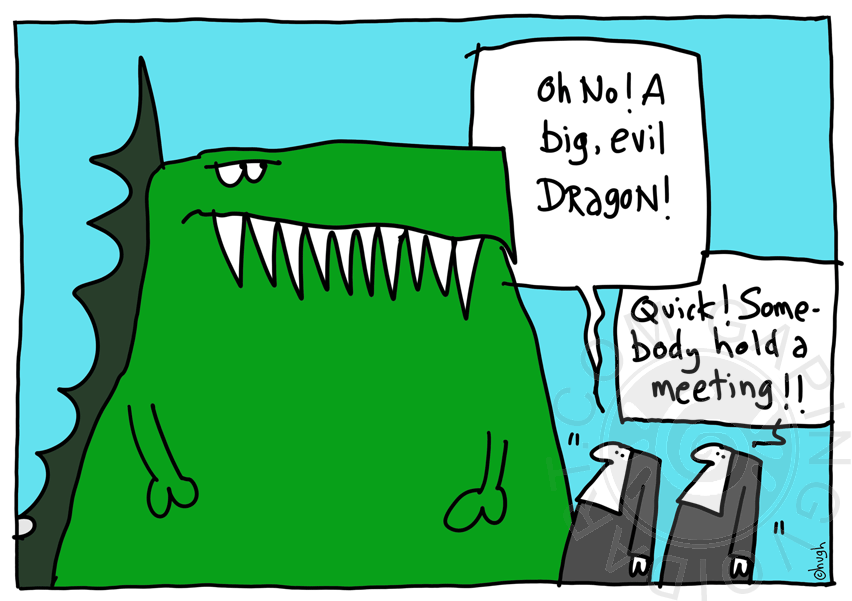
    In my mailbox, a few minutes earlier, I had seen this, in which Hugh MacLeod takes a (what I considered a) legit shot at meetings. As always, the toon says it all. When confronted with a business problem, (generally) the organisation’s first impulse is to meet, discuss, analyse and arrive at a consensus… probably 24 hours later. Yes, even when it involves a real-time platform.

    As I was writing last week’s post on culture, I was asking myself on the ingredients that make up a great organisational culture. Based on the above, I’d say Empowerment. When you have hired a professional to do a job that he has skills in, he/she should be empowered to apply his judgment to situations and not have to go through red tape or meetings involving people with minimal perspective on the matter. The first tenet of Zappos’ famous core values is “Deliver WOW through service”. In the same breath, Tony Hsieh also talks about “investing in a corporate culture that allows employees freedom and space” and follows it up with “If you get the culture right, then most of the other stuff, like great customer service or building a brand will just happen naturally.” On a related note, their unique hiring policy ensures that their sales staff don’t need scripts, they are trusted enough. It also ensures that an excellent culture is built by finding a fit between what makes the individual and the organisation tick. Empowering the employee so that he grows and so does the organisation.

    until next time, power trips

  • Time Off

    In an earlier post – “Brood Mode“, I’d written about expectations, and how sometimes, they cannot be met. In the context of that post, Austere had commented thus “Is it the instant-ness demanded of the response that puts one’s brain to a side?” I messaged her on Twitter, that ‘the time construct’ was something I’d planned to write on next.

    Our response time has been shrinking on a continuous basis, twitter, FB etc are a manifestation of that – real time, but the changes have been happening much before that, probably with every advancement we made, not just in communication, but even things like transportation. So, the thought is, if we had more time on our hands, would we be behaving differently with people?

    When I was chatting with Meeta recently, we started discussing this, in the context of relationships with people. It started with me saying that the traffic during the daily commute to work, made me forget all the rules I make for myself, because with all the lane cutting and parking woes, its easily a scenario in which you’re either aggressive or you end up on the road, literally. So I wondered if it would be different if there were no time constraints.

    Despite only a superficial similarity, I was reminded of another construct – money. What started out as a tool of convenience has enslaved many and managed to dictate their actions. Much like the things we create to crunch time. The similarity ended there. Time is not money. Quite obviously, time exists with or without us, though the latter can force one to ask “Who does it exist for then? So let me put it this way, it is a construct that’s still not fully understood, whereas we made the money construct. But for the fun of it, imagine what you would’ve done if your life wasn’t dictated by time. What if you had all the time in the world. Would you be a different person? Would you behave differently with people?

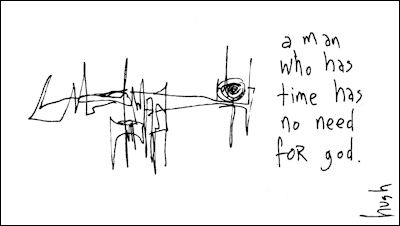
    As it regularly happens these days with me- by sheer coincidence, the day after I had this discussion with Meeta, I came across this work from Hugh MacLeod, which puts it so well

    time

    until next time, timed out for a fortnight 🙂