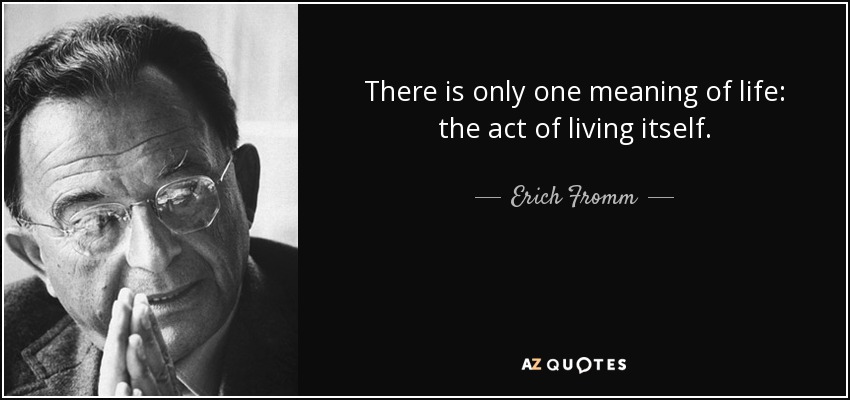
Erich Fromm’s Fear of Freedom (1941) has been my favourite read this year. The book was largely meant as an explanation for the rise of Nazism, but by tracing historical patterns of man’s interaction with society, it ended providing some fantastic perspectives on the self. Specifically, man’s contradictory needs of wanting to conform and wanting to be free. As Fromm points out, across ages, we have attained a variety of ‘freedom from’ (nature’s whims, Church etc) but have also systematically discouraged the expression of emotions, our spontaneity.
He lives in a world to which he has lost genuine relatedness and in which everybody and everything has been instrumentalised, where he has become a part of the machine he has built. He thinks, feels and wills what he us supposed to think, feel and will; in this very process he loses his self upon which all genuine security of a free individual must be built…
By conforming with the expectations of others, by not being different, these doubts about one’s own identity are silenced and a certain security is gained. However the price paid is high. Giving up spontaneity and individuality results in a thwarting of life.
Fromm explains how spontaneous activity is the means by which we can attain “freedom to”. This is positive freedom.
Spontaneous activity is the one way in which man can overcome the terror of aloneness without sacrificing the integrity of his self; for in the spontaneous realisation of his self, man unites himself anew with the world – with man, nature and himself.
The inability to act spontaneously, to express what one genuinely feels and thinks, and the resulting necessity to present a pseudo self to others and oneself, are the root of the feeling of inferiority and weakness.
Somewhere in all this, I sensed the indirect presence of a favourite topic – the abundance mindset. Specifically, in the idea of spontaneity. In my immediate circle, I know three people who are quite spontaneous. Interestingly, they also share an abundance mindset. Yes, correlation, not causation. But maybe…
Let me unpack the connections. One reason to not be spontaneous is conformism. But I have never really been a conformist. (I have recently figured out the probable reason, but that’s a different story.) However, there is a wrinkle, perhaps best explained by this:
If loneliness is to be defined as a desire for intimacy, then included within that is the need to express oneself and to be heard, to share thoughts, experiences and feelings. Intimacy can’t exist if the participants aren’t willing to make themselves known, to be revealed. But gauging the levels is tricky. Either you don’t communicate enough and remain concealed from other people, or you risk rejection by exposing too much altogether: the minor and major hurts, the tedious obsessions, the abscesses and cataracts of need and shame and longing. My own decision had been to clam up, though sometimes I longed to grab someone’s arm and blurt the whole thing out, to pull an Ondine, to open everything for inspection.
To refuse scrutiny is to dodge the possibility of rejection, though also the possibility of acceptance, the balm of love.
The Lonely City, Olivia Laing
I’m still working out the paradox, but while I am nonconformist in most things, I also avoid getting judged. It doesn’t help that I am shy and introverted. My trade-off has been similar to Laing. Rather than conform, I clam up, as a shield against judgement. But it also means that I am forgoing chances of a genuine connection beyond a handful of close friends, and yes, this blog. Clamming up and spontaneity don’t mix well.
“…to be ourselves causes us to be exiled by many others, and yet to comply with what others want causes us to be exiled from ourselves.”
There’s another factor that works against my being spontaneous – a scarcity mindset. My reaction to it, instinctively to begin with, and by design later, was to create predictability by planning my life. Or, in the insightful way that Khaled Hosseini has framed it,
But I had a plan for spontaneity. My thinking was that by making many things routine (clothes, diet, finances) etc, I can use choice avoidance to have the space and the mind space to be spontaneous. (read) But the extreme is a bad place to be, and in my case, I not only became a slave to routine, but also got upset if it didn’t happen in a certain way. As it goes, the neurons that wire together, fire together, and over a period of time, it also led me to seek efficiency in everything.The instrumentalisation of life, in Fromm’s words. Also, the crowding out of spontaneity.
Before we get to possible solutions, a few reasons I need to solve this. At a human level, the combination of non-conformity and the slavery to routine and efficiency is practically a fool-proof way to push people away! Also, the uncertainty in things around us is only rising. Trying to have a plan that covers everything is just hubris. As a species, we will have to draw upon the innate strength that got us here – adaptability. And finally, there is philosophy
People say that what we’re all seeking is a meaning for life. I don’t think that’s what we’re really seeking. I think that what we’re seeking is an experience of being alive, so that our life experiences on the purely physical plane will have resonances with our own innermost being and reality, so that we actually feel the rapture of being alive.
Joseph Campbell
So what’s a possible fix? In Atomic Habits, James Clear argues that we can behave in a certain way until we get to the mindset. Intuitively, and from experience, that seems relatively easier than theoretically changing a scarcity mindset. If one isn’t blessed enough to have an abundance mindset, maybe behaving like one does – spontaneity to begin with, will get one there. So, if spontaneity is the behaviour change, I have to go oxymoronic – force myself to be spontaneous! In other words, use my nonconformism to unlock the ‘freedom to’ be spontaneous. Hopefully, its positive results will temporarily override shyness, introversion and the desire for efficiency, and an abundance mindset might find a way in. The first baby step is to watch myself when killing spontaneity. I also have another clue. Money is a factor that has a disproportionate influence on my mind, and I have discovered that when something doesn’t make a dent there, I am more amenable to spontaneity, and joy.
At a daily level, to quote from this fantastic read on happiness, “any neuroscience article will tell you that the “reward centre” of the brain – the nucleus accumbens – monitors actual reward minus predicted reward.” In my efficiency play, I will have predictable happiness, which will get normalised to practically zero happiness over time. I have found a couple of ways to engineer prediction error – one is not to plan the minutiae of travel, and the second is to spend more time with people who are spontaneous. Or as Venkatesh Rao puts it, ‘differently free people’, in this fantastic post. The good news is that I have three readily available ones and I am now ‘awake’ enough to spot others when I find them. Predictable unpredictability!
Thus the idea is to go from choice avoidance based on efficiency to choice avoidance based on the freedom to be. As Venkat so brilliantly put it, “Detachment does not mean you don’t care what happens. It just means you don’t care whether a specific thing happens or not.” I have solved it in terms of conformity (freedom from) I now need to solve for spontaneity (freedom to). To live for an in-the-moment version of the want in Hosseini’s quote.
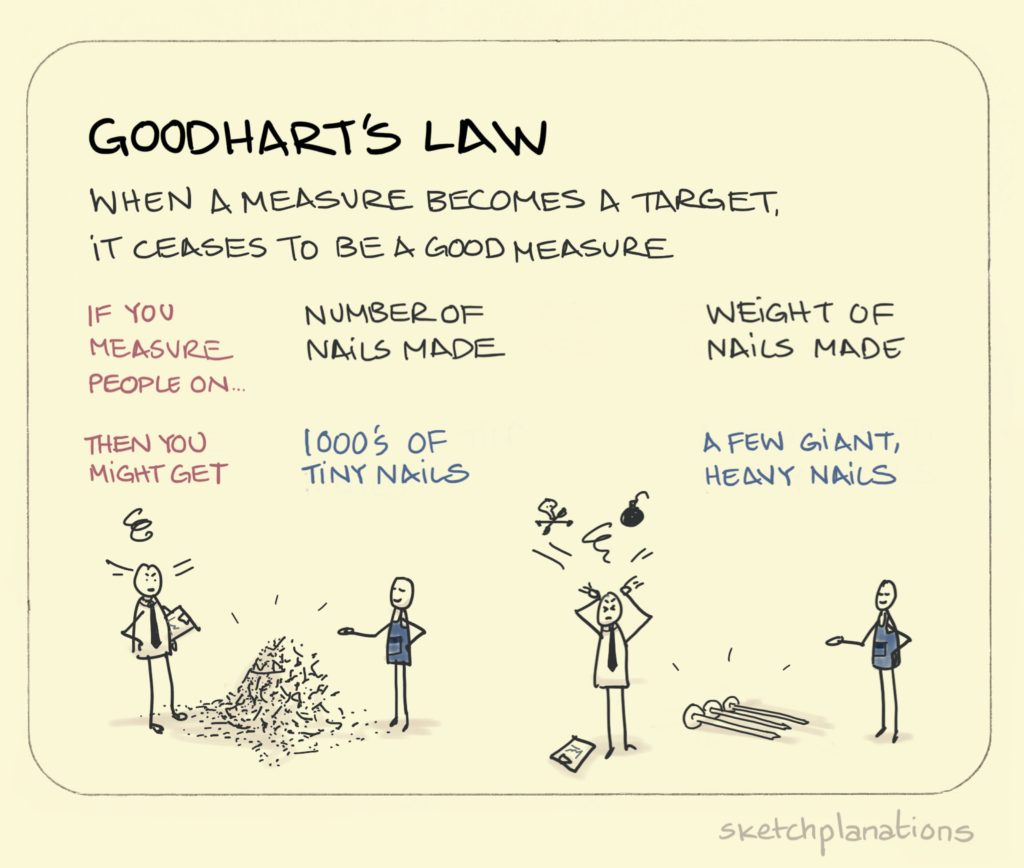
I have forgotten where I first came across Goodhart’s Law. It was probably Farnam Street. It states that “when a measure becomes a target, it ceases to be a good measure.” An illustration should help.
In the organisational context, it serves as a great lens to evaluate strategy and progress. As the illustration above shows, the entire direction of a desired goal can be changed when measures become targets. But, and maybe it’s a Baader -Meinhof phenomenon, I am now seeing different versions of it everywhere.
To set some context, as more and more things have been digitised, the volume of information has just exploded. For instance, before the advent of social media, there were limits to one’s “people like me” canvas, because even an awareness of them was constrained by physical distances and the limits of one’s social circle. It had to be in real life, and public spaces like a cinema or even a vacation spot were probably an extreme. Social media changed that scale massively. Many factors including this volume of information, the lack of a granular understanding of the lives of this new set of people whom you’d never meet, and the innate human desire to do better than neighbours meant that appearances became the norm. Since we are not wired to process such large volumes of information, we dug deeper into ‘measurement by proxy.’ Not that this mode of measurement is new. For instance, we have used material manifestations (apparel, cars etc) as a measure of wealth. The stock price is a single-number measure of everything about the company. But with abundance of choice and the limits of processing power, we started developing heuristics and measuring what was easy. Meta photos (FB/Insta/WhatsApp) became a measure of everything from the quality of life to the strength of relationships. Popularity as a measure of excellence, price as a measure of quality, fitness as a measure of health, #booksread as a measure of erudition and so on.
How does this connect to Goodhart’s Law? We end up optimising our resources for the measure, not the end goal. Which means that though the goal is say, happiness and a good quality of life, we end up aiming for the measure. From the kind of photo that will get more likes to buying that thing/experience that will surely make us happy. And as we feed this more, the mind keeps on wanting. The happiness fades in a short span of time. And as the Buddha has wisely pointed out, that loss of happiness is what becomes suffering.
In the AI risk narrative, there is the story of the paperclip maximiser, a seemingly trivial task of maximising paperclips that might lead to “first all of earth and then increasing portions of space into paperclip manufacturing facilities”. The corresponding human version that I wrote in Peak Abstraction was that maybe we will get to a state where, if we get enough likes on the couple photo on Insta, there would be relationship bliss! What a wonderful world.
In a workshop I attended recently, the trainer made an interesting point that being a little selfish and taking care of our own needs first will actually enable us to help others better. Around the same time, I also read this very interesting post on the conversational gambit. Extremely helpful for those of us who aren’t good at going from zero to conversations quickly. Put simply, ask a question. The one that stuck with me was “When were you happiest?” I directed the question inwards and got some answers. Then I upped it to “What will make me happy?” That was complex, but something I heard recently gave me some direction.
People say that what we’re all seeking is a meaning for life. … I think that what we’re seeking is an experience of being alive, so that our life experiences on the purely physical plane will have resonances with our own innermost being and reality, so that we actually feel the rapture of being alive.
Kaamyaab is a wonderful movie – the subject, the performances, the sensitive portrayals, not to mention the nostalgia of seeing familiar old faces. Sanjay Mishra, playing Sudheer, a side-actor who decides to come out of retirement after realising that he is only one short of acting in 500 films, does a fantastic job of bringing to life the minds and lives of struggling actors. But, to me, good movies make you think beyond the scope of their narrative, and this one was no different.
Before Sudheer began his mission of a 500th movie appearance, his life has settled into routines, and I found it difficult to fathom whether he regretted his career choice. For instance, he describes himself and others like him as “aloo” actors who can be added to any film. But he is also chuffed when he is recognised by people. And then there’s the alcohol. Is this how Babulal Chandola (Sudheer is a screen name) imagined his twilight years?
We’re surrounded by success stories, not just from the movie business, but other walks of life too. Success, as we commonly define it, takes hard work, and luck. It requires the tenacity and perseverance to break through what Randy Pausch calls the “brick walls”. Bahut hi bekaar shahar hai,” Isha Talwar says in the movie, “Rejection ki aadat dalwa deta hai.”
Kaamyaab draws attention to the not-so-successful, and brought up the question to me, again. What really is success, kaamyaabi? Being true to yourself, becoming exactly what you set out to become, but having to deal with the consequences of your trade-offs? Or being malleable with your trade-offs such that many a time your own desires are secondary, but being melancholic about the roads not taken?
In the larger canvas of history, individual successes are blips, even the very best of them. But that’s philosophical, and it’s inevitable that as your film roll nears its end, you will analyse your role. Something that came up in an earlier post – The half of it. One which took me to whether to float with the tide, or to swim for a goal (Hunter S. Thompson). My take for the future was to float with the tide and seek small goals while at it.
I now realise that the questions of “why” and “what” still need an answer. One framing I have used in this context is FML – fame, love, money. Not by design, but the irony of the more traditional definition is unmistakable. Meanwhile, at a certain stage, after one’s biggest adversary is self image and not others, the love for something is the obvious answer (at least to me). Despite that, the motivation is not easy. I could really relate to a tweet by Orange Book, “You are not talentless, you just fell in love with comfort.” There are also the “false securities” that SRK eloquently framed in his tweet. Not completely past it. Related to that is the notion that one has done enough (for even the self image) to take a breather. All challenges to overcome!
It almost seems like the opposite of life is not always death, it could be a lifestyle too! But then again, that depends on how one measure success – happiness or contentment? At one point, they seem to be opposites too!