
Tag: habits

  • Habit much!

    Nearly five years ago, when I wrote about the closure of my second (and probably final, given the zero usage now) book of accounts, I had ended it with how the days of our lives have found a rhythm, a familiarity. They actually point to the habits that have become a part of my life. Earlier this year, when I wrote The building blocks of freedom, the ending was again a commentary on habits. As I quoted in it (from a splendid post Routine Maintenance), while habits are indeed a way to off-load cognitive overheadat their most extreme, habits can slide into addictions and compulsions, patterns that resist our conscious efforts to break themRitual dissolved into routine.

    Habits, as I wrote, are possibly a micro-version of intentionality. They are are physical, mental and even emotional. But when we don’t review them, it is almost as though they hijack our intentions and make them subservient! It’s almost like the new Batman’s point about scars – Our scars can destroy us, even after the physical wounds have healed. But if we survive them, they can transform us. They can give us the power to endure, and the strength to fight. As I have realised many times recently, it is extremely difficult to be objective about my habits. It is only when I am deeply mindful that I observe some of my habits, and sometimes laugh at their absurdity. But when I go back and understand where it came from, I also give a mental hug to my earlier self. 🙂

    Very recently, it also made me review my deep-set approach to retirement. I had mentioned that in my previous post – the third point in Uma Shashikant’s excellent article (below).
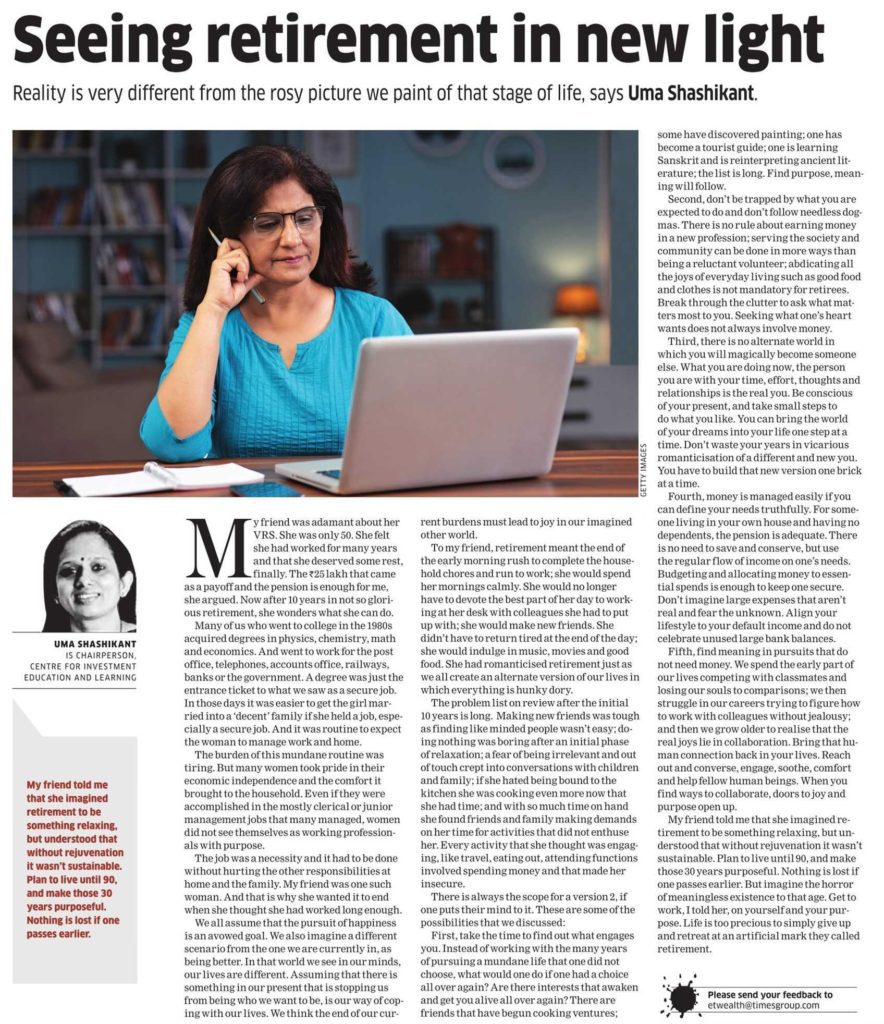
    I always assumed that the day I stopped working for a living, I could switch into a ‘different me’. I now see how it’s quite impossible. I will have to start looking at the ‘difference’ right now, and build new habits and junk old ones that can help me move in the direction of the ‘new’ me. The idea is that it won’t seem new. Turns out this isn’t a problem that only I encountered. In a couple of books and articles that I read recently, I came across some very insightful perspectives.

    Familiarity and habit impoverishes the way they look at things. They are mostly unable to break away from the past and see things in a fresh way. It doesn’t help that breaking away might mean losing everything that made them great/admired. Lack of interest and curiosity are aggravated by biological conditions, and this intellectual and emotional indifference may cause inertia. 

    Simone de Beauvoir, The Coming of Age

    Marcel wrote of the human tendency to become stuck in habits, received ideas, and a narrow-minded attachment to possessions and familiar scenes. Instead he urged his readers to develop a capacity for remaining “available” to situations as they arise. Similar ideas of disponibilité or availability had been explored by other writers, notably André Gide, but Marcel made it his essential existential imperative. He was aware of how rare and difficult it was. Most people fall into what he calls “crispation”: a tensed, encrusted shape in life — “as though each one of us secreted a kind of shell which gradually hardened and imprisoned him.”

    “On the Ontological Mystery,” Gabriel Marcel, via At the Existentialist Café

    And while being too lazy to type out the one above, I found someone had already written about ‘crispation’. And found this (below) there. It reminded me of the converging life Amor Towles wrote about.

    “We all end up as packaged goods,” Westbrook Pegler remarked a little while before he died. The dreary road to the wrapping and bundling counter is probably inescapable: there is the hunt for the discovery of what works, then the erosion of curiosity about what else might work, then the disappearance of all curiosity about anything unfamiliar, and at last the prison of the safety of one’s own accepted manner. Yeats was a little way off the mark; the peril for the artisan no less than for the artist is not that his circus animals may desert him but that he will let slip past the time when he ought to turn them back to the forest.

    via James Mustich

    And finally, my favourite story on what habits can do, and where I don’t want to end up. Poignant, hard-hitting, and true.
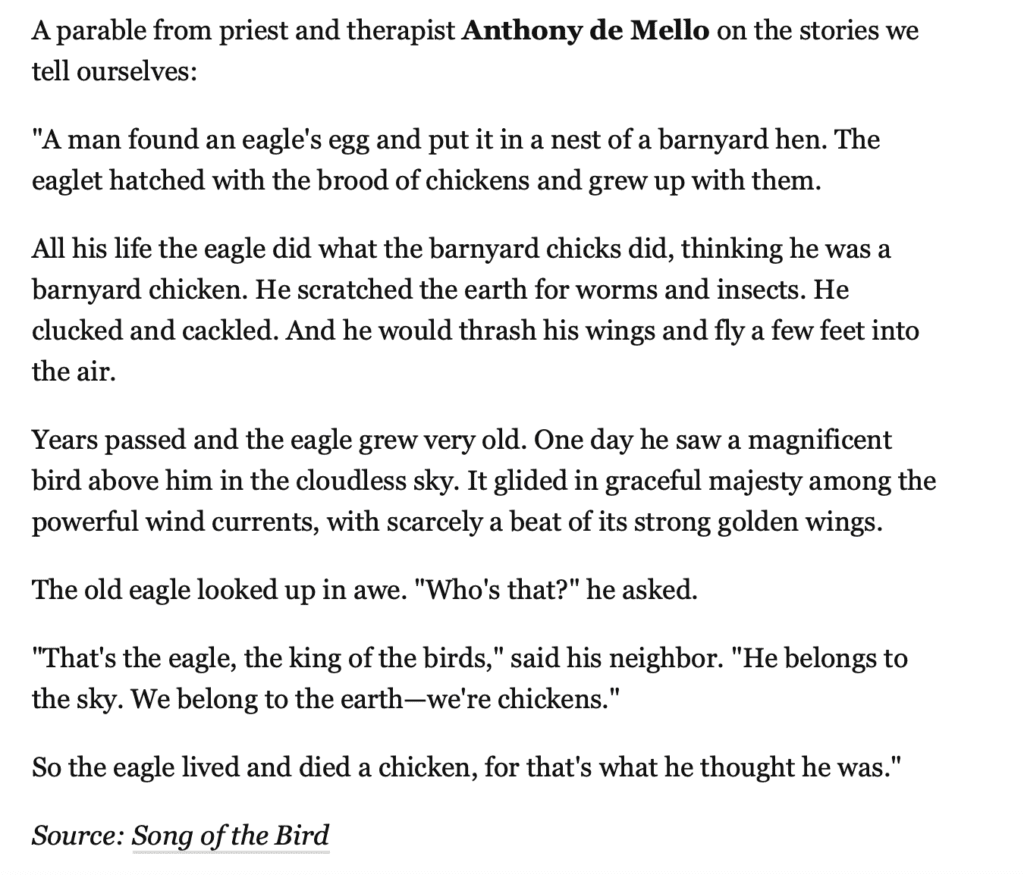
    via James Clear

  • The building blocks of freedom

    In The Constraints on Freedom, I had brought up the impact of the loss of three basic freedoms at a personal level. The freedom to disobey, the freedom to go somewhere else, and the freedom to create new social arrangements. A big lesson from the book I got it from is that even at a civilisational level, ‘the map is not the terrain’ i.e. the granular trade-offs, impacts, and daily wins and losses of different societies don’t get covered in broad strokes. At an individual level, therefore, mapping one’s worldview and practices purely according to popular discourse and aping lessons from ‘experts’ blindly is probably not a great idea. This post is a start to framing my own can-need-want list and specific actions I would like to take to give myself (and hopefully some others around me) more basic freedom, and a bit more. I am framing this around three aspects.

    (more…)
  • Zoned Out

    On hindsight, I should have known it wouldn’t be that easy. A little over 150 days after Comfort Zoned appeared here, 2021 did a 2020 to me with a heart attack. Yes, literally. There is no hidden wordplay, as most of my friends assumed when I let them know! Should have done Anjuna to angina, since we had just returned from Goa the previous week! For someone paranoid enough to have done a genome-based preventive health assessment to detect and insure, this was insulting. I hadn’t expected it for at least another 3 years.

    Heart attacks seem to be common now, and I checked in and out after a 3D/2N (Columbia) Asia sojourn. But cliched as it sounds, I had a lot of time to reflect. More so because while in the ICU after the angioplasty, I could hear the man who lay opposite my bed, in throes of pain and anguish, trying to find some meaning in the life he had lived. Maybe he sensed something. He became silent in an hour, even as nurses and doctors frantically tried to save him. A few minutes later, a long beep was all that remained.

    It made me revisit the luxury (and privilege) of my comfort zone, and since this will be published after my second angio (done on a date that has other life-changing memories), I thought a good way for me to figure out the next chapters would be to frame the story so far.

    Money

    • D and I arranged our own marriage, and began our lives in Bangalore with a 1 lakh loan from Citibank. Everything that followed – the hard work, the decisions – was to prevent dependence on anyone. This is not an easy responsibility and probably what led to a scarcity mindset.
    • It has an effect on many things, including career choices i.e. how you make money. If I had to “follow my passion”, I would probably be a travel writer, try my hand at script writing, and maybe even aspire to blink-and-miss roles. But that’s a bet. You get paid a lot if you’re in the top 1%, but the world is mostly the 99% who didn’t. Instead, I chose financial security as my North Star, and thankfully marketing isn’t the most boring career. In terms of learning, it never stops, but the focus for 20s, 30s and 40s – explore, expand, and extract respectively. See, alliteration! It’s important to keep your side interest alive. 🙂 You’re fortunate if you manage to do both.
    • I think financial security is underrated – there is a trade-off, but it gives you the agency to lead the life you want. Even when you’re only moving towards it, you will become increasingly comfortable investing in things you like – in my case, books, travel, good food and alcohol, ridiculous decor… And I think, if/when you’re able to tame your ego and self image and get rid of delusions of significance, things become even better! The biggest trick in the book is starting early – compounding is an extraordinary phenomenon, and it needs time.

    Relationships

    • One problem with the scarcity mindset is that it also tends to define relationships. It was only after I got to a certain comfort level in terms of our “f*** you money”, that I even let most people in. Because early on, I had at least a couple of experiences when a friend/relative borrowed money, and only after a couple of missed deadlines told me about their philosophy of “Do I even have to pay you back?” That led to exits – money and relationship, and I became cynical about the value of relationships.
    • Only recently, I realised that the early mindset of being independent and not taking help might have caused a judgmental “not giving help” side effect. Funnily enough, this isn’t applicable to causes and the world-at-large, but instead, directed at friends and relatives (The intrigues of my empathy). I am still cynical, but more conscious of it, and its machinations.
    • Find and hold on to people who can give you non-judgmental company. It’s a treasure. I think you have to be lucky to find new friends in your 40s! That damn ability seems to shrink with age. And once you have made certain consequential and irreversible choices – the kind of apartment you buy, being parents (or not, like us) – it adds constraints. On a side note, I think folks who are parents are better at compromises and negotiations!

    Health

    • Back in 2006, I first came to know about my stratospheric cholesterol levels. Since then, in one form or another, I have been exercising five days a week. I love my beef and chocolate, and my rum and whiskey, but everything is consumed in moderation. But fitness and health are different things that we tend to conflate. Also, the genes have a will of their own, and despite reading a lot about it, I thought I could beat it with a diet and exercise regime. Nah.
    • Do yourself a favour and at least at 35, start an annual checkup habit. Yes, you might have to do trade-offs, but at least to me, being in control of the narrative seems like a better choice than a take-it-as-it-comes approach, because the latter also has an effect on your spouse/partner/family. One realisation is that we have a remarkable ability to normalise things, even those we thought we could never change/live without.

    Navigation

    A couple of things that are applicable to all three aspects above

    • Habits: Another underrated phenomenon. And they work as a force multiplier in both directions i.e. the good ones will give you superpowers, and the bad ones will pull the rug from under you. Take the time to understand what kind of person you are, and want to be. And build your habits around that. The caveat to that is moderation. For instance, I am a compulsive planner. The good part – I could guide D while experiencing a heart attack, because I had the scenario planned. The bad part – irritation when things don’t go according to plan e.g. not enjoying a vacation because the plan is chockablock. On a related note, it is in the nature of things to change. I can assure you that you will laugh at the things you decided/did when you were younger. In that context, acknowledge that habits will need rewiring too. To borrow from another context, “we first shape our habits, then our habits shape us”. A good idea to revisit them every once in a while, and look at them objectively.
    • Trade-offs: Many things in life are finite, include time and money. While “All I want is everything” is a perfectly normal stance, reality most likely will include trade-offs. Some conscious, and some that you realise only later. The higher the ‘conscious’ tally, the better I feel. You will need to find your own balance. A related application is in decision-making. A friend taught me to ask myself “how important will this be in five years?” For the past few years, my optimisation has been to give myself optionality, with a broad idea of where I want to be. Reality is a full contact sport, and there’s only so much control you have.

    P.S. A good book to read on many of these things – Morgan Housel’s The Psychology of Money.

  • Default in our stars

    The thought first occurred to me a couple of years ago, when I realised that thanks to outsourcing and automation, we would struggle today to do many things that were once life skills. We also lost a little more than that – learning.

    Sometimes directly, and sometimes, through the interactions with the world, they facilitated a learning experience that taught one how to navigate the world and the different kinds of folks that made up its systems. 

    Regression Planning

    It was continued with a bit more specificity in a subsequent post.

    Instagram, Facebook, Tinder, Spotify, Netflix, Amazon – everything is a feed of recommendations, whether it be social interactions, music, content or shopping! Once upon a time, these were conscious choices we made. These choices, new discoveries, their outcomes, the feedback loop, and the memories we store of them, all worked towards developing intuition. 

    Intelligence, intuition and instincts. The journeys in the first two are what have gotten the third hardwired into our biology and chemistry. When we cut off the pipeline to the first two, what happens to the third, and where does it leave our species?

    AI: Artificial Instincts
    (more…)
  • Comfort Zoned

    I think it was in a Taleb book that I read that writing was born because of accounting. In my case, as I have chronicled here earlier (2010, 2017), my account books pretty much tell the story of our life. Towards the end of the second post, I wrote “the days of our lives have found a rhythm, a familiarity….Wild zigzags giving way to smooth curves and then straight lines.” This is because our routines, and therefore, expenses were predictable. The last few months have obviously meant a few changes, but the ballpark is the same. This stability has also meant that the usage of xls/sheets have increased at the expense of the book. I suspect this change is permanent, and it does make me sad.

    What it has also made me think about is the subject of the “comfort zone”. My work domain is marketing, and there’s no way I am getting into any comfort zone there. But for all practical purposes,  in my personal life, my perception is that I have hit a comfort zone. Many of my posts in the Flawsophy section have been about my own approach on living one’s life – happiness, success, signalling, the idea of freedom in daily life – and learnings and changes. I think it’ll show that I have a fair idea of our needs and wants, what it takes to get there, and a plan. It has helped that we have avoided lifestyle creep quite a bit, and kids completely, and disproportionate spends are on things we actually enjoy. Self image on that last bit was a challenge until recently, but I think that’s over now. None of these are things that happened overnight, and obviously a work in progress but we’re comfortable with where we are, and where we want to be. (more…)