Tag: Google

  • Even distribution

    The per second and per character billing wars happening in the Indian mobile space now, made me consider whether its beyond a price thing – a need for consumers to slice and splice until they get exactly what they need. I see a parallel in the flow of content too, something I discussed earlier.

    Which explains why I tweeted that I was still watching with great interest, the results of Murdoch’s arachnophobia, though it will take months. (despite having some fun with irobot.txt, and Walled Street Journal 😉 ) Now that’s a subject on which everyone’s had an opinion, so I’ll refrain. (though I’ll share the interesting Bing Theory) The other part of his announcement, where he wants to be paid for content, will obviously depend on the quality of content he can give, and whether it can be found elsewhere for free.

    Meanwhile, as a believer of the link economy, I should’ve logically said that News Corpse was the future, but I refrained. The reason was that for me, the complete mechanics of content distribution is still in an evolution stage. I wrote about brand content distribution last week, and I’m exploring similar thoughts on information in general, especially when i see studies on sharing trends like these (via Social Media Explorer), which I still think is a good indicator despite the inherent skews in sample/methodology it might have. The specific part that interested me being the low shares of Google channels and Twitter, and the larger understanding (reminder) that the web is much bigger than the social media savvy crowd. While Google News has become a great aggregator, there might be other distribution mechanisms that can be developed, keeping a paid model in mind.

    Media has long served as a distribution platform for brand communication, so its obvious that any effect on media would also force brands to think differently from what they’ve done so far. It means seeking and understanding various smaller ecosystems that are bound to develop, where media itself would be different from what we see now. In essence, brands would have to slice and splice their content to reach various audiences. Again, one can’t completely rule out the possibilities for Murdoch with niche specific audiences.

    Meanwhile, I had a good debate recently with Surekha on social media’s usage by brands- product/brand centric vs communication centric approaches. This great post (via Surekha) sums it up quite well. My contention was that ‘buzz’ (for lack of a better term) could be generated without a communication centric agenda, if brands/products were serious about social media and approached it from a business design perspective. Communication centric approaches would tend to see networks as broadcast platforms and the focus would be on ideas and execution, which may quite often be platform centric, with less thought on how sustainable it is in the long run,  especially if all parts of the organisation are not aligned to a different way of working that’s required. Also, in addition to the spurious ROI methods which are evolving, my issue with communication – centric approach is best described by Godin in Hammer Time (every function (PR/Advertising all bring their own hammers to nail social media) and Rex in “If Advertising is your middle name, your surveys will always suggest the solution is….

    (Update: Thanks Dina, for sharing this)

    It led me to wonder if brands’ usage of  FB, Twitter etc as broadcast platforms, also contributes to the way these platforms are evolving – from the concept of digital sub-prime crisis that Umair Haque has written about recently to the kind of hiring that brands do. (In this context, the Ad Contrarian’s 3 Distinctions post is also worth reading) Taking it further, is that why (simplistically put) instead of collaboration and easy interoperability, there is the scenario that Tom Reilly very interestingly describes in ‘The War for the Web‘ – war between natural monopolies  (search, social networking, classifieds etc) for adjacent areas.

    I’m hoping that like with all things web 2.0, the community will turn both the fights in a direction that is beneficial to itself, and we won’t be left replacing one system with another that develops with the same principles.

    until next time, choosing sides 🙂

  • Twitter lists, Social Search and brand content distribution

    So its been quite a while since Twitter lists launched, and the ego seems to have stopped trending now. The open API means that we can hopefully see a some interesting apps/services (eg.directories like Listorious or alert systems like Listiti) soon. In fact, Twitter has already made an interesting widget, which you can see in action on the left side, at the bottom. Its a list of people who create/share content/have an interest in the Indian web space.

    Meanwhile, though Twitter lists will add a new dimension to search – people, content etc, like I mentioned in the last post, and create perceptions about people (basis lists they appear in), there are already directions which make me feel ambivalent (country lists, and I agree largely with this take). Even as they try to balance utility with threats like spam, I wonder what features Twitter will add to lists – feeds of lists, search (and advanced) within list tweets or add this option in existing search, one click DM to all members of a list (at least by the creator for starters),  or at least a way to send a tweet to only a list (so that I can be more pertinent to specific kinds of users – eg. there are those who hate my godawful puns, but like the links I share 😀 )

    (Let me know if these exist in some form – even on apps, and add on the features you can think of)

    Another line of thought occurred to me while on Twitter lists – brand communication. It started off by me wondering whether we’d now see brands occupying Twitter backgrounds of relevant lists (considering the web interface is still the most used source of tweeting) say, Star World on a a Heroes/Lost fans list, Kingfisher on a beer fans list. (all of you brands pay Twitter and the list creators, please) Taking that further, would we have brands create lists? Hopefully, not just something as vanilla as their fans, but say, a relevant common interest topic. 🙂

    This led to a larger picture of how brand communication’s distribution would evolve. This also fit into last week’s post – aggregation of content and serendipity. How would brand communication fit into the varied methods of content consumption, aggregation and discovery?

    Even as new distribution and consumption patterns develop rapidly, the identity of the traditional distribution means i.e. mass content creator-aggregators (newspapers, TV. and even web entities) as just a platform for vanilla advertising (and that includes ‘innovations’ like force-fitted editorial) has been changing for a while now. For example, Yahoo, even as it takes steps in creating and curating content, is also making deals “to help marketers creatively incorporate their brands into original online programming. The programs will appear exclusively throughout Yahoo!’s network of leading media properties including News, Sports, Finance and Entertainment.” ESPN Sports Center worked with Toshiba to create advertising that illustrates specifically how ESPN fans could use Toshiba TV sets and laptops. But all that’s still only creating more context. Seemingly seamless content and advertising, tricky territory, that.

    To compare it with say, Twitter lists, the latter already have the context and the audience in one place, and these are created by the audience themselves. Isn’t that at least a step ahead. Meanwhile, there’s another way of looking at it – the Google way, using Social Search, and that includes not just Google’s own services like Reader, Profiles (and that means all your other service details you shared there and your respective networks), Mail contacts, but also Twitter. That means, when a person is searching for information, Google can now give him socially layered real time results, quite a good start to a man+spider filtered way of search. I have to wonder (again) how long the SEO way of making sure the brand website appears on top will work.

    All of the above – traditional content platforms, social platforms, search are different kinds of people and content aggregators, and options for brands to create/share content (self created or UGC) in. While it might look challenging, it offers enormous possibilities of tailoring content according for the brand’s different audiences and their needs. They have varying sets of positives and negatives, several parameters will decide the medium, but as far as the message goes, interesting content is now, increasingly and thankfully mandatory. 🙂

    Brands have always been experiences. Brand communication has sought to build/reinforce/manage perceptions. In an unconnected world, the audience had to rely on the communication, and the small set of experiences that they knew of – their own, and those of their circle of friends, relatives etc. In a connected world, the audience will experience in many more ways, and the content they create will be shared and distributed in ways they deem fit, across a much larger audience. Perhaps, now, the experience is the message, and the audience is the medium.

    until next time, medium, message and mob mastery 🙂

  • Wavering

    My twitter stream over the last weekend and to a certain extent this week too, was dominated by Wave. People asking for invites, writing about their first impressions, cracking one liners and so on. The entire activity reminded me of how brand custodians try to create ‘virals’. From making ‘viral’ a part of the strategy, to announcing on the day of the release that they have ‘launched’ a viral, there are stories and stories. For me ‘Wave’ was a viral. Google has done this before with GMail. This time too, there was hardly any advertising. It was banking on the brand and product equity of Google, and the (potential) awesomeness of the product. It made me think on both fronts.

    Google’s brand identity has been dominated by search. For most people, it is their starting point on the web. But its not just that. From the iconic, simplistic, patented home page and the doodles it exhibits there, to its attempts to disrupt the real time conversation domain that is dominated by Facebook and Twitter with Wave, Google is many things. GMail, Orkut, Picasa, Blogger, YouTube, Maps, all operating on different domains, and brands in their own right. And they only make up one part of what Google is today. (link to an informative analysis of Google) Currently valued at $100 billion, and rising. Though wary of it, the brand has my respect, and for me, Google has been awesome.

    Awesomeness. Umair Haque had an extremely interesting post about awesomeness recently. He wrote that innovation is passe, that it is ‘what is commercially novel’, doesn’t create anything fundamentally new, and that awesomeness is the new innovation. He lists ethical production, insanely great stuff, love, and thick value as the four pillars of awesomeness. Arguable, right from a semantics/ new buzzword premise. But I tend to agree, especially when I see the stuff being passed around as innovation.

    Now, some of you might be aware of this, but for those who don’t, Google has a ten point corporate philosophy. An extremely interesting set of things, which you must take a look at.#10, I thought, was related to awesomeness. It goes “Great just isn’t good enough.” Google believes that great is just a starting point, and their “constant dissatisfaction with the way things are becomes the driving force behind everything we do.”

    They obviously felt that the entire domain of real time communication, search, sharing and collaborating could do with some disruption, that would explain Wave. And from the time I saw the video, I’ve thought that it would be a game changer, and wrote as much. But the feedback so far has been less than encouraging. From productivity killer to RSS, The sequel, it has been called quite a few things. The opinions are from guys who know what they’re talking about.From the little I have tried it out, I’ve to admit it can totally knock off productivity, but then again so can Twitter. Its less fun if there aren’t many around. Twitter in 2007, for me. Most are still learning, because it IS quite different. Seth Godin called Twitter a protocol (yes I keep saying that because its absolutely apt), I still figure that Wave has the potential that it showed in the video, the potential to create its own protocol. After all, there must be a reason why they call it a preview.

    But it did make me wonder about Google and awesomeness. Is Wave awesome, as opposed to an innovation? What if the idea is too advanced/difficult to provide ‘thick value’ now, does it still deserve to fail? Does that mean that sometimes innovation is better than awesomeness? How does ‘failure’ feature in the awesomeness manifesto? What does this do to the overall brand equity of Google? Or is brand equity an excuse/surrogate for thin value, and exist only in theory, or until the last good product?  But maybe Mitch is right when he says that we’re killing it before it begins. More after I play more with it.

    until next time, a wave new world

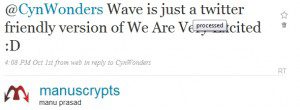
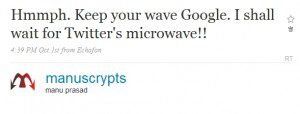
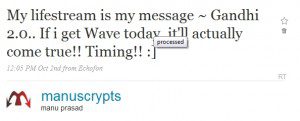
    PS: a few of my Wave tweets below 😉

    Clipboard02Clipboard03Clipboard04

  • Brand Chats – Google & Godin

    Last week, Seth Godin’s company Squidoo launched “Brands in Public” (BIP from now), a  service which creates pages -‘public-facing dashboards’ that aggregate conversations about brands on Twitter, YouTube and blogs, in addition to news, videos, images etc. BIP will create the pages anyway, but for a fee, brands can develop this page. Brands then get control of the left column on the page, and can respond to the content, highlight certain content, run contests etc. (example) In Seth Godin’s own words, brands “can respond, lead and organize.”As Godin himself states, there are many monitoring tools online (found an excellent wiki by Ken Burbary) which can be used to ‘listen’ to the conversation, but this service allows brands to respond publicly.

    I saw a couple of posts which asked an interesting question – whether by creating pages ‘anyway’, Godin was brandjacking. Godin had clarified that if a brand requested him to take a page off, he would do so. And in a later update (to clear the air) he took off the 200 sample pages that had been put up. Bravo! Not that there was anything technically wrong with it – after all, like one of the articles states, Google does something similar- sell ads next to contextually relevant others- generated content (search, ad sense on sites), but the non-paid for brand pages just didn’t sound right.

    But it made me wonder again about the location of brand-consumer conversations. Before we get to that, another interesting news item in context, albeit a bit tangentially. Last week, Google launched Sidewiki, “which allows you to contribute helpful information next to any webpage. Google Sidewiki appears as a browser sidebar, where you can read and write entries along the side of the page.” The entries which are shown, are selected not by recency, but an algorithm that has among other things – the contributor’s previous entries and the feedback on the entry. Moreover the entry will also be used on sites with the same content. Users will have to be logged into Google for leaving comments and rating.

    As Jason Falls notes in his post about Sidewiki, this adds another layer for brands to keep in touch with, because users may not even have to search for information about the website (or the product/service sold there). If they have the toolbar downloaded, they can see the information as they browse the site. He also rightly remarks (IMO) that we should expect ads (even that of competitors) in the wiki soon. Meanwhile, like any good social product, there is no control that a brand can exert on this content, as it exists on Google’s servers. Jeremiah Owyang  also has a post on the same subject, which offers several great insights and advice. Apparently, the comments a user leaves will also be displayed on his Google profile. The web as one giant social network, he’s right, that’s what Google’s after. There is also the option of sharing it on Facebook/Twitter. It’d be interesting to see a Facebook version of this whenever it happens – a play with Facebook Connect, the website, and perhaps, Facebook fan pages. The Facebook newsfeed means that it can bring the conversation back to Facebook. That’s something Google can’t do..yet.

    Now, back to the location. Attempts are being made to aggregate these conversations, and in BIP’s case make it a conversation involving the brand itself. My problem was not with brandjacking, the conversations are happening anyway, and brands are free to create their own ways of aggregation and response, I was more concerned with two other things. One, the creation of a destination point , a ‘middle man’ whose only context connecting its users was the brand itself. Like a subject popping up while chatting over coffee vs a focus group – they both have their uses, but for me, the former is more social media, simply because of the difference in intent. To be fair, I’ve always thought aggregation was inevitable, but Chris Brogan wrote recently about ‘Feeling the Community‘, where he talks about how “we don’t join communities because we  happen to like a product or service. We gather around people who feel what we feel, and we share passion for things that bring us some sense of pleasure or joy, or even healing.” I can completely relate to that, it is the reason I’m not a fan of many things on FB, and was/am not an active member of the groups I’d joined. Now, I talk about all these things (whose group/fan page I am part of) on Twitter. I follow blogs and use these as conversation points there, on Twitter and offline, whenever I feel there is a context, and whenever I can identify with what’s being said on the subject.  What I’m trying to say is that the objects (brands) or even the platforms are not the important context, the people are. Even though the brand has an identity and a personality, different people associate to the same brand differently, and my conversations happen with people who I feel can relate to what I’m saying. Also, the aggregation may not really show the context in which a comment was made. (esp. Twitter). For that, the brand has to be present on Twitter. I’m not sure whether an aggregation point would have the same effect. Woods, trees, and mistakes.

    The second issue I have is whether such destination points would tend to become band-aid fixes for a larger problem. Would brands approach the issues with a short term tactical mindset – highlight the issues that they’re able to solve, gloss over the ones they can’t? In essence, see this a point where they can control the conversations? Shouldn’t the greater priority for organisations be changing their internal processes and structures to adapt to social media, than having a dashboard responding to comments? I’m just not very sure it can work in parallel.

    So, conversations on the brand website, on its side, and on some other site..actually everywhere. At some point, all data would have to become portable, and depending on context (and perhaps other parameters) I would choose the platform/service/location for interaction. For now, world wild web indeed. 🙂

    until next time, a website with a sidekick 😉