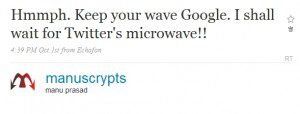
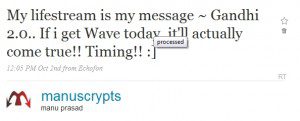
Tag: Google Wave

  • Converse

    A few days back, I read on RWW that Google Wave has released Wave Elements, which allow waves to be embedded on any website. Despite what might seem a ‘never took off’ status, I still thought Wave had potential. Buzz did confuse me in this context, and I wondered about Google’s strategy – whether they’re simultaneously developing the two products for consumer/enterprise users, or using one as a stepping stone for the other etc. My usage of Google Wave was limited to the first few weeks and Buzz faded out in a few days.

    My primary issue with Buzz was that rather than new conversations, my contacts mostly had feed imports from Reader, Twitter etc, with little value addition. Buzz never gave me the option of removing specific feeds of users. Also, I couldn’t export the conversation which happened inside Buzz to the blog. The latitude-buzz based ideas remain complicated. All this, in addition to all the criticism that came their way right after the launch. It just made a mess of all my contexts.

    But when I implemented the Facebook ‘Like’ button last week, I wondered whether I should implement the ‘Buzz’ button too. Like I’ve said before, I think most offices can’t afford to block GMail, so Buzz might help in the sharing better. 😉 Still thinking about it. Meanwhile, what I did try, is to add Facebook Insights to this domain. I stopped at six ‘Bad Request’ responses. Now, if I have shared my blogs with FB, I can’t see why they can’t make it easier for me to add Insights. They seem to be prompting me for a dozen other things these days!! With all the other plugins, this could really help.

    I had hopes on a similar line for Buzz too. Simplistically put, if i shared my blogs with Buzz as a publisher, could they automatically assign a shortened goo.gl url to it, and notify me when it was shared? While at it, also tie it to my Analytics, for even more details.

    The thought is pretty simple. Someone ‘likes’ this post, shares it on FB/Buzz, a discussion happens around it, and a reader here might not even know about it. Hell, I might not even know about it, if I haven’t implemented a few tools.  Can that be rectified? Also, can FB/Buzz help export the conversations from there and (also) show it on my blog,  because it provides the reader an easy way to know different perspectives on the matter, even though discussions have been happening on other platforms, and perhaps even discover people with similar interests. (There is at least one FB comments plugin that pulls comments from Notes, but I was looking at something that would identify the url irrespective of who shared it)  I’d say the same for Twitter too, except I don’t think they even have threaded conversations completely right.

    until next time, scaling walls

    PS. I don’t think Disqus is there.. yet
  • Wavering

    My twitter stream over the last weekend and to a certain extent this week too, was dominated by Wave. People asking for invites, writing about their first impressions, cracking one liners and so on. The entire activity reminded me of how brand custodians try to create ‘virals’. From making ‘viral’ a part of the strategy, to announcing on the day of the release that they have ‘launched’ a viral, there are stories and stories. For me ‘Wave’ was a viral. Google has done this before with GMail. This time too, there was hardly any advertising. It was banking on the brand and product equity of Google, and the (potential) awesomeness of the product. It made me think on both fronts.

    Google’s brand identity has been dominated by search. For most people, it is their starting point on the web. But its not just that. From the iconic, simplistic, patented home page and the doodles it exhibits there, to its attempts to disrupt the real time conversation domain that is dominated by Facebook and Twitter with Wave, Google is many things. GMail, Orkut, Picasa, Blogger, YouTube, Maps, all operating on different domains, and brands in their own right. And they only make up one part of what Google is today. (link to an informative analysis of Google) Currently valued at $100 billion, and rising. Though wary of it, the brand has my respect, and for me, Google has been awesome.

    Awesomeness. Umair Haque had an extremely interesting post about awesomeness recently. He wrote that innovation is passe, that it is ‘what is commercially novel’, doesn’t create anything fundamentally new, and that awesomeness is the new innovation. He lists ethical production, insanely great stuff, love, and thick value as the four pillars of awesomeness. Arguable, right from a semantics/ new buzzword premise. But I tend to agree, especially when I see the stuff being passed around as innovation.

    Now, some of you might be aware of this, but for those who don’t, Google has a ten point corporate philosophy. An extremely interesting set of things, which you must take a look at.#10, I thought, was related to awesomeness. It goes “Great just isn’t good enough.” Google believes that great is just a starting point, and their “constant dissatisfaction with the way things are becomes the driving force behind everything we do.”

    They obviously felt that the entire domain of real time communication, search, sharing and collaborating could do with some disruption, that would explain Wave. And from the time I saw the video, I’ve thought that it would be a game changer, and wrote as much. But the feedback so far has been less than encouraging. From productivity killer to RSS, The sequel, it has been called quite a few things. The opinions are from guys who know what they’re talking about.From the little I have tried it out, I’ve to admit it can totally knock off productivity, but then again so can Twitter. Its less fun if there aren’t many around. Twitter in 2007, for me. Most are still learning, because it IS quite different. Seth Godin called Twitter a protocol (yes I keep saying that because its absolutely apt), I still figure that Wave has the potential that it showed in the video, the potential to create its own protocol. After all, there must be a reason why they call it a preview.

    But it did make me wonder about Google and awesomeness. Is Wave awesome, as opposed to an innovation? What if the idea is too advanced/difficult to provide ‘thick value’ now, does it still deserve to fail? Does that mean that sometimes innovation is better than awesomeness? How does ‘failure’ feature in the awesomeness manifesto? What does this do to the overall brand equity of Google? Or is brand equity an excuse/surrogate for thin value, and exist only in theory, or until the last good product?  But maybe Mitch is right when he says that we’re killing it before it begins. More after I play more with it.

    until next time, a wave new world

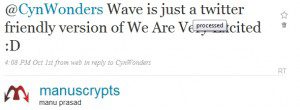
    PS: a few of my Wave tweets below 😉

    Clipboard02Clipboard03Clipboard04

  • It starts..again..

    Facebook is on the march, though I have no clue about the destination. A few days back, I read about the ‘Search Inbox’ feature getting added, that’s after the overall search was revamped and the rumours of the “Everyone Button“. With photo sharing, a revamped mail box, status updates, videos, games, I guess I’ll have to correct the earlier statement and say that the ‘walled garden’ has offered enough evidence that it is making itself *the* destination.

    I remembered an article I read a couple of weeks back on how its this merging of activities on facebook that has given it a growth of 8.54% growth in the last month, as compared to Twitter’s sudden fall to a relatively dismal 1.47% growth rate. As Shefaly pointed out the last time I’d compared the two services, there’d still be an audience that consider the Twitter protocol more useful in spite of Facebook’s ‘charms’. A general comparison of the user figures would show that Facebook has the mass. Whether the Twitter audience is a good enough number, time will tell.

    The other interesting article I read was about the social network identity crisis. For one, this is not about us, the users, but the networks themselves. I’d written sometime back about LinkedIn’s attempts to be like Facebook, which thankfully didn’t develop much. This article compares LinkedIn, Facebook and Twitter, and their overlap. Friendfeed is another unique character in the mix, and serves well as a great aggegator, though it does appear geeky as far as the average user of Facebook goes. Like I’ve said before, Friendfeed thinks up all the neat stuff, and Facebook makes them popular to the masses. As for LinkedIn, their ‘official’ networking positioning keeps them at a safe distance now.

    But yes, the battle, in different manifestations for several years now- as mailboxes, portals and so on, has been for the spot of destination site, or rather the starting point of the user experience on the web, the first site a user opens on his browser, the base. And that’s the reason i feel that the recent spate of Facebook’s initiatives, while they seem to be aimed at replicating the utility of Twitter, are actually targeted against Google, and specifically, Wave. The approach of both are actually from two opposite directions – Google, from Mail and Talk to the spectacular collaborating, sharing and weaving features of Wave, and Facebook from social networking to newsfeed, to chat and mailboxes. Wave is Open Source, Facebook is opening the stream to developers. It will be interesting to see whether there can only be one/couple/all survivor/s from Wave, Facebook and the simple appeal of Twitter.

    until next time, Wavebook 🙂

    Update: Excellent post on Facebook vs Google, (click it, dammit :p) and here too, and why Facebook has a chance.

  • Facebook, Twitter, and the future Wave

    Call it coincidence, but in the last few days, I have read two detailed interviews of the founders of two of the most talked about services  these days- Facebook and Twitter. Coincidence, because my last post ended exactly there – the future of Facebook and Twitter in light of the impending Google Wave.

    Inside Facebook had an interview with Mark Zuckerberg a few days back on his plans and the direction which Facebook would want to take. It starts off with how Facebook’s profiles are based on real identities and that has been at the core of Facebook’s activities, the Newsfeed, the developer community built around the Facebook Platform, and the more recent Facebook Connect. He points out how real identities drives communication, siting examples of how mail on FB is used a lot since people need not remember someone’s mail id. He discusses the rise of content creation – specifically photo sharing. (where Facebook is speeding ahead of competition) On another front, Facebook is also testing out a payment service, which if aligned with Connect, can be useful outside FB too. While on currency, he clarified that FB aims to be cash flow positive next year.While he expects music, location based services and travel to be the main verticals, he says that gaming has been the surprise package.

    Search Engine Land’s talk with Biz Stone on Twitter was also a very interesting read, thanks to references to the repositioning of Twitter, as a sharing and discovery service, aided by the ability to form groups, a redesigned homepage. He also discusses the importance of real-time search and the ballooning of rumours that happens on Twitter. While on the subject of the recent change to the @replies sharing, he talked about creating ‘playlists’ of people that can then be shared.He also spoke about the importance of SMS and how Twitter can be made more useful to beginners – “what do you want to find out” instead of “what are you doing?”. Meanwhile, in a panel discussion in New York, Twitter exec Jack Dorsey commented that he wanted twitter to be as ubiquitous as SMS, but obviously much more advanced and useful than that. I also saw a very useful article recently that discusses the 10 ways Twitter will change US business, which include hyper local marketing, measurement of other media, replacing message boards for stock/financial discussions, democratisation of media, data mining, news alerts, micro payments, effect on telecom companies and governmental agencies, and fund raising. But there’s something about Twitter that goes beyond all this, maybe I am a bit biased, but check out this excellent read on the subject.

    Now in this context, let’s take a look at Wave. If Google is able to sync existing high profile properties like You Tube, Blogger, Picasa, News, Calendar, Latitude, Orkut and even say Knol and Reader, a lot of the advantages of Facebook that pertain to real profiles might cease to be huge advantages, since my connections on Google are usually people I already know – real people, so to speak. The other point is that all these services have quite huge crowds on their own, and sets of crowds that use combinations of these services. It remains to be seen whether Google finds it worthwhile to provide integration options on Wave, and then top it with real time conversations, and the ability to create portable waves. The consolation for FB is that so far, Google has not been able to do any breathtaking synergy exercises.

    Twitter seems to be moving towards harnessing the power of crowds to help people find what they’re looking for. Twitter’s dual strengths, IMHO, are still its simplicity, that allows it to be used for a variety of purposes, and the army of developers who create apps that actually transform these concepts into usable tools. The overlap of my Twitter crowd and Gtalk (and so possibly Wave, when that happens) is in decimal percentages, but if Wave can use its ‘openness’ to connect friends of friends..to a few degrees, that advantage might be lost sooner than later. Wave might also be able to replicate the real time advantages and the ease of use that makes twitter so useful. To be noted that twitter is working on Verified Accounts.

    I’d say that both Facebook and Twitter have to work harder and faster if they’ve to offset the effects of Wave. They will obviously not disappear overnight, but users might actually question the ‘utility’ of being on the networks. On its part, Google’s success with Wave will all depend a lot on how they manage to integrate their services, and the kind of apps that the developer community manages to bring out.

    until next time, the changing status quo? 😉

  • Wave Content

    And just when Microsoft seemed to get moving on Google, with Bing, its new search engine (in case you haven’t heard) with a $80-100 million ad budget, and bundling the real time social search engine OneRiot with IE8, Google comes right back with what could potentially be a game changer for a whole set of services, including Facebook and Twitter, in addition to the obvious mail, and search services. Last week, most of the web world were giving raves for Google Wave. In many ways it took the zing out of MS’s announcements.

    Look no further than Mashable’s Google Wave guide for details. To summarise, Google Wave combines email, chat, IM, wikis, social networking and many other potential uses. A ‘wave’ is a conversation thread that can feature one or more friends and even bots (that can source and modify information, communicate with users etc) and have documents, videos, images, maps etc, there’s drag and drop file sharing too. It can be modified by any participant, who can also add other participants and all this and can even be taken outside to say, a blog. And all this is real time, and really real time, where I can even see the other participant/s typing.  There are also gadgets (like Facebook apps) built on the OpenSocial platform. (so if someone develops a Scrabble gadget, we can play a multi user game live, and maybe add photos of our playing while at it). And there’s an API for developers to build more and more applications. To really understand what the fuss is all about, check out the video. Its way more than an email+real time communication and collaboration  tool on steroids. But with all this content, Google really needs to have a lot of storage space.

    httpv://www.youtube.com/watch?v=v_UyVmITiYQ

    Wave seems to be aiming at turning the entire concept of social networking on its head. Instead of a single service (Facebook/Twitter), a conversation could be started on anyone’s Wave interface, participants dragged in, and new content created and collaborated upon, and then taken outside. Take a few Google products, for starters – Blogger, Google News, Picasa, YouTube and imagine what one could do with real time collaboration on these. Create a post, have live comments, and then post it. Wait, maybe I won’t even bother to post it!! I am wondering what sort of privacy settings would happen here, would we able to create groups (like say, FB) and set different criteria for different sets?

    Now, look outside Google, say Twave – Twitter + wave, that uses a Tweety Google bot to display your entire Twitter feed on Wave, where you can archive it, thread conversations and so on. Imagine what this could do to say, news reporting. Live wikis, with witnesses collaborating to create authentic news stories, and the crowd being the check and balance.

    Gmail is addictive, and many users usually neglect their other ids after they become used to the functionality of GMail. If Wave does deliver all the above, then the season’s favourites – Facebook and Twitter really need to look over their shoulder, more so, because the new stream creator is not just another player, its Google. There’s another aspect I am thinking about. Mashable’s testing report states that “Central to Google Wave’s interface is search – you create specific searches based on not only keywords, but activity, history, person, and more.”  Unlike FB and Twitter, GMail users are used to ads, if Google Wave starts off with ads, the resistance to it might not be a lot, especially if they’re of the useful contextual+semantic kind. Twitter was called a protocol (Seth Godin, I think), perhaps the protocol standards have been upped.

    Meanwhile, though i think that Google Wave is a great piece of work, as always, I am also worried about Google being the beginning and end of my web experience. There’s just too much power there. 🙂

    until next time, surf the wave