Tag: Google Reader

  • Death of an echo chamber

    The BBH Labs Blog has a very interesting post based on a research that reexamines one of the most debated topics even in the hyper-connected era – the echo chamber. From the research abstract “We propose a trade-off between network diversity and communications bandwidth regulates access to novel information because more diverse network structure increases novelty at a cost of reducing information flow” I am yet to read the research completely, but the post gives me enough fodder for now, because it asks “where does one find the most novel information per unit time?

    For a lot of people that I know virtually, the answer would be Twitter. My relationship with Twitter has had several kinds of highs and lows over 4 years. For the last few months, it has been a constant though, and is a very limited relationship. Somewhere in the journey, Twitter became too crowded for me.

    Thankfully there was another ‘social network’ that has been my bedrock for a long while now, and that is my answer for the question asked earlier – Google Reader. Reader is not a network that has grown exponentially for me. My network there does not exceed a dozen, and without referring to it, I can name the people I connect with, and why.

    I rely on Mahendra to give me the latest news and best perspectives in tech. Ditto with Prasoon, whose “Share with note” gives me the money-shot notes in posts I should, but am too lazy to read. 🙂 Surekha keeps me up-to-date on media and PR news that I wouldn’t otherwise know about. Balu – despite being an NRI now – unearths India-specific tech posts I’d ordinarily have missed, and gives me vicarious experiences of the world of gaming. Gautam John provides mouth-watering food posts and news/views on India/Wiki that everyone should know about and have a considered view on. Vedant gets quoted in many blog posts that I write – on this blog and the personal one – as the source of the work that started a thought in my head. There’s Josh Rutner, who must be reading a zillion posts to discover the insane stuff he shares. Rahi is a relatively new connection, and I have to thank her for some of the best blog posts get to read these days. Anand somehow has a way of bringing to my notice posts that I missed in their first run, and I silently thank him each time. Just when I think Patrix has gone away from Reader, he shares an excellent post that grabs my attention. My network on reader would notice a name that’s conspicuous by its absence – and that happens to be my favourite Reader buddy – Roshni. If she has shared it, it has to be read, because one way or the other, the piece will deliver! That, ladies and gentlemen, is my Reader network, and that long paragraph would explain why I was shattered when Google decided to get evil with Reader.

    The BBH Labs post, and the research has this to say about strong ties – those who know you well know what type of information is novel for you. Over a period of time, the network and I have grown to know each other very well indeed. Once upon a time I had a theory that once everyone figured out everyone else’s sources on Reader, shares would become unimportant and I’d never discover anything new. I was obviously stupid, and guilty of hugely underestimating my network because they were constantly filtering and building new sources to learn, and help me learn. It made Reader the best echo chamber I ever had, and this post is so that I, and the web, remember it, always. “Oh oww, Oh oww, Oh oww.”

    until next time, MAAR – Mark All As Read
  • While on contextual reputation…

    Though I don’t answer much on Quora, I am quite a gawker and vote up answers too. One feature of Quora that I found extremely interesting and useful (and tweeted about) is the way Quora gives contextual ‘reputation’ (while reading answers) using the person’s topic bio. The interesting coincidence (because he also RT ed this tweet) is that I noticed it thanks to Mahendra‘s answer to a ‘Google Reader’ based question, and right next to his name was “Daily, dedicated user. Subscribed to over 200 feeds, followed by over 700 people on Reader/Buzz”. I must admit, before I realised that it was a topic bio, my first thought was why Mahendra was ‘wasting’ his Quora bio on Reader when he had such a huge list of phenomenal things he could say about himself. 🙂

    But yes, coming back to ‘contextual reputation’, I liked it because it gives a lot of relevance and credibility and adds a layer to an answer – you can better understand where this  answerer and his response is coming from, for example. Another nuanced way of helping the reader weed out noise. I also thought this was a good way for brands/organisations to develop credibility in their domain, and involve their users, using function specific spokespersons, (brand, HR, operations etc) since “brands are currently not supported on Quora“.

    And now we can go off on a tangent and check out a few brand experiences I had last week, all with oblique connections to contextual reputation, though lycra like they might seem 🙂

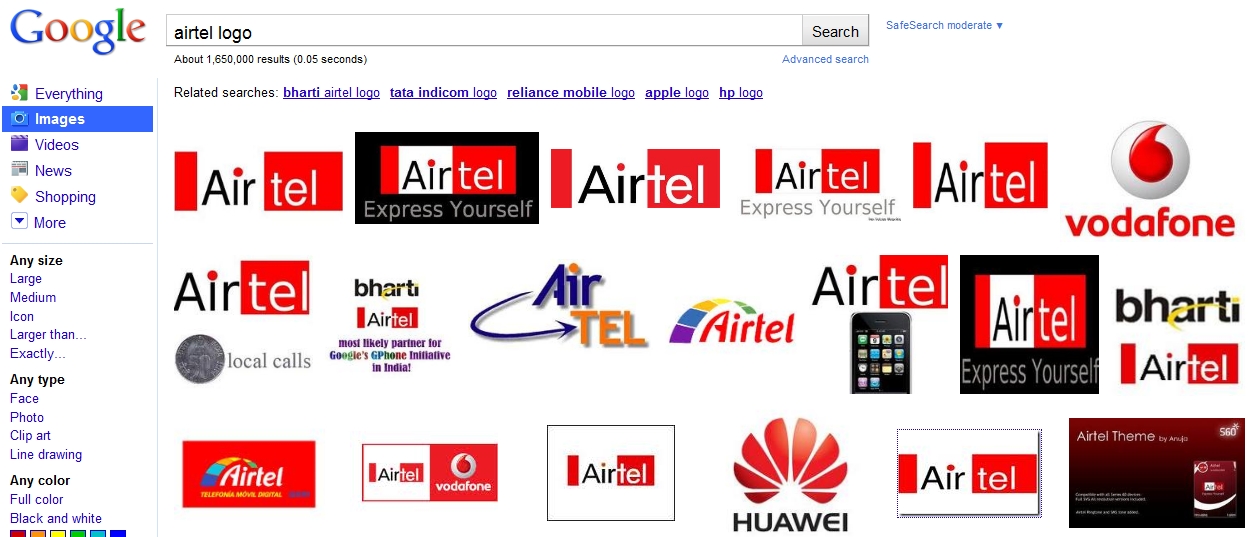
    When Airtel changed its logo sometime back, though there were infinite debates on the need and quality of the new logo, their on ground management of the logo change was almost unequivocally appreciated. However,

    To their credit, the ‘everything’ search, though has the old images, has the first link pointing to the new logo. But from an image perspective, ‘contextual reputation’ for logo change online gets a thumbs down.

    Cleartrip, quite a favourite brand for their ‘no nonsense. clear talk and action’ way of managing their product and online presence, has a new campaign ‘Every trip has a purpose‘. But favouritism unfortunately doesn’t stop me from wordplay and I tweeted

    Just as i was chided for provoking a brand, and was replying that I trusted Cleartrip to have a sense of humour, they replied with a ‘laughing hard’. Contextual reputation thumbs up. Hopefully they weren’t being sarcastic.

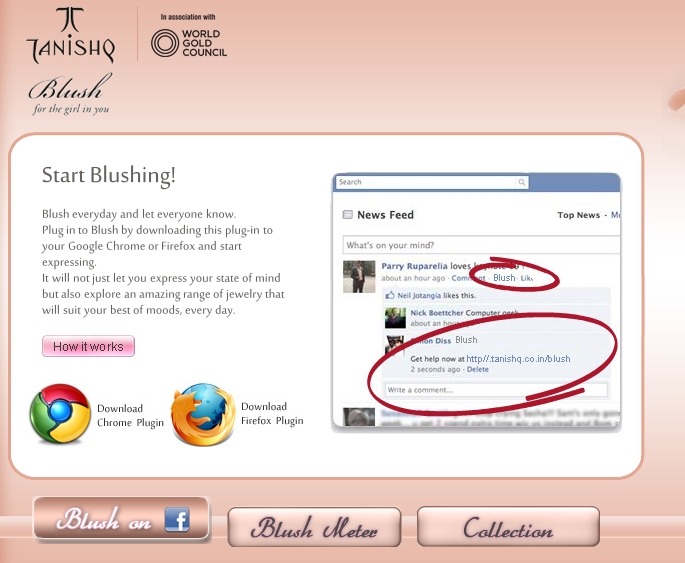
    The last experience was from Tanishq, whose new Blush campaign I came across last week. Like I tweeted then, immediately after the Quora tweet, I found it quite interesting and worth an applause that a brand was experimenting with a Firefox/Chrome plugin. Instead of me explaining how it works, I will, in my new found enthusiasm for imagery, give you a screenshot.

    As you can see, the plugin gives you, in addition to the ‘Like’, ‘Comment’ options you see after a Facebook status, a ‘Blush’ option, which when clicked, adds a comment with a link to the ‘Blush’ page. Hmm. I won’t get into a ‘app within FB vs outside website’ debate (there must be some reason, I assume). But unfortunately, boring that I am, I’ve never seen a jewelery that has made me blush. I can’t even see it in the Tanishq collection, assuming that I have the ‘where to wear it’ right. Maybe girls/women see it differently. So, why didn’t Tanishq just have a ‘Gold’ button, which would actually add to their ‘contextual reputation’ more than blush, and tie it to some sort of action that would actually get something tangible for all involved.

    For example, I install the plugin and start using it just because of the ‘show off’ value. What if they tied in an offer linked to the number of “Golds” I gave/received on statuses, and then communicated that in the comment that appears after I have ‘Gold’ed a comment. Or how about virtual gifts, a way to showcase the gallery, and then an easy app to add the virtual gift to a profile pic? I have an inkling that women are likely to have a “nice earrings/pendant. where did you get it from” conversation. They could even make this Like based contest i.e. if you virtually gift someone and get them to add it to their profile pic, and they get maximum likes (make a leaderboard) we’ll let you actually gift them for free. Do that on Valentine’s day, and it just might work.

    Meanwhile, I have a ‘reputation’ for longish posts, so I’ll just stop here.

    until next time, add to the context?

  • But what do I know?

    Unlike in my other blog, Seth Godin is rarely referenced here. But when I read this post (rant, he says) from him titled “Deliberately uninformed, relentlessly so“, I sensed some vague connection with something I’d written a while back.

    Unlike other posts of Godin, whose blog I religiously follow for its ‘food for thought’, I found a smugness to this post – perhaps the rant provides the liberty. But as always, he manages to make a point. However, for a second, I wondered about the irony of this post coming from someone who does not allow comments on his blog. And thus this post.

    It is to be noted that he did not switch off comments just like that, he has valid reasons. Even if one just looks at the scale (1858 people retweeted and 2373 ‘Like’s) and considers  only a certain % commenting, it would tend towards chaotic. But whatever the reasons, he has chosen not to use comments as a channel.

    Ok, lets move on to me now. 🙂 I don’t read business books, however I follow several blogs in my line of work and otherwise. I rely on my Twitter, Reader and (occasionally) Facebook connections to point me to interesting reads. I also use Wikipedia extensively, despite the accusation that crowdsourced content can only be so trustworthy. From all this consumption, I have ‘superficial’ information on a lot of subjects, which make good conversation. This is also because I have way too many interests, and I’m forever in awe of things I don’t easily understand. My interest sometimes wears off after I’m able to bring a subject to my horizons of understanding. Sometimes, a more knowledgeable person corrects me/points me to things he/she thinks might interest me further and whenever I need/want to know more about a subject, I try and use the web’s sources to the fullest.

    But here’s the thing. Once upon a time, I could remember websites in context and add to discussions (offline), but increasingly I rely on delicious, among other things. I’m forced to prioritise my memory thanks to the ton of information out there that I process daily. Ok, that, and age.  🙂 And this is not a problem that will end soon, and its something I keep bringing up here. (Read)

    Time is the new currency, and I increasingly feel that people now react mercilessly to an “I don’t know”. Is that an excuse for people to claim knowledge of things they know nothing about? Maybe not, but perhaps like many other things, it is one of the ways for them to feel accepted and have a sense of belonging. So yes, it might be easy to label it as being deliberately uninformed, but in judging people so, without context and more understanding, we might be falling into the same trap ourselves – about people this time, as opposed to subjects.

    until next time, judge mental capabilities?

  • Facebook Groupie

    What kind of a blog would this be if we didn’t discuss Facebook’s new announcements. At a simplistic level, it would seem that Facebook learned a lot from that Google study. (via a conversation with Mahendra)

    Though i can’t access it yet, I’m very happy with the backup option, and hope that its a step towards portability. The new chat availability ‘visualisation’ seems slightly better than the old one. I can’t see the app dashboard yet.  But the other big announcement was the revamping of groups. I’d been categorising friends using lists for a while, but didn’t actually utilise them for anything specific. Though its easy to see this as a wall within a wall, from initial usage, I think the new Groups allow that one layer that needed to be added to generic ‘friendships’ – context, not to mention better control over who sees what. And from what I see, I don’t even have to be friends with a person to share things and have a great conversation on a topic both of us like. There are other advantages too. Of course, there are a a few issues, and as always, Facebook kept everything as public as possible (as default) but changes in this version is as inevitable as the waves of outrage that follows all Facebook announcements.

    I’m still debating whether I’d like the Groups to be integrated better in the newsfeed (with ways to filter as per importance) or whether its current location (sidebar) is a better approach. From a signal-noise perspective, perhaps it should stay the way it is. I’m not very convinced about looking at Groups as ‘Friendfeed going mainstream‘ or even Wave. But that does make me wonder whether the next version will also have a feed aggregator, directly, or indirectly – allowing apps like Networked Blogs. That might actually get RSS to go mainstream. 🙂 If that happens, I am also wondering about the implications on Google Reader, and actually any other network which serves as a content distribution/consumption channel.

    Groups can be made ‘Secret’, and I’m still not sure how ‘Open’ and ‘Closed’ groups will show up in Facebook Search. Also, since I still don’t have access to Places, I can only wonder whether ‘Location’ can also be made a group feature. I’m seeing both the above from a brand perspective. Would a brand, for example, be able to highlight a location specific group on their Page, as part of a local promo? Even if the brands do not get information about the groups, Facebook would still have it, and that would definitely help target ads better.

    Groups are not really a silver bullet, but I don’t think Facebook is aiming for that now either. Its just that they’ve not missed the starting gun, to slice and dice my social graph – that’s useful for me, as well as advertisers.

    until next time, group on 😉

  • Version next

    Those kind souls who follow this blog’s feed on Google Reader or a similar service, might have noticed the change in url a few weeks back, to the /blog sub-domain. Apologies for the sudden flood of old posts in the last few days, the shift caused a few hiccups, and a post was also sacrificed. Thanks to an e-mail, it was retrieved, and was re-posted yesterday. The kinder souls who read posts till the very end might have noticed a small line on an announcement, a few posts back. Actually there are two, linked to each other. One of the announcements is the revamped main domain – www.manuprasad.com.

    I’ve always been experimenting with lifestreams – from the easy to set up Friendfeed to the slightly more difficult sweetcron, and several in between. But this time, I decided to get it done by a professional, and as far as my needs and expectations are concerned, Chugs did a great job.

    But why now, and why a professional approach. Well, the other announcement is that I’ve quit my job in The Times Group, though my last working day is more than a month away. I sense great shifts happening in the way we work, live and the way we function as a society, and I also feel that this is a great time to start creating the job work profile I’d like. The new website is a reflection of not just my work interests, but also me, as a person. My skill sets and interest areas are here. Thanks for your interest in advance. 🙂

    We started with Google Reader, so let’s end with it too. A significant feature was added to the service a few days back. Google Reader will now help you keep track of even pages which don’t have a web feed, like www.manuprasad.com. I plan to test this using my website, as I see it as a harbinger of some inorganic developments in the ‘feeds updates’ domain, which will be of great interest to corporate and brand websites.

    until next time, www.manuprasad.com, take a look 🙂

    Bonus Read: Hugh McLeod talks to Seth Godin on Linchpin

    PS. Meanwhile, a slightly dated piece of news – Got featured in Surekha Pillai’s list of top 10 desi twitterers in Impact magazine :))