Tag: Google Me

  • A different social circle

    The ‘inefficiencies of scale’ in a social business scenario is something I keep writing about – wrote about it recently in the context of Google vs Facebook too. So I found this article, which was about the demise of Facebook in 5 years, very interesting. Though predictions are dime a dozen and are many a time used as traffic boosters, this one comes from a person who predicted the decline of MySpace four years back. What interested me even more was that he said the single social networking platform concept will give way to smaller networks.

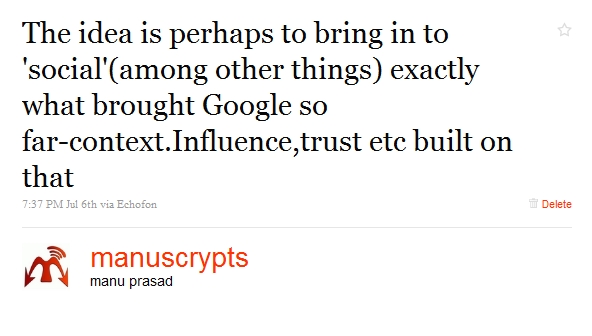
    Meanwhile, after all the hype Google Me generated, and expectations of launch in Fall 2010, our knowledge remains at a ‘social layer’ level and its internal project name – Emerald Sea. So, when i saw Google’s foray into fashion – boutiques.com, and its working, I wondered for a moment whether this could be another rendition of Google Me. After all, a common interest is a great context for social interaction too. And over a period of time, search would be honed better and be social too, with a curation (like shown in Boutiques’ case) that goes beyond algorithm and crowd.  This interest could be a place (say hello to Google Hotpot), or an interest that aggregates people, like books. (yes, Google’s store is coming soon) That would be changing the social landscape quite a a bit. Add to it shopping and say, a GroupOn integration by context/location and Google will have fun, not to mention local advertising revenues. It would also have a better grip on aspects like privacy, influence, and would be smaller networks rather than an all encompassing one. Its a bit of wild and far fetched thought specially when we know that Google Me is now slated for Spring 2011, but interesting, you think?

    until next time, off for a fortnight 🙂

  • Culture Bridges

    There was much excitement when I saw that much talked about presentation that somehow seemed connected to Google Me and Google’s approach to social. But the sounds made recently by Darth Scmidt don’t really give cause for delight.

    While it doesn’t make sense to talk ill of something even before launch, the ‘social layer’ does sound underwhelming. It doesn’t help that Mark Zuck recently hinted that ‘social is not a layer you can add’. ( What is interesting though is he also said in the interview “We’re trying to build a social layer for everything”) He should know about what works in ‘social’, because whether you love or hate Facebook, it is definitely a creation (and creator) that demands respect, on various parameters.

    Somewhere towards the end of his post titled ‘The Forever Recession‘, Seth Godin, while talking of the ‘recession of an industrial age with its imperfect market communication’ paraphrases Clay Shirky and states that ‘every revolution destroys the last thing before it turns a profit on a new thing’.

    I thought about this statement in the context of Google and Facebook, and also remembered an earlier post at GigaOm which showed the difference  between the way Facebook and Google work. And that prompted me to wonder whether every age has a unique organisational and workforce culture that best fits it, and the entity that grasps it, succeeds.

    This is not just a Google-Facebook question, but one that I’d consider across domains and categories. The leader in an earlier era would try to capture that culture mojo and would most likely fail because it tries to add to what it has been doing so far, where a start from scratch is what is warranted. The interesting part is also that the time between ‘revolutions’ seems to be consistently decreasing, so how do brands and organisations carry their success across?

    until next time, a revulsion for revolutions?

  • A different kind of social

    Despite a healthy skepticism for all things Google attempts with social, Wave and Buzz not having helped very much, I was quite excited after I saw the presentation below by Google’s Paul Adams. (the link which I had shared last week) It meant that Google Me was worth keeping a watch on. No, not the movie, the service.

    [Read Mahendra’s excellent key takeaways+thoughts post if you need a quick snapshot without having to read 216 pages.]

    I was quite impressed with the scope of the presentation – from looking at people’s motivations behind their ‘social’ actions to the insights that have been gleaned. I must admit that i was a bit surprised that Google, or at least its employees took social this seriously. Good to know that Facebook and Zuckerberg’s stated aim of 1 billion users in the near future is finally pushing Google to do something other than killing of services (Jaiku, Dodgeball…) or making a mockery of itself in front of its competitors with half baked products. And that they’re doing research too. My first thought, after I finished reading the document was
    Clipboard02

    Its ironic that Google faces a ‘What Would Google Do’ on itself. The good news is that there is enough scope for developing a network for context based social relationships and transactions. Like I said in my last post, the tools available still don’t allow me the freedom to aggregate and disaggregate connections and content at will in different contexts. It is possible to build a social network around many contexts – enterprise/professional use, location, family, interests and so on. I even saw an interesting app built for ‘proximity based networking’ – it syncs your existing networks – Facebook, LinkedIn, MySpace with location and thereby does a twist on location based networking, with seemingly good privacy controls.

    The bad news is that Mark Zuckerberg won’t take too kindly to encroachments in his space. As if ‘friends’ weren’t universal enough (at least inside the FB universe – including Connect), ‘Like’ is even more universal, and Facebook’s recent play is aimed at pipping Google’s (relative) ability to deliver the most relevant content to the user. It doesn’t help that social doesn’t seem to be what Google’s comfortable with.

    But assuming Google Me is a social platform of some sort, what I’m wondering is that how many users would use Facebook lesser for a service which allows context to be brought into the picture. There’s something really simple about the ‘sharing’ on Facebook. For a service that used to be labeled ‘complex’ in the Orkut era, it has come far. Users have adapted. Also, how difficult is it for Facebook, which already has a massive userbase to introduce features that allow a user to create sub identities to splice and dice friends (already has lists) and content and choose what to use outside the network? It already has filters to control the kind of information I want to see on my newsfeed, these can be improved too.

    The other thing is how/where Google would build this – a separate service/ something around or integrated with iGoogle/Buzz (brrr)/Chrome (browser or OS)/ Search itself ? A lot of the design would be based on this. And how can it balance the simplicity of Facebook sharing with the more complex needs of context and privacy?

    A larger perspective is that we’re nowhere close to the end game as far as our (probably seamless in the future) network of digital and real activities go. Its having a larger impact than what we sometimes credit it for. In fact, we are only discovering how the web is changing our behaviour and even perhaps motivations. A few of us have yet to decide whether we want to sync our multiple online identities. And that means that though Facebook is probably the most accepted solution now, its by no means the perfect one, even for our current understanding. Facebook, Google and the ones we haven’t even heard about are all Work In Progress, but boy, what interesting work it is! No monopoly, lots of chance and multiple community chests 🙂

    until next time, google yourself 🙂

  • Services, Information, People

    Even as the first trailer of ‘The Social Network‘ was released last week, and even as fresh rounds of humour/angst on Facebook’s privacy algo (Google’s too) are unleashed regularly, I found that the amount of things I share on Facebook has vastly increased, though the time spent hasn’t increased in proportion. Its probably the ease of sharing information, the threaded conversations (none of my usual twitter clients have it) around the shared item, or the lack of (self imposed) constraints that my blogs suffer from, but photos, videos, comments and all sorts of content (my own as well as the ones I find) get shared on FB. Sometimes I even miss not being able to send a quick mail (where is Project Titan?!) to someone on FB from GMail (yes, I have FB friends who I don’t connect with on GTalk) In a recent interview, Mark Zuckerberg also shared his views on credits, and its portability. With search and location coming up as major initiatives, I wonder when my Facebook data will become portable.

    In this context, I saw the three kinds of webs (similar to the ones mentioned in the last post) and more that are almost seamlessly connected now – information, service and people. The need for filters in this information deluge is indeed pressing. While I do see some nifty tools that are being developed (eg. Pivot , Avoidr, specific search engines or even Twitter’s annotations) I sometimes wonder if it can ever catch up with the broadening scope of commonly used services. That’s also the reason why I think Facebook’s Open Graph search engine, which aims for social semantic search, is a big step, even while granting that not everyone’s on Facebook and their execution still has some way to go. Add to this privacy/security concerns (even Twitter was pulled up recently), and it does look complicated. Further layers like location will only add to this. And I wonder what new levels of complexity Google Me will bring. With each new service, the deluge of information increases, many times in the form of repetition, and our consumption changes.

    The increasing usage of these services has meant that the web of ‘friends’ have also increased. In my case, while FB consisted of only real friends earlier, in the last few months, the number of virtual friends – mostly from Twitter, have increased manifold. Since I don’t usually share anything on the web that I don’t want anyone to see, my problems with privacy have been limited. But as the amount of sharing increases, I realise there are things I share that could be taken out of context. There is also the fact that personal and professional lives are no longer silos. (Read) The other take out from the last point is that its not just communication from brands/services that need to be looked at closely, but people too.

    When the three webs are absolutely seamless, we will also see a shift in the kinds of relationship we have shared with brands, services and people. Facebook making payment for advertisers easier, sending me marketplace links, services making it easier for embedding ads, posts from my ‘friends’ plugging services/products with no disclosure, all work as signs for me. I do see a lot of work in setting up new ‘trading currencies’ and even different kinds of social networks (mobile phones – closed network ) and also note that the one factor that all the three entities need to keep in mind is trust. And that’s when I begin to wonder if similar systems are being developed for ‘sharing’ trust and whether they can keep pace with the deluge of information, services and people. Or maybe its already working under the radar – new services (endor.se), recommendations on LinkedIn, Twitter lists etc.

    until next time, SIP investments for mutual benefits 🙂