
Tag: God

  • The wonder eras

    The Lanka trip earlier this year, and specifically the Day 2 visit to Sita Kotuwa was quite an experience. Like I said in the post, its difficult to describe the feeling when one sees evidence that points to the actual existence of characters who were  considered a part of stories and mythology. Its one thing to theorise about what our gods really were, or read  historical perspectives, and another to come face to face with the reality of it. Of course, we could debate that Rama was human, and only considered an incarnation, but if the events in the Ramayana did happen, there is enough ‘godness’ in it for us to still wonder.

    I read ‘The Rozabal Line’ by Ashwin Sanghi recently, which is a fictional story based on the Jesus in Kashmir theory. The author has done considerable research on this, as evidenced by the notes, acknowledgments and references section of the book that spans more than a dozen pages. The domain the book operates in meant that these trails were fascinating, and I plan to follow them online soon.

    Meanwhile, in the book, the author draws parallels to the various messengers of gods who shared a lot of commonalities with Jesus, mostly in terms of events in their lives. They belonged to various cultures and eras before Jesus, thus ‘a great deal of material available to create a story around the historical Jesus Christ’. The existence of Jesus has probably never been in question, as opposed to say Rama/Krishna, but the above, and other things I read in the book, does make him much more human.

    Cut to the present. I read an actress’ comment recently – that she wasn’t on social networking sites because it took away the mystique surrounding her. Fair point, and I had to agree, considering how most actors and ‘celebrities’ in general use the sites to showcase feet of clay. I’m not comparing celebrities to gods, not yet, but in the eras before hyper communication tools, and further back, before ubiquitous magazines and television, there was probably more fiction than fact built around celebrities. The persona overshadowed the person. But now, they seem to be just regular people. Not that they aren’t that, but its more in-your-face.

    And thus I wonder, about the gods of yore. In those times, news got around much slower, and it was perhaps easier for legends to be born and for facts to be coated liberally with fiction. It was also perhaps easier to believe. So when I see images and statues of Jesus these days, I wonder what the real story and who the real person was.

    Ashwin Sanghi took 2 years of reading and 18 months of writing to complete this book. You see, the other thrill of ‘The Rozabal Line’ was having a conversation with its author, while I was reading it. Wonders never cease. 🙂

    until next time, acts of faith
  • Recycling Gods

    Sometime back, I’d written a post about super powered individuals who later came to be known as Gods, and how technology is perhaps taking us closer and closer to these versions of gods. And sometime back, Vimoh too wrote a very thought provoking post on the evolution of Hindu gods, and how, over a period of time, important Vedic gods like Indra, Varuna, Agni etc have lost their importance to a newer set who rose to prominence according to the stage of our civilisation – Ganesha, Saraswati, whose ‘hidden’ characteristics were brought to light. An evolution from gods “that govern the elements of nature to gods that govern abstract concepts of the mind”. He also hypothesises that  in the future, the list will be further transformed when man realises that the universe is more of a network than a hierarchy and when he finds himself at par with the highest of gods and the lowest of forms, he will realise his divinity.

    I’ve always wondered whether the original set of gods was a small number and as needs arose, historical characters were pushed into divinity, their stories exaggerated, and for later generations they served as gods. The original triumvirate – Brahma, Vishnu and Shiva have remained more or less a constant in their importance, though Brahma lost out in terms of places of worship.  But the evolution of gods is something I completely agree with.  As our needs changed and the things we could control changed, it was perhaps inevitable that the things we attributed to them would change. More importantly, they also changed with out interpretations of good and evil. Since our gods have always been close to us, their character and behaviour also reflected this change in ethos.  Huffington Post says they’re now pop culture, through Bollywood movies, for example. But yes, they were always more human, and ‘approachable’ anyway.

    It does bring up a point though. I wonder how our current depiction of Hindu Gods would affect how later generations perceive them. The modern retelling, which sometimes adds layers hitherto absent. Imagine a future generation treating Ramanand Sagar’s Ramayana the way we treat the vedas now simply because earlier sources may not stand the test of time. If they saw Sippy’s Mahabharat and also saw Jha’s Rajneeti, would they be able to grasp the parallel? Or would they miss it because they haven’t ‘lived’ with the gods like we have? ‘Sita’ in the television series was ‘Deepika’, the actress, who has also played other roles in serials and movies. So, without a context, it might be just another role she did. There is a reason I’m thinking this way. Any of the gods could be just a role play – incarnations/manifestations – different roles in different contexts at different times. We rely on certain images and certain texts which are possibly incomplete in their current form. And thus rises the question that invariably gets asked in such discussions – who created who?

    Each age fills up the void of its unknown with its own versions of God or his opposite number. Like Vimoh states at the end of his post, the future explorer will be an amalgamation – with knowledge from many disciplines. For now, we pursue the mystery from among the tools we choose based on our interest, bias, and faith – science, religion, philosophy, and so on. The question is, will we ever reach a point when everything is known, and the God shaped hole would be finally filled with our knowledge. Maybe that’s the point when the current Brahma gets irritated and presses the ‘Delete All’ button, and the Brahman starts with the next Brahma. 🙂

    until next time, divine grapevines 🙂

  • Moth-eaten

    The Mothman Prophecies, a 2002 film (based on a 1975 book, which is supposedly based on real events!) starring Richard Gere, is about a town that has several people experiencing paranormal events. Gere tries to get to the bottom of it, and as part of his research meets an expert on the subject. There is an interesting conversation between Gere’s character – John Klein, and the expert – Alexander Leek. The snips that interested me –

    Alexander Leek: If there was a car crash ten blocks away, that window washer up there could probably see it. Now, that doesn’t mean he’s God, or even smarter than we are. But from where he’s sitting, he can see a little further down the road.

    ………………….

    Alexander Leek: In the end it all came down to just one simple question. Which was more important – having proof, or being alive? Trust me. I turned away years ago, and I’ve never looked back.

    John Klein: Didn’t you need to know?

    Alexander Leek: We’re not allowed to know.

    …………………..

    Alexander Leek: Their motivations aren’t human.

    John Klein: Alright, then. What do they want?

    Alexander Leek: I have no idea. What you really want is to know… why you?

    …………………..

    John Klein: I think we can assume that these entities are more advanced than us. Why don’t they just come right out and tell us what’s on their minds?

    Alexander Leek: You’re more advanced than a cockroach, have you ever tried explaining yourself to one of them?

    …………………

    Now, I’m sure conversations similar in meaning to these have appeared in other movies or books, but that doesn’t make this any less interesting. Though in this context, the entity being discussed was more alien, the discussion could still apply to what we consider God, or for the sake of discussion here – a creator. (architect for Matrix fans) Humour me, and forget evolution for a while.

    Leek nailed it when he said the ‘Why me’ part. The search is that – ‘what am I doing here, really’ though the question manifests itself in many other ways – meaning, purpose, secrets of the universe, life and death etc. Sometimes the argument that one is not meant to know is quite compelling. I read an article a few days back in the TOI, coincidentally, written by one Jonathan Leake. To quote

    Some of the greatest mysteries of the universe may never be resolved because they are beyond human comprehension, according to Lord Rees, president of the Royal Society.
    Rees suggests that the inherent intellectual limitations of humanity mean we may never resolve questions such as the existence of parallel universes, the cause of the big bang, or the nature of our own consciousness.
    He even compares humanity to fish, which swim through the oceans without any idea of the properties of the water in which
    they spend their lives.

    I wonder if that also applies to the ‘God’ question. But when the unexplainable happens, when I sit there awed by the stars in the night sky, when I pause for a moment and try to figure about where this is all going, and the inevitability of it all, it is frustrating not to find any answers.

    Meanwhile, I’m not sure how much of research has been done on the cockroach’s brain (can’t open this completely 😐 ). But sources on the net say that its brain is ‘spread around its body‘, and the question of whether it has emotions is unresolved. Unfortunately for us humans, it is known that we have an ego, and can’t understand why all of it can’t be explained to us. We’re the chosen ones, isn’t it? And we need closures, we’re uncomfortable otherwise. And so the search must continue, irrespective of the result.

    Is it the gods who put this fire in our minds, or is it that each man’s relentless longing become a god in him?” ~ Virgil, Aeneid

    until next time, roach ka lafda 😉

  • Back to eternity

    Despite being a Star Trek fan, I happen to think that Time is the final frontier, at least in the horizon that I can see. I find it quite intriguing that, though it might be looked on as a tool for tracking, I can perhaps not account for most of my lifetime. I don’t mean the large picture, I haven’t lost it totally yet, but specific minutes. Take for example, the last hour and account for all the thoughts that rushed in. I would find it difficult.

    If you close your eyes, and allow your breath to be the only meter, the perspective of time undergoes a shift. Meditate a bit, and its easy to see. Easy to see that even the measurement of time – years to seconds and beyond is our  construct. But it is so ubiquitous and enmeshed in our lives that it seems as though it is a constant and only we change. It requires dramatic events for us to pause and note the passage of time. Kahlil Gibran has said, ‘Perhaps time’s definition of coal is the diamond”

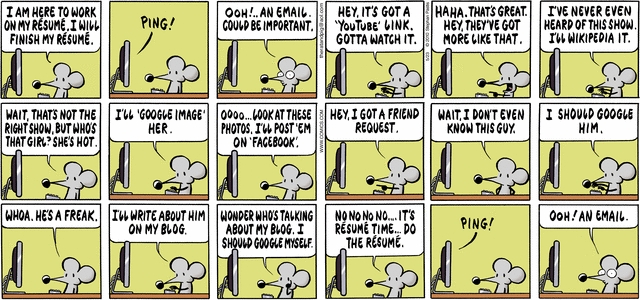
    Meanwhile, I wonder if all the information about those unaccounted for minutes is stored somewhere in my brain, and is just not deemed enough to be of any priority for me, and hence seems inaccessible. The tools that consume me these days – most specifically Twitter, and more recently, Foursquare, also help me keep track of what I’ve been up to, and when it works the same way for everyone is when there is an information deluge, and that seems to be something we find difficult to handle. Something that we have discussed before. There is a toon I found (here) that correctly describes the way a lot of us seem to be functioning now

    Clipboard01

    And in another example of how man is shaping his own evolution, I read about companies like Lifenaut, which  ultimately aim to create humanoid robots powered by a backup of the original human’s brain. (via @pkaroshi) The first step is to create a digitised version – an avatar, and give it enough data for it to mimic the original human. It makes me wonder whether we will be able to create ‘consciousness’.

    And that makes me think a bit more – by the time, we are technologically advanced to create it, will we have forgotten what consciousness is? Which also begs the question whether we have ever understood it at all, when we are not even mindful of the minutes of our lives? How does one define it? So many reactions which seem pre-programmed when one thinks of it, actions and reactions more out of habit than any conscious choice being exercised.

    So yes, with all of the work happening at a rapid pace, (do read) I think its more ‘when’ than ‘if’ – that we will become immortal, and time, from a future point of view, will become immaterial, because the future will be infinite. But we still may not be able to undo what we did a minute back. Where does that leave us? To quote Pico Iyer (from Abandon) “God has to be understood in the context of everything that is not Him”. But that is a different discussion, I guess. Its only that with every advancement that humanity makes, and in that process also usurps things once attributed to divinity, I begin to wonder where that leaves our versions of God?

    until next time, time.ly links 🙂

    PS. I tweeted sometime back, even if you never read an Asimov work, or never plan to, this is one that you should read. The Last Question.

  • Storied

    The best thing about buying second hand books is that they might contain stories. No, I haven’t completely lost it, I meant additional stories. Messages, notes on the side, bookmarks from previous owners – they’re all stories. Stories that give you a tiny glimpse of the person who wrote it, or the person it was meant for. The last one I saw – in Pico Iyer’s ‘Abandon’, was very interesting. It said

    Dearest A****,

    Though this seems, and is the last day at C-72, I promise that its the first day and a nev be start to the best days of our life together.

    Yours

    S*******

    30/Aug/03

    I thought there was an amazing sense of romance in that little note. A story from almost seven years back. I wonder why A sold the book. Did they break up? Maybe she didn’t like this genre? Maybe they shifted, and there was no way to carry this. It was an empty page, A could’ve torn it off, she didn’t. Maybe she didn’t have time, maybe she didn’t care.  Maybe she didn’t remember. Maybe, God forbid, something happened, and S didn’t want any memories? Maybe  she returned it to S after they split, and he sold it. Maybe S never gave it to A, and instead sold it because some memory was too painful? Now you see the possibilities? But, to quote from the book itself “We are no greater than the height of our perceptions”.

    I’d only started on the book, but it had already given me a thought. “The death of the author is a way of talking about the death of God. The world itself becomes a poem whose author disappeared long ago.” So the poet dies, the poem remains, the artist dies, the art remains, the author dies, the book remains, God dies, his creation remains, to be interpreted and shaped by us, the ones who see and experience it, limited by the ‘height of their perception’. Maybe the creation was never completed? Like the stories that remain in the head, never to be told. Like the pages that fill the waste baskets. Like the blog’s draft folder? 🙂

    Meanwhile, on the next page of the book, there is a signature now, dated 10/04/10. He thinks he won’t sell any of his books.. ever. But then, stories have a way of twisting themselves in time. 🙂

    until next time, home pages 🙂