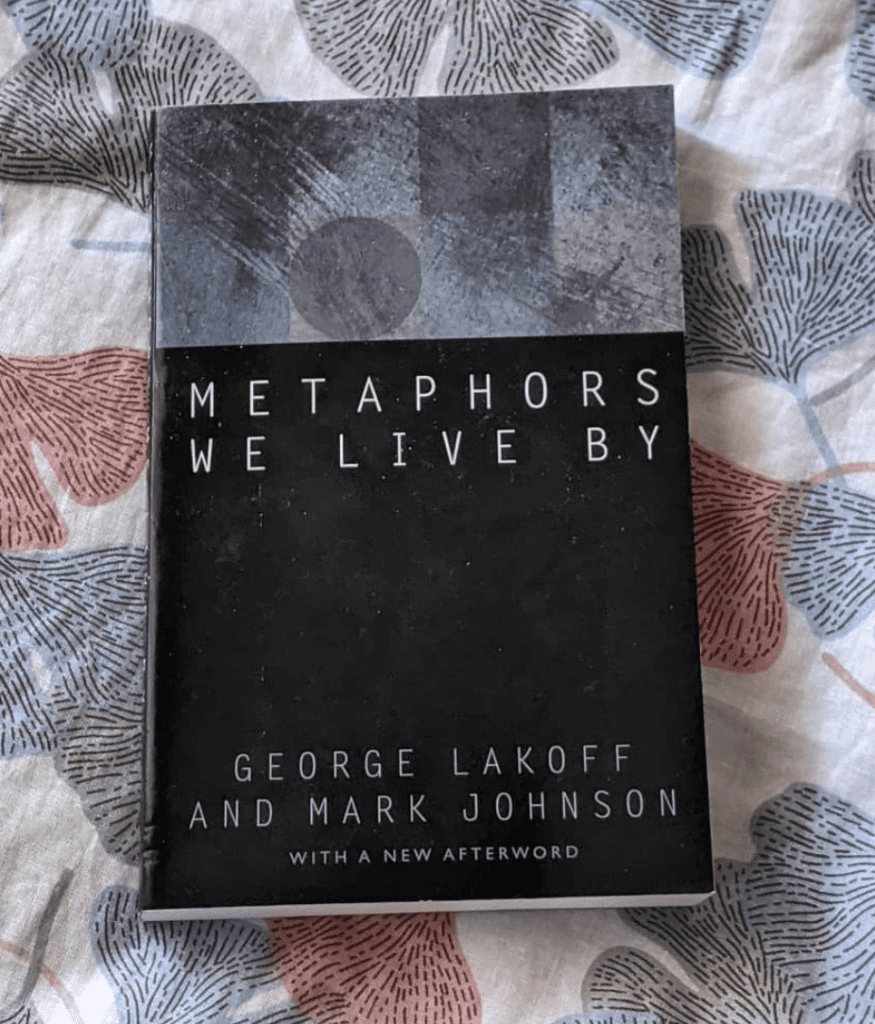
George Lakoff, Mark Johnson
In “How Emotions are Made“, Lisa Feldman Barrett wrote how concepts, goals, words all help the brain frame any new stimulus it receives and that by reframing concepts and looking at them more objectively, we can reshape what emotions are surfaced, and thus exercise free will. But how does one go about that? In the vast scope of “Metaphors we live by”, we get an answer to that too.
Metaphorical concepts are so ubiquitous in our thoughts and deeds that we don’t even realise they exist, let alone their effect on how we think about everything from business and ethics to marriage and poetry. Conceptual metaphors allow us to use the inferences in domains we can sense (space, objects etc) on other domains of subjective judgment. In a way, this is how we are able to transmit ideas and create a shared understanding. We often ascribe this to language, but it actually begins with metaphorical concepts.
The light bulb goes off in the first few pages, when the authors use “Argument is war” as an example. It’s because war is the metaphor we have used at a concept level, that the words we used to describe it are about winning/losing it, or “your claims are indefensible” or ‘He demolished my arguments” or “I attacked his weak points” and so on. Another example to think of is “time is money” – you use spend/save/run out of/invest to describe time.
In addition to the structural metaphors above, there are oriental metaphors, which provide a spatial orientation, and are based on our physical and cultural experiences. For instance, happy (spirits rose), consciousness (woke up), control (top of the situation), more (numbers went up), future events (what’s up), good things (looking up), virtue (high standards) are all “up”, while their opposites are down.
A thing to note is that a concept can have multiple metaphors e.g. Ideas are food (half- baked), people (father of modern physics), plants (fertile imagination) and many more. Another interesting part is the grounding of concepts. For instance, how we conceptualise the non-physical in terms of the physical. Harry is in the kitchen (which is spatial), in the army (social), in love (emotional).
The book further talks about the structuring of our experiences – experiential gestalts, as well as coherence of metaphors (including overlaps of metaphors, how they affect form, and how they can ultimately create realities. It also gets into very interesting territories – the nature of truth, objectivism and subjectivism. It points out how both miss the part that we understand the world through our interactions with it, and proposes an Experientialist alternative.
Since I started reading the book, I have been watching the words I use (” I am running late”, “I don’t think we should spend more time on this”) and imagining different metaphors. Because by changing the metaphors we live by, we can change our everyday life, and our future. This is far from an easy read, but even (more than) 40 years after it was first published, it is still pathbreaking.