Tag: Generations

  • 10 Observations from working with Millennials

    The dynamics of ‘work’ have been changing for a while now, so much that when I think about writing on the subject, my thinking almost seems outdated! Not surprising, GigaOm’s post from a year ago – How the great generational shift is causing transformation in the very nature of employment – shows as many as six generations active in the workforce these days! Each of them with different world views, attitudes, priorities and approaches to work. But given that I’m trading one demographic number for another in a couple of days, I thought it an appropriate time to share a few observations based on my recent experiences. Since I had written earlier on the challenges faced by my generation in The Future of Work and The Entrepreneur & the Professional, this post focuses on a younger workforce. Millennials, if you are into labels.

    The first two points set the context. I mention these two because I think they have a direct link to the worldview, attitudes and behaviours of the emerging workforce towards work, and their life in general. They serve as the backdrop for me to observe the 15+ people I have managed in the last 4-5 years. (more…)

  • The entitlement of the self

    IMO, Season 4 of Mad Men really took it up a notch. I think it’s because the human condition started showing up much more than before. Episode 6 – Waldorf Stories – offers quite the example. <spoilers> To quickly give context to the non viewers, a flashback shows how Don Draper, the show’s lead character and a fur coat salesman then, was hired by an inebriated Roger Sterling (partner at an ad agency) years ago. Don rises right to the top, becoming a partner at the new agency that Sterling, and others form. When the agency wins its first award, Roger feels entitled to an acknowledgement from Don. When he doesn’t get it, he asks for it. Later, in the same episode, Peggy, whom Don ‘raises’ from secretary to copywriter, also feels entitled to Don’s  acknowledgment of her contribution to the award winning ad. In the first instance, Don is gracious and acknowledges Roger’s hand in making him what he is, but in the second, he is furious at Peggy.

    It made me think of entitlement. I have read many an article about the millennial generation’s sense of entitlement, but maybe it’s not a generational thing at all. Maybe, it’s just that this generation expresses it more than others, and this is being documented much more courtesy the web. A point of difference is probably what is being asked for – opportunity (millennials) and acknowledgment. (earlier generations) (more…)

  • A different kind of prosperity

    A couple of months back, there was a very heated debate (mild term) based on an article that was titled “Why Generation Y Yuppies Are Unhappy” and (also) dealt with something that has occupied my thoughts for a while now – the sense of entitlement. It had a very simplistic formula on happiness : Happiness = Reality – Expectations, and the author’s take was that a sense of entitlement/being special heightened expectations and when that collided with reality, Gen Y’s happiness suffered. Another key factor in this was they are also regularly ‘taunted’ by people who are doing better – simply because the latter share their successes much more.

    I must say that my observations on the sense of entitlement have led me to believe that it’s not totally an age thing. I do agree that societal and lifestyle changes have led to parents becoming more indulgent, but I think the larger culprit is mass publishing platforms –  the ability to broadcast one’s thoughts to large number of people. It is enhanced when the publisher realises he/she has an audience. It does seem higher in younger groups but that’s only because they have been exposed to these platforms much earlier in their life than an earlier generation and therefore do not have the alternate perspectives and experiences of the latter. But the entitlement discussion is for another day.

    An interesting point made in the article was that Gen Y wanted fulfilling careers. What does not come out though is what defines ‘fulfilling’. Is it the emotional satisfaction of working towards a shared purpose, or is it the perks that come with a high-flying career? I suspect that fulfilling at this point swings more towards the material success that the latter provides. Umair Haque has an interesting take called ‘Growthism‘, a devolved form of capitalism, whose dogma is to achieve growth at all costs and according to the author prevents us from developing a sophisticated conception of what prosperity is. It does seem fluffy but that’s probably because we have been conditioned by various institutions for a long while now.

    But I sense a change is on its way. For instance, thanks to this post, I came to know of The Prosperity Index, which goes beyond the GDP and economic success based models of measuring prosperity of nations. While this is indeed a positive step, I think true change will happen when constituents like the Gen Y mentioned earlier begin to look at currencies beyond money for a sense of fulfillment, and happiness. In this must-read article titled “Who Will Prosper in the New World“, the author mentions “People who don’t need money” – people who have the incomes of the lower middle class and the cultural habits of the wealthy or upper middle class.

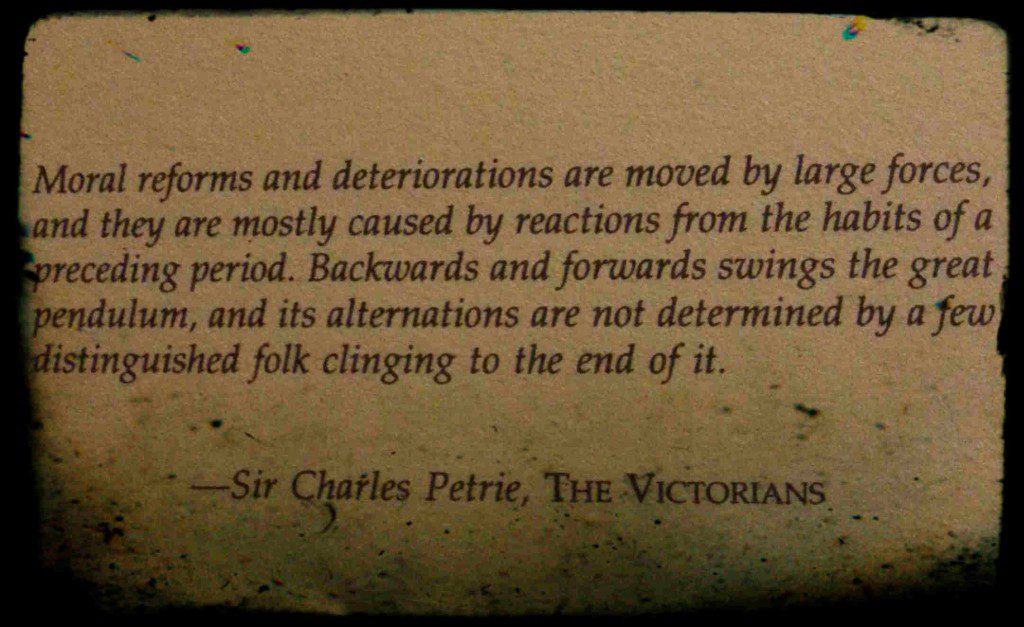
    I think we’re at the beginning of a new cycle – a generation will start ignoring the paradigms of success and fulfillment set by its predecessors and their institutions, and use the fabulous technologies that are evolving to craft its new narrative of happiness. I also think that my generation might be the casualty of two large concepts at war with each other, but maybe that’s what it takes for a civilisation to be entitled to its prosperity….

    moral

    until next time, changelings

    P.S. On a related note, do read ‘On Lifestyle Rigidity

  • Moral Signs

    A little more than a year back, I remember writing a post on identity – what exactly constitutes the individual – work, relationships, consumption, combinations of these…….

    More recently, I read a Scott Adams post which actually asks the same question ‘Who are you?’ He also provides his best answer to it ‘You are what you learn’. It’s an interesting point and I do agree that what you learn is what gives you additional perspective. It changes the way you view older experiences and how you react to new experiences. And so, despite believing in being prisoners of birth to some extent, and knowing that the apple never falls far from the tree, and at the risk of generalisation, I would tend to agree.

    Which brings me to learning. In an earlier era, our ‘channels’ of learning were limited – parents, relatives, friends, teachers, literature, some amounts of media, and so on. Limited when compared to the abundance that a media explosion and the internet have brought into our lives. Sometime back, I read a post in the NYT titled ‘If it feels right‘, which discussed a study on the role of morality (rather, the lack of it) in the lives of America’s youth. The author clarifies that it isn’t as though they are living a life of debauchery, it’s just that they don’t even think of moral dilemmas, the meaning of life and such. The study ‘found an atmosphere of extreme moral individualism’, mostly because they have not been given the resources to develop their thinking on such matters.

    It led me to think about the moral frameworks that were instilled in us by our sources when were young. At the very least, value systems existed, though obviously their ‘quality’ would be a subjective affair. I wonder, if in this era of abundant sources, we are missing out on inculcating the basic moral guidelines that are necessary for a society’s sustenance and  evolution. If people are what they learn, then the least we could do is take a closer look at our own moral framework. The next generation, despite the abundance of sources, could be learning from it. Or perhaps this is the way it has always been, between generations. 🙂

    until next time, moral poultice

    PS: a beauuuutiful related video

  • A lot can happen over coffee

    Part 2 of last week’s post. Contrary to what the title might suggest, this has nothing to do with Coffee Day. Well, almost.

    I waited outside Fresco’s for the next meeting and this caught my eye. Coffee, destinations and experiences.

    httpv://www.youtube.com/watch?v=oTYh6OSnAIY

    And just as I finish erm, shooting the above, she zooms in and after parking the car, chides me for not responding to her first wave from inside the car, until I point out to her that from where I stood, I could barely make out that its her inside the car. I also tell her that it might be unwise to wave at people of the opposite gender when one’s unsure… I was meeting her after a few months, and was yet again, struck by the precociousness. She’d called me to discuss a website idea of hers. She is all of 22, and has a knack of making me feel ancient, though unwittingly. We agree that the place demands that we concentrate solely on the chocolate desserts, but then we compensate by (me) arguing that the Oreo’s cream in her pastry was just wasting space that should’ve been taken by more chocolate. I pointed out my unadulterated ‘Chocolate Demise’.

    I ask her about her new idea, and out comes the story that its happening thanks to the money made from another business of hers, that’s apparently quite a success. She informs me that the idea for the first business came about from an earlier meeting we’d had. She explained, and when I heard it, I felt like a favourite character of mine – Forrest Gump!! Meanwhile, her book is already with the agent, she tells me its been 5 months, and maybe its time to check out another agent. I tell her that’s a hell of a lot of things to be doing at 22. She finds it worrisome that she might be trying out too many avenues, too many side lanes, which might take her focus off the main road, and i tell her about the number of posts I have written about the paths not taken. After we’re through with our chat, I tell her that I’m very happy for her, the way she’s handling her life, and not to stop.

    I wondered about the stuff I’d been doing when I was 22. One week later, I watch ‘Wake Up Sid’. (I Saw, Puked, in case you like anagrams)  After the movie I tweet,

    Clipboard02

    Dil Chahta Hai was released in 2001. I was 23 then, close enough to 22 when one looks back now. Not then, of course.  Business management and beach bumming. There’s no comparison. 🙂

    A thought on WUS vs Lakshya before we move on.  Both are ‘coming of age’ movies, and that’s where the comparison ends, for me. Lakshya had an individual who got himself something to focus on, Sid just becomes relatively more mature. Movies work differently for different people, in fact I identified more with Lakshya than Sid, but to me, the comparison itself is perhaps unfair, because it means equating coming of age to focus. In my book, they are not the same.

    Though WUS did remind me of DCH, it was another comparison that gave me food for thought. Konkona plays someone who’s older than Ranbir, by about 5 years. She comes to Mumbai, focused about what she wants to do. Ranbir is barely trying to figure out what he wants to do. Two different approaches to life.

    I wondered if the age difference explained it, or was it the individual character, or their different circumstances. In many posts, I have explored each of the three separately. I have wondered whether today’s generation has many more choices than I had, and whether that’s the reason why I am constantly thinking about roads not traveled. I have wondered whether people are just made differently, in terms of aggression, risk taking mentality etc. I have wondered about how one’s circumstances, and the people one is surrounded with, influence one’s destiny. I have even wondered  about the combination – whether society has changed and has helped the young of today by giving them freedom to experiment, to make their own responses to choices, and thus made them smarter along the way, and helped them build confidence.

    And then i remember the coffee choices I’d seen as I stood in front of Fresco’s. Choices have always been there, maybe lesser, but there. I could have the coffee on the roadside or inside the CCD. They’re completely different experiences, and any judgment of one being better or worse than the other is simply a matter of perspective, based on time, person, place and so on. It perhaps isn’t even about the journey, its about how  one sees the journey, and what one wants to make out of it. 🙂

    until next time, ennui anyone? 🙂