Tag: gaping void

  • Lovestrong

    Slightly dated in the context of real time, but I thought this was a pertinent read in the Armstrong era. It’s titled “Honesty of the long-distance runner” and is about a Spanish runner Iván Fernández Anaya. He was running second in a race he had no chance of winning when he saw race leader Abel Mutai pull up about 10 meters before the finish, thinking he had already crossed the line. Instead of exploiting the situation, he let the Kenyan win using gestures to communicate. He thought it was the fair thing to do. He also candidly said that if a Eur/World medal was at stake, he’d probably have done things differently.

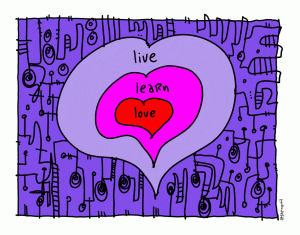
    I saw this poster at gaping void, related to  purpose, but twisted it a bit in this context. It isn’t as though there aren’t things we love to do. As we move further in life, we learn more about the way life works. Sometimes these things we love make business sense, sometimes they don’t or requires either stellar talent or more hard work than we are willing to put in. Some of us work at it, some of us lock the love away and some of us decide to find an easy way out. And thus it is that even things which involve love and passion – sports and arts – have been converted into competitions and ruthless economically viable phenomena. So really, where does the corruption begin?

    until next time, strong-armed

  • In Principle

    Stannis Baratheon is probably the least charismatic among the contenders in the Game of Thrones, but I have liked him for his stubborn, unwavering sense of duty and justice – even in those situations when a compromise might have helped him meet his objectives. Even his claim for the throne is not borne by desire, but by his belief that he is the rightful heir. I am on Part 2 of Book 3, so I have no idea how this is all going to pan out, or whether his character will change later, but for now I can relate to it, though in my daily existence, I’m not able to shake off the pragmatist in me many a time.

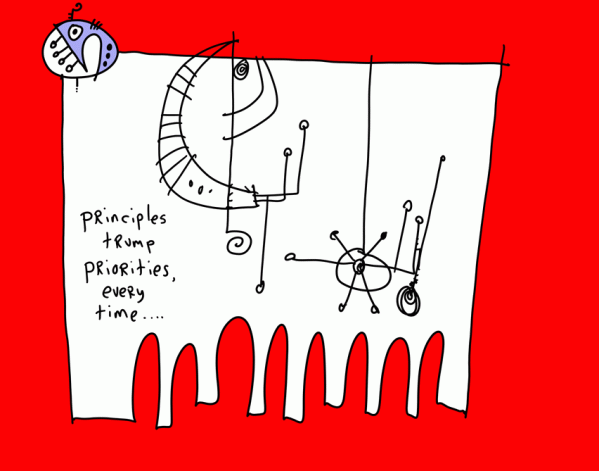
    That is also why I loved this Gaping Void poster, and identified with it immediately.

    As I’d written in the 1000th post in another context, perhaps the joy is in doing something because it is the right thing to do.

    until next time, first principles 🙂

  • Master Class

    Last week, I read a profoundly insightful post at Gaping Void, titled ‘On Mastery‘. The post seeks to answer (in Hugh’s own words) ““Suc­cess”. What does it take to be suc­cess­ful, pros­perous, happy, have a sense of pur­pose etc? What does THAT actually look like?” The answer, according to his post, is mastery. (do read his post for examples) When I shared this post on Twitter, Asmita related it to Chandni Chowk food vendors. Bingo. Around my own city – Bangalore- I can see examples of that. I can also see examples of when some of them have tried to scale and have fallen apart.

    Fame, popularity and money are by-products, but the master is not really dependent on that. In fact, he might even see it as undesirable side effects. As someone commented on Hugh’s post, it’s not even about the product, it’s the process. In Hugh’s own words “It’s something that truly belongs to you” and perhaps that’s why it’s so much more better, because there’s no dependency, unlike the by-products.

    It’s more of a personal learning for me, and it struck a chord as soon as I read it, as though I had the thought in my subconscious but lacked the cognizance to express it, even it to myself. In fact, I’d go on now to slightly disagree with Hugh MacLeod and say that for many people, mastery is success.

    Meanwhile, how does all this apply to business and brands? If I look at it through the prism of how things work now, I might be inclined to say that mastery cannot really scale, and I’d go back to my ‘Institutional Realignment‘ post and say that we’ll eventually get back to making mastery, a smaller ‘audience’, and a lesser scale the norm.  But in some ways, I can see examples of brands having mastered a culture and found a way to scale it – the much abused example – Zappos.

    However, if I had to look at it another way, I’d say that the web has made discovery much easier. Not in the traditional media way of ‘push the message to a mass and the interested ones will find you’ kind of a way, but the exact opposite. To use the data that people are sharing and through that, to find the right audience. The kind of audience who will appreciate the brand’s mastery, and who will then create good old fashioned community and word of mouth. The web offers tremendous opportunities to focus, but unfortunately we’re still in the early days of organised marketing and CRM data and most brands are busy losing focus and spamming themselves into oblivion, courtesy the lure of scale and its trappings.

    Of course, a part of me believes that mastery should have nothing to do with business, but as with many other things, the web might just change my perspective.

    until next time,  Master of Business Administration 😉

  • Empowerment

    In ‘Is Kindness a Strategy?’, Jeffrey F. Rayport shares the story of an American Airlines employee who ingeniously helped a passenger catch a flight though he was late, by using the express lane for ‘invalid’ guests. He mentions that many colleagues of the employee might not be happy with her way of dealing with the passenger. He also writes about Ritz-Carlton’s use of “service recovery” – a company’s ability to respond quickly, decisively, and effectively to a service problem of its own making — is a powerful way to increase loyalty among existing customers. He rightly draws the distinction between the two approaches – they vary on who’s at fault, the customer or the company, and asks what any business might stand to gain if it oriented its associates to look out aggressively for opportunities to perform true acts of kindness for their customers.

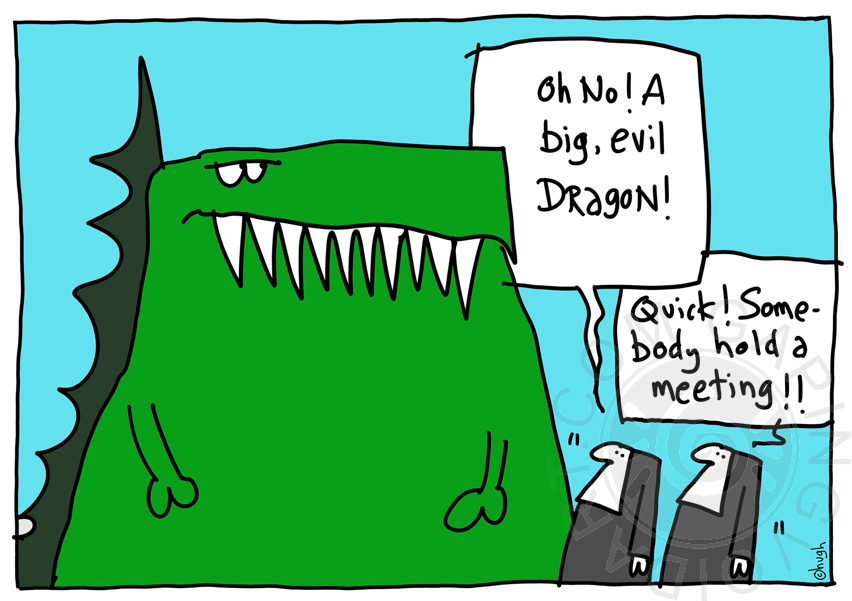
    In my mailbox, a few minutes earlier, I had seen this, in which Hugh MacLeod takes a (what I considered a) legit shot at meetings. As always, the toon says it all. When confronted with a business problem, (generally) the organisation’s first impulse is to meet, discuss, analyse and arrive at a consensus… probably 24 hours later. Yes, even when it involves a real-time platform.

    As I was writing last week’s post on culture, I was asking myself on the ingredients that make up a great organisational culture. Based on the above, I’d say Empowerment. When you have hired a professional to do a job that he has skills in, he/she should be empowered to apply his judgment to situations and not have to go through red tape or meetings involving people with minimal perspective on the matter. The first tenet of Zappos’ famous core values is “Deliver WOW through service”. In the same breath, Tony Hsieh also talks about “investing in a corporate culture that allows employees freedom and space” and follows it up with “If you get the culture right, then most of the other stuff, like great customer service or building a brand will just happen naturally.” On a related note, their unique hiring policy ensures that their sales staff don’t need scripts, they are trusted enough. It also ensures that an excellent culture is built by finding a fit between what makes the individual and the organisation tick. Empowering the employee so that he grows and so does the organisation.

    until next time, power trips

  • A social culture?

    Even as I write this, Titan is looming on the horizon – not Saturn’s moon, but Facebook’s purported mail service, which can (potentially) stake claim on another front that Google has made much advances in, though its still only #3. And so the thoughts from last week’s post continue – on whether culture is the key differentiator that sets apart the dominant player in an era and everything else from superior technology to better marketing evolves from it.

    The two posts I had linked to last time remain relevant in a Google vs Facebook  discussion – “Google’s real problem – GTD” at GigaOm and “Facebook and Google” at Piaw’s blog. Meanwhile, Robert Scoble wrote an excellent post last week titled ‘Why Google can’t build Instagram‘, which brought out a whole lot of other perspectives on what prevents Google from innovating at a rapid pace (also probably the reason why Facebook is stealing its thunder regularly) – organisational size (something we keep discussing here), controlling the scope of products/services, an infrastructure that’s not built for a smaller social scale, the necessity to support all platforms (because they’re Google, that’s expected of them, thought this holds true for FB too), the inability to use a competitor’s graph (in this case, Facebook), the need to ship a product/service that’s near perfect (because they’re Google!) and so on. Scoble also throws in a few pointers on how Google could still innovate, and I thought some of Android’s success could be attributed to one of those – sending it out and allowing developers to build on top of it. You can get another interesting perspective on Google and scale here. (via Mahendra)

    The other understanding I developed was that with scale, even the organisation’s vision could change, (though the reverse is what we see regularly) and that would affect everything from competitor landscape to culture. So the challenge is to keep people hooked on – employees and users.

    I’ve come across excellent posts on both these. The organisational aspect is the core theme of Gautam’s blog, and so its not surprising that I’ve seen two posts in the recent past that tackle this subject – Inspiring People, and Making Work Meaningful. The other must read in this context is the 2010 Shift Index, specifically the ‘Passion and Performance’ part. From a consumer perspective, few people can articulate it better (especially since a toon is usually more popular than a 1000 words) than Tom Fishburne, and again, two relevant posts – App  of dreams (as a devout Angry Birds player, I identify completely) and The Antisocial Network.

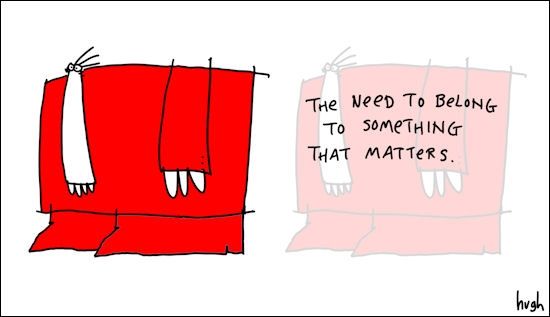
    Despite approaching it from two different sets of stakeholders, the common thread is easy to spot – that brands/organisations need to figure out a reason for existence that goes beyond their business mission and balance sheets. This would then help them identify the ‘something’ that people – both employees and consumers  can identify with and would want to belong to. Coincidentally, this is the drawing I got on my Gaping Void subscription today. 🙂

    (Hugh credits Mark Earls for first voicing this thought)

    Not very long ago, Google spearheaded a revolution of sorts, by creating an algorithm that connected a web user with the information he sought. The only thing that topped it was the business model they built on it. Many have attempted it before and after them, but there was only one Google. The world changing mojo seems to have been transferred to Facebook these days, and even to Twitter to a certain extent, as, in different ways, they connect us to people we know/want to know in various contexts. Information sharing then becomes one of the applications of this connection. This phenomenon is called (by) many names, including social media. 😀

    Perhaps brands and organisations fail to understand the philosophy of social platforms/interaction and get lost in the applications. A bit like wanting to build a social layer on top of everything you have created so far and meanwhile, firing an employee for telling the world he got a bonus and raise 😉

    until next time, titanic shifts 🙂

    Bonus read: The Heart of Innovation via Dina