
Tag: free will

  • ..the question remains

    It has been more than a couple of years since I wrote on the subject of planning – the acceptance of destiny vs free will in The Uncertainty Principles and the balance between change and stasis in its follow up. In my mind, the debate continues to rage, with flash points on a regular basis, thanks to various life scenarios and the things I read. I also realised that the recent narrative posts (1,2) are also a different way of framing this debate. Like I wrote in the posts, some narratives are already chosen for us, and some we choose, but these are all our attempts to fulfill our sense of belonging. In other words, our endeavour to find the reason for our existence – our purpose. Does one find it by working towards something or by dealing with life on a real time basis?

    A few days back, I read an article in HBR titled “It takes purpose to be a billionaire“, in which the author classifies ‘purpose’ into three buckets. Not that everyone’s idea of ‘purpose’ is to become a billionaire, but this is very clearly a planned path to achieve something that contributes to the sense of purpose. While the article does not mention it, the category I have always wondered about consists of people who have followed their passion – sports people, artists etc who have worked on a skill and honed it to near perfection. A very interesting perspective I read on that premise is the Scott Adams’ “Practice and Genes“, which takes a look at the theories on the subject and finally states that the critical element is luck. The most important skill involved in success is knowing how and when to switch to a game with better odds for you.

    Which brings me back to purpose and how we find it, and my introspection. “Who looks outside, dreams; who looks inside, awakes” ~ Carl Jung. (via) I thought about the ‘living in the moment’ perspective that finds a place in Buddhism texts and several other works of wisdom. At first, I thought it supported the destiny and real time approach, specially because it is difficult not to have baggage associated with the plans one makes. (literally and otherwise!) But then I realised that it was less to do with the planning aspect and more to do with how we deal with scenarios. Even if one works on a plan, how one deals with a setback to it is where the advice has value. In essence, that won’t help solve the debate.
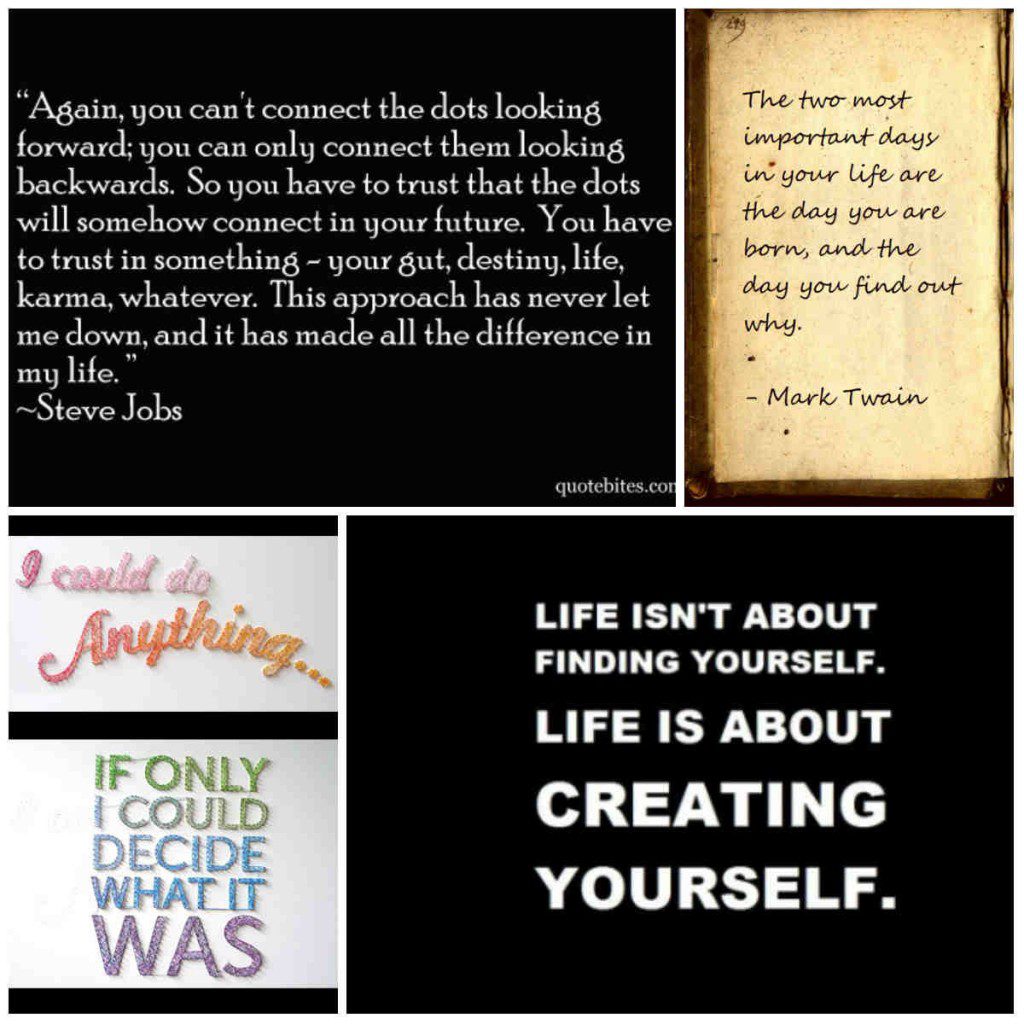
    collage

    There are profound statements that support both ways of looking at it. I continue to rack my brains to find the path that will fit me, or make it. I think there is an element of subjectivity involved. That does not make the job easier, in fact, it probably makes it tougher. After all, “He who knows others is wise. He who knows himself is enlightened.” Lao Tzu

    until next time, the clock ticks away in real time

  • Conscious choices

    I found this video shared by K (part of a series by Professor Russell Stannard) offering me a very interesting perspective on the free will vs determinism debate. (earlier post)

    httpv://www.youtube.com/watch?v=V8EI4obG5zM

    He starts with talking about the brain as a physical object which is governed by the physical/chemical/biological rules of nature – like a computer works within a  set of mechanical/electronic laws – and therefore predictable. So it should be possible to predict our choices. But it doesn’t work that way. Consciousness is different.

    He then talks about how some are trying to apply quantum theory to the free will – determinism debate. Apparently, at sub atomic level, the ‘future’ is not predictable with absolute certainty. It has a built-in uncertainty in it. What we can do, however, is predict the odds of various possible outcomes – the average behaviour of various items. So if this is applied to individual cells whose behaviour is unpredictable, it would be free will, say the proponents of this theory. But the prof refutes this, and says that this is one of the debates that can’t be solved to everyone’s satisfaction.

    [This prediction of group behaviour reminded me of Asimov’s Foundation series and specifically Hari Seldon‘s psychohistory, through which he predicts the future in probabilistic terms.]

    But more importantly, it made me think that if indeed, there is a creator, maybe he built the automaton inside our head to make us predictable. The automaton grows with us, making most of our decisions unconscious ones, based on baggage accumulated over time – conditioning. That could explain why those few who break out of it are able to attain a higher level of thinking in which they can bend the rules, predict the future and so on and the only advice they can give others is to be aware of every second.

    And when I think of predicting the odds of outcomes, I wonder if the results of all our free will choices are written, like a tree with infinite branches. And as we continue our journey of choices that is life, one by one the branches disappear, until on hindsight, they look like one straight line that was always meant to be that way.

     until next time, a predictable end

  • God Plus

    The thread that interested me most in Neal Stephenson’s Quicksilver (Volume One of The Baroque Cycle) was on Predestination vs Free Will, something I’ll continue to read up on. The book has a conversation between Daniel Waterhouse, a fictional character and Gottfried Leibniz, in the chapter Daniel and Leibniz Discourse (II), in which Leibniz puts forward a thought that there is an incorporeal organising principle, which organises and informs the body. He calls it the Cogitatio, and later uses it interchangeably with Mind, but different from brain, which is a mechanical phenomenon. With this, he attempts to find a middle ground between free will and predestination by stating that Mind and Matter grew out of a common centre and “I have complete freedom of action… but God knows in advance what I will do, because it is in my nature to act in harmony with the world..” (seems close to Molinism)

    While the recent exploits of humans would dispel this last thought in a jiffy, it did set me thinking on another subject of fascination – Singularity, “the hypothetical future emergence of greater-than human intelligence.” I still wonder whether it would be a ‘Skynet’ version (a superb post by Chris Anderson) or a an augmented human. (something I wrote earlier)

    The thought is whether God’s design had anticipated a Singularity for humans. A state in which the human being will understand and create things far more ‘advanced’ than God can? What would be the relevance of the idea of God then? And in parallel, what would be the human’s role if machines are the way to technological singularity?

    On the flip side, as i wrote in the earlier post, if augmented humans are the way to singularity, would the human mind as we know now exist then? Most probably not, and that would explain why if indeed God did make us in his form, we have no recollection of him or his idea of Singularity.

    Or maybe, some among our species already have reached it, without artificial augmentation, and that’s what we call nirvana, when you can bend the spoon, if it exists. 🙂

    until next time, the God complex is also a possibility 🙂

  • Is He dead?

    doing a lil bit of analysis to find the functional tendencies of the Almighty, if He were like a new age organisation, he should be having some sort of a customer feedback mechanism..either He hasnt got one, or it isnt functioning properly…. higher grounds of moral/spiritual thoughts aside, a large majority of people wouldnt be happy with what god gave them on their plate, and they cant be blamed….and who in hell (no pun intended) is the signing auhority these days on our fate, individual and combined….. who decides that most people, when they grow old, have to become vulnerable to the vagaries of their offspring or fate, or both?…. who decides that some new born infants have to be deprived of parentship?… who decides that people who love may not be loved?….who decides who is born rich and who is is born poor?…..who decides luck?….who decides that tears are necessary in life?….who decides that natural calamities have to take away what people slaved for and saved?….who decides the right time to die?…. who decides to make psychopaths and autistic people?…..who decides who should be a cat, dog, monkey etc. ?… who decides that people be born blind/deaf/dumb and not experience things people around them can (there could be an argument that they are lucky)…..who decides that life isnt fair?…who decides that man shouldnt know the purpose of his life?…..if i were part of a rebirth cycle, isnt it only fair that i know my account balance during each birth… if there was no rebirth, then why arent i given the place of someone i wish i were??…personally, on the whole, i am happy with the way my life is shaping up, but what about the less fortunate ones?since there is hardly any trace of fairness left in this world, i have to conclude that He is dead….. but manuscrypts trivia isnt
    check this out, its an interesting read, even if you arent part of the corporate scheme of things.