In The Shock Doctrine – Naomi Klein’s book on how capitalism hijacked crisis to further its own unbridled growth agenda – she calls out Francis Fukuyama’s “History has ended. Capitalism and freedom go hand in hand” and essentially considered liberalism the endpoint of mankind’s ideological revolution. That book gave me a lot of (alternate) context on the general narrative of capitalism, and also shifted my view on Fukuyama because of his role in (probably) encouraging the Chicago School of thought that impacted the development of multiple countries across the globe.
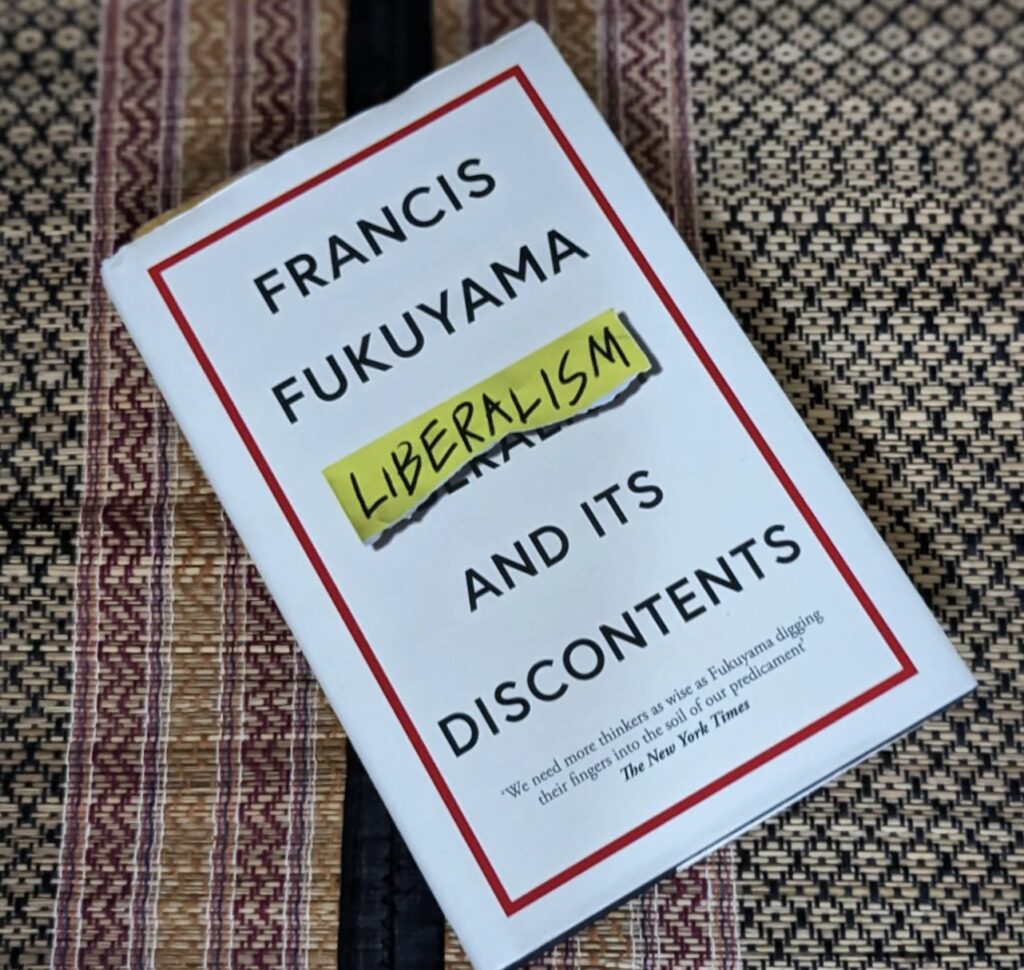
That meant I picked up “Liberalism and Its Discontents” with some skepticism, but though Fukuyama defends liberalism, I felt that he has tried to dissociate himself from the extreme forms the ideology has taken, and attempted to see the criticism and shortcomings objectively. In that sense, probably redeemed himself in my eyes a bit. (not that he cares)
He begins by acknowledging the challenges facing liberal democracies, and then steps back to trace the historical and philosophical evolution of liberalism and how it came to be the go-to ideology after the Cold War, and begins his defence by reminding us of the significance of individual rights, rule of law, and market economies in creating and maintaining political and economic freedom. He also looks at liberalism’s internal frictions and contradictions. For instance, tension between individual rights and collective identities, and the excessive focus on individualism undermining social cohesion and communal solidarity. Individualism, which has resulted in the twin extremes of identity politics and populist nationalism.
Liberalism is attacked on many fronts since its basic tenets are all open to separate criticism, thereby questioning its essence. Collectively, these forces challenge the principles of liberal democracy by undermining institutional structures, eroding trust, and fostering polarisation in the general public. What has also compounded this is the the rise of social media, surveillance technologies, and artificial intelligence, and while these could be beneficial to liberal values theoretically, the current usage is mainly manipulation of information, erosion of privacy, and the potential for authoritarian control.
But what I felt was that his thinking is still largely Western, and thus does not really go deep into the nuanced challenges faced by other parts of the world, or the intersections of related issues – globalisation, economic inequality, and complicated cultural dynamics, which foment populist movements. And because of that, his dismantling of the alternatives seem less convincing, and look closer to the paraphrasing he attributed to Winston Churchill – liberalism is the worst form of government, except for all the others.
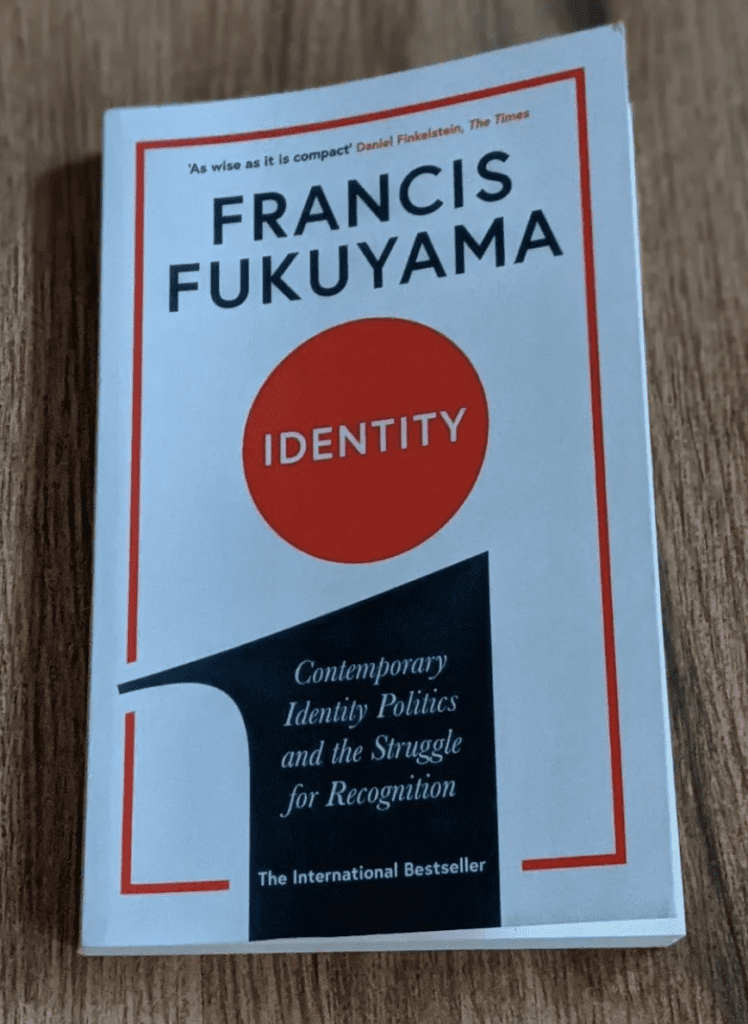
Francis Fukuyama did a fantastic job of framing the history of geopolitics in the two-part Political Order series. At a very broad level, most people agree that liberal democracies are the best form of governance and are ‘moving towards Denmark’. However, there are critical exceptions, like Russia and China, and there has also been a revival of (hyper)nationalism. A related area is contemporary identity politics. This is what he attempts to unravel in the book.
Early in the book, he points out that liberal democracies have not solved for thymos – ‘the part of the soul that craves recognition of dignity’. Whether it’s a large nation like Russia or China, or smaller segments in US, Britain etc, the common link is an identity that they feel has not been given adequate recognition. The segments could be based on religion, gender, ethnicity, sexual orientation, and so on. In all cases, the conflict is around an inner self whose worth and dignity is not recognised by an external world. With the modern world laying a lot of importance on authenticity, anger and hate are not far away.
The first few chapters are around the evolution of identity – from Plato’s Republic to Luther’s Protestant reformation and capacity for moral choice to which Rousseau added expression of personal experiences and feelings that were suppressed by society at large. As we moved away from agrarian societies with a strict hierarchy to technology-driven societies with multiple social classes, pluralism, diversity, and choice emerged and identity started becoming increasingly complex. By early nineteenth century, there was a fork – universal recognition of individual rights, and collective recognition. Nationalism and religion have been the largest aggregators of the latter, and he offers an excellent perspective on the parallels between Nazism and Islam fundamentalism to show how they’re grounded on the same principles.
The latter led to a narrative of a historic culture being undermined by ‘others’ around. That’s the area that everyone from Modi to Shinzo Abe to Islamic fundamentalists have exploited. Meanwhile, the former led to a ‘therapeutic society’ catering to the emotional requirements of individuals and raising self esteem. The question to any group thus becomes ‘do you want to be treated the same or different’.
The thrust in the rest of the book is about the need for dialogue and discourse and how identity politics could hamper that. There are examples of the US, EU and the solutions to their current problems around identity and politics. The good part is that the story thus far has been viewed through a multidisciplinary lens and is elegantly thought through. But the challenge that Fukuyama faces is that while there are very few arguments one can make on how the path to the current state has been framed, by definition the subject of identity is nuanced, and one could argue that it cannot be attributed to a single factor like thymos. Note, arguable only because it could be that things like economics, caste etc are dimensions of thymos.
The hope is that he writes a second part – a forward-looking one that captures how contemporary phenomena like social media, increasing wealth disparity, gender fluidity etc affects identity and its politics, and what it means to society and culture as we ‘progress’.
The Dawn of Everything: A New History of Humanity by David Graeber & David Wengrow was in my long list of favourite reads in 2021. It would have been in the top 10 if it weren’t for my Arundhati Roy bias, because it gave me at least a couple of fundamental perspective shifts.
The first is at an information level. The book is primarily a rebuttal of what now looks like a simplistic and linear way of looking at human history. The two Davids go up against the Goliath of the contemporary civilisation narrative that comes out in practically every book that even briefly touches upon the evolution of our species. This popular narrative can be (simplistically) summarised by three of my favourite books – Sapiens by Yuval Noah Harari and the two-part Political Order series by Francis Fukuyama. We were foragers until wheat domesticated us (as Harari would say), which led to societal hierarchies as we now see it. To massively paraphrase Fukuyama’s books, from various kinds of states (governance styles), we then evolved into preferring liberal democracy through the interplay of the state, rule of law, accountable government and social mobilisation, idea legitimacy, and economic development. Both Harari and Fukuyama have been instrumental in helping me understand what we could call ‘the system of the world’. (borrowed from a Neal Stephenson trilogy).
But in this book, Graeber and Wengrow use archaeological evidence to show how these broad strokes don’t do justice to the experiments and trade-offs that many societies played with in farming, property, democracy and thus civilisation as we know it. It is far more nuanced, and in doing that, bring up the freedom that our ancestors had.
Which brings me to the second shift. This insight, while was stated in a broad human context, also hit close to home. Has civilisation, they ask, caused us to lose what they see as our three basic freedoms – the freedom to disobey, the freedom to go somewhere else, and the freedom to create new social arrangements? It’s something to ponder over at a personal level. Liberal democracies might tom-tom freedom as a non-negotiable and enshrine it in their constitution, but ‘civil society’ and its economics would probably crumble if we actually had these freedoms. As I tweeted, The book made me realise even more that the freedom the individual needs and the structure that society wants will always be at odds. The differences are of degree not of kind.
It’s when I think about it that I realise how much we have normalised the loss of these freedoms at a societal and an individual level. Why is anyone obliged to obey anyone else? I realise I’d be ok with an answer that has some emotion as the primary reason, but the most likely answer is power – physical or monetary. Between state and corporations, a duopoly exists on this. But the tyranny is rampant in daily lives too. House help, people being turned away from public parks, expectations of service staff everywhere. The list can go on.
Why can’t we simply go anywhere else? Beyond money, the lines that we have drawn on paper get translated into checkposts and immigration counters, and crossing them is now a privilege. The lines aren’t natural, but try crossing them without the necessary paperwork. And even if you manage somehow, you will live in constant fear of being thrown out. It’s not that easy to go someplace else.
Between these two losses, the freedom to change one’s social arrangements is pretty much taken out of play. Who one is (identity) and what one does and where, are very difficult to change. Wake up, go to work, get paid, use the money to add to cart, travel, entertainment. Rinse, repeat. Yes, we all have choices, but society’s choice architecture also bias our decision-making.
How the hell did basic freedoms become a privilege? How did the ‘civil society’ we traded it for go rogue and become tyrannical? I hope to get a better understanding through the books I read this year. How does this manifest in my own life, and what can I do to help myself and at least a few others become a little more free? That’s a life’s work, and a different post!
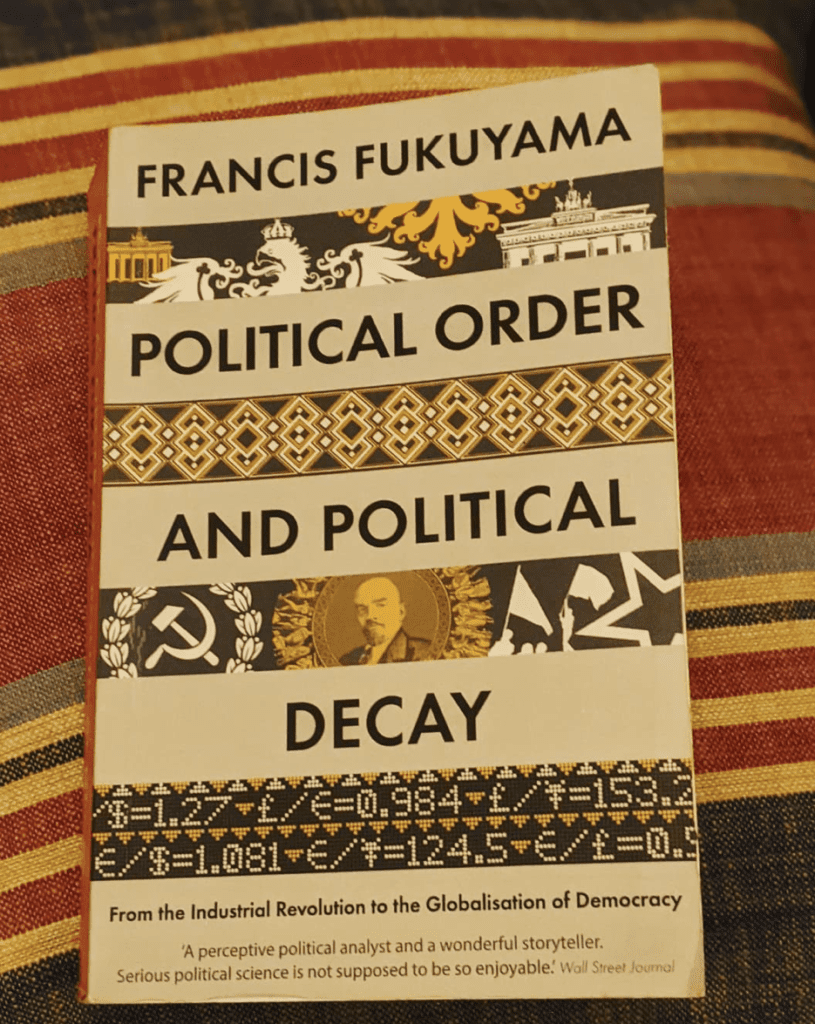
The first volume – The Origins of Political Order – went straight into my favourites, and so does this one. While the former was about the components of a stable state, and how political institutions developed differently in various parts of the world, this book begins at the dawn of the Industrial Revolution and shows how state, law and democracy developed to their current state, by (also) considering three additional dimensions of socioeconomic development – social mobilisation, idea legitimacy, and economic development. The industrial revolution and the economic growth that followed caused a movement to urban areas, where new social groups were formed based on fluid identities. This mobilisation serves as a foundation for changing political institutions with new ideas. The book also throws light on the various reasons for the decay of institutions, and offers directional thoughts on fixing them.
The author frames the development of the stable state by asking how a country can “get to Denmark”, which is the benchmark for an ideal state. While there is some specific focus on the US, also warranted by its early and unique path to democracy, the depth of analysis that has gone into many countries, across Asia, Latin America, Africa, Europe, is just astounding! History, economics, policy, geography, (with critique and usage of content from another favourite book – Guns, Germs & Steel), culture and many other facets, all going into understanding the state of politics in a particular country. There are many routes to modern government, including the necessities that war creates (“unfortunately”, Latin America never had its share, and Europe had plenty of it – both have class stratification, national identity, and geography to thank) and peaceful political reform. And once there, the principle of effective government is meritocracy, the principle of democracy is popular participation, effective states operate through law, but law can be an obstacle to appropriate levels of administrative discretion – how is balance achieved? The material is phenomenally complicated, and bringing it to this level of accessibility is something the author should be credited for.
The first part of the book focuses on parts of the world that experienced liberal democracies first – Europe and the US. It also analyses why Germany has an uncorrupt administration while Italy and Greece are plagued by corruption. In the former, how is state strength related to organised crime? How does cynicism and social distrust get culturally embedded? How were Britain and the US able to reform themselves from patronage-led public sectors? And why was Britain able to get there faster than the US? An active middle class accelerated Britain while US got a unified business community and middle class professionals only in the late nineteenth century. At a broad level, we learn early that the sequencing of events matters greatly. Countries where democracy preceded state-building (US) have had higher problems in achieving high-quality governance than those who inherited modern states (Germany, through some excellent civil service reform and an educational system) from absolutists. And that democratic societies without a strong national identity have trouble unifying the population with a common narrative.
The second part deals with parts of the world that had been colonised – Latin America, Asia, Africa, and the Middle East. When the imperial powers left, many of these nations were neither fully Westernised nor able to retain their traditional political organisation. However, there are success stories like Costa Rica, which according to many frameworks should have become a banana republic. There are also disasters, like Argentina, which, blessed with climate and resources, should have become a model country. The reasons are complex, and Sub-Saharan Africa vs East Asia is a great example of different development paths. In both areas, as well as Latin America and the Middle East, states that had strong institutions were able to reestablish them, while those that didn’t struggled. Interesting to note that African ethnic groups are largely a modern phenomenon, created or at least consolidated in postcolonial times! The specifics of the Japanese system and how their military-led nationalism has evolved until the present day is also fascinating. The problem that East Asia now faces is making the state accountable. The nuanced difference between rule by law (state using law for its ends) and rule of law (law binding on the state) is superbly explained. In the Middle East, the threat is that popular mobilisations risks being hijacked by religion.
Part 3 focuses on democratic accountability and goes back in time to the period after the French and American revolutions to see how democracy spread. The timing in various countries vary depending on the changing relative positions of social classes – middle class, working class, elites, and peasants. The rise and growth of middle class was a great catalyst to democracy. While doing this, it raises a question extremely important for the current times – with increasing globalisation and technological advances, the middle class is getting hollowed out. What happens to democracy then?
The final section of the book is on political decay, and there is a heavy focus on the US, which has now gotten tied up in the very checks and balances it had set up to protect democracy. In the author’s words, “there is too much law and too much “democracy” relative to the American state capacity”. It has now become a vetocracy, with economically powerful special interest groups and the judicial arm having hijacked the system and preventing reforms. No modern book can avoid China, and this is further proof. The author sees the Chinese model as the biggest nondemocratic challenge to the idea of liberalised democracies. How will the Chinese middle class behaves in the next few decades? Even as it grows, will it be content to live under a “benevolent” one-party dictatorship?
I think I will re-read both volumes, they are such treasure troves of information. If you like books that explain the system of the world, this is a set you most definitely should pick up.
Once upon a time, humans moved around in bands. Then there were tribes, and then there were states. States and the societies that make up its population have developed a bunch of institutions (defined as “stable, valued, recurring patterns of behaviour”), some of which are uniformly present across the globe, and some not. How did this variation happen?
Why is every country not a democracy, which is largely accepted as the best trade-off for all concerned? How did different countries reach their current form? That’s what this book is all about – how did different countries develop institutions that currently make up their current society and state?