
Tag: Foursquare

  • On location.. and beyond

    A few weeks back, @gkjohn and I were  invited to Chandu’s Military hotel in Malleswaram by the inimitable @parthajha . After an amazing meal, we walked back to where I’d parked my vehicle – Mantri Square, the new mall that had sprung up in the locality. It was new enough to be regarded as a shrine/tourist spot by many, and was already creating many traffic hassles. Both my companions had seen/lived in Bangalore much longer than I have, and shared interesting stories on Bangalore’s evolution. The new mall, and the changes in Malleswaram (which happens to be one of Bangalore’s oldest  residential localities) made me think aloud that soon, a locality’s culture (as expressed by stories about the place, people, historical locations as well as relatively unknown joints like Chandu’s) would begin to get packaged, as people  – both the city’s inhabitants as well as tourists, might want to look beyond the ‘sterile’ mall-multiplex-pubs-eateries jungle, and have more diverse experiences.

    And then, a few days back, i saw this article in PSFK titled ‘The Birth of the Microhood‘, which talks about an organisation called The Bold Italic initiating “a celebration of pocket microhoods through block parties and featured cross-sections across the city, introducing and promoting the social net worth of the people and businesses that inhabit them”. You can check out the details of the last event here, and the comments on Facebook here. Note the different establishments taking part.

    Those familiar to Bangalore might know of BangaloreWalks, which undertakes themed walks. With new services and technologies popping up and developing at a rapid pace, I wondered about the possibilities. On Foursquare, Chicago was a pioneer, allowing users to earn badges while exploring the city. Now Pennsylvania has followed suit. (via Mashable) There’s more. Check out the Augmented Reality iPhone app from the Museum of London. (via Gizmodo). The way it works – hold the iPhone up to a present day London street scene, the app shows the same location as it looked in the olden days. Tap a button and you get historical facts about the place. Meanwhile, QR codes have been around for quite a while now, also noticed Microsoft’s “tag” a few days back. While on the subject, also check out stickybits, a ‘fun and social way to attach digital content to real world objects’, through barcodes (existing ones, or new ones you print), and an app.

    Imagine a Coke/Pepsi/Kingfisher using this to tell us the origins of various iconic retail establishments they tie up with? Imagine augmented reality apps that allow an establishment to show us consumer reviews of the food it serves, or some content from the chef, say, how he’s made the dish. Relatively unimaginative, yes, but we haven’t even got there yet. 🙂 With the new version of location becoming increasingly important for brands, its perhaps time to check out the potential of using these services. A new way of aggregating content – videos, photos, literature – basis the location a person is in. More than anything else, i feel they offer splendid new means of storytelling, a way of making a brand go beyond the transactional relationship with its consumers, and the constraints of real time/space. It links the brand and its consumers through culture and shared experiences.

    until next time, vocal locals 🙂

    PS: To-do – check out my, ahem, interview at the newly launched www.foursquaretalk.com 😉
  • Early Bird Rewards

    At least two major virtual happenings, one that has massive implications on the future of the web, and the other, slightly more subdued, but not lacking in potential. The latter – Twitter Annotations, announced at Chirp, allowing developers to “add any arbitrary metadata to any tweet in the system.” You can take a look at the various possibilities here, here and here. The former – Facebook’s  Open Graph, unveiled at the f8 conference, and aimed at making itself the centre of everything that happens on the www. A  combination of  plugins, developer tools, new markups which can make the user experience on any site that plays along increasingly personal, social, semantic, from plain hyperlinks to layered information. Already, one small manifestation can  be seen at the bottom of this post – a Facebook ‘Like’ button, which will carry your liking of this post into your activity stream on Facebook. More and more data, not just what you do on FB, but outside as well, across the web. From what I read, smells like Google, perhaps worse, because the flow of information seems possible only through the Facebook conduit. A good round up of implications here.

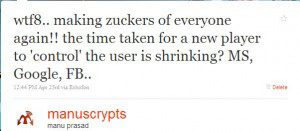
    When I returned from he break, and read up on these developments, my first thought, which i also tweeted was

    1

    And that’s the point of the post. During the break, the only network I was hooked on to was Foursquare. One of the things that happened, thanks to long waiting times in the Kolkata airport was that I became mayor of the neat CCD outlet just outside the airport complex.

    CCD has completed the re-branding at this outlet (unlike the one inside the airport) and has done a decent job at establishing ‘conversations’ as the prime focus area, in terms of in-store design. The feedback posters, ‘snippets’ at each table and the ‘quotes’ design on the roof were nice touches. When I got back, I found a CCD account following me on Twitter. Seemed like a more synergistic effort after the earlier snafu.

    It made me think once again about how alert brands need to be in such a dynamic scenario. If CCD were an early adopter, would they have braved the earlier storm better? What if they become active on Foursquare now, experiment with the new services being built on top of it – friendticker, snacksquare etc, still in their nascent stages. Or at least acknowledge their outlets on Foursquare and engaging the users. “@xyz congrats on becoming the mayor of our abc outlet”, and then build on top of that relationship. Won’t that help them gain some crucial evangelists in a new medium? If not evangelists, at least someone who will listen to their side of the story when something nasty happens? Wouldn’t they get a headstart on ‘authority’ by being an early bird?

    Even the era of quick responses being a reasonable expectation seems to be blurring by fast. Perhaps brands are now required to have an advance scout mechanism, to test out new services, features, changes, understand the implications and see whether/how business and objectives needs to be realigned. Page Rank, Social Platforms at consumer and enterprise level, Social CRM, Location based services, tools and platforms keep shifting. Early adoption and balancing objectives with diverse ways and platforms of engagement may become an imperative. Multiple options, two way communication manifestos, its all changing real time. Hold on tight.

    until next time, service level disagreements

  • Endurance Models

    I’d ended last week’s post wondering about the role of durability in the design of communication and organisational structures. Dina has continued the discussion on her blog, adding on some very pertinent questions. Do visit and add on to this very interesting thought flow.

    I got myself three threads of thought in her post. One, the dependency (of one product on another’s durability) factor, highlighted by the classic example of Twitter, where app developers have been flummoxed by recent events. (Twitter buying out Atebits and making Tweetie a free app for iPhone). Two, brands needing to create enduring, sustainable relationships, and being agile and flexible, because neither consumers nor their relationships are ‘static’. And therefore, three, durability is morphing.

    Before we dig into all of them, a small point of view. While one one hand, Twitter buying out services/competing with them could be seen as very Google like, and something that kills innovation in my book, I do have faith in Twitter and believe it won’t go the way Google has. (Simplistically) Unlike Google, which practically kills (eg. Dodgeball, jaiku), Twitter has just removed one entry barrier (paying for the service) for Tweetie’s adoption. As for Fred Wilson’s post, i can only remind you (again) of Godin’s description of Twitter – a protocol, and that’s why I completely buy the argument in the post on creating something entirely new on top of Twitter. (a contra view on Twitter being a protocol, informative read)

    This, you would notice, is a thought that continues from Dina’s point on dependency. But there’s a link to the second point as well – creating enduring, sustaining relationships and being flexible. The services which (to quote Fred Wilson) were ‘filling holes’ were (IMO) way too dependent on twitter. They were only providing a value, which Twitter had not deemed as a priority at a particular point in time. Not sustainable.

    Now, social gaming is one of the opportunities that Fred Wilson notes. So, look at Zynga. Their creations acquired massive adoption because of Facebook. They keep making more games, running them on Facebook, but simultaneously, also made farmville.com, with integrated FB Connect, and offers them more flexibility to provide more value. More importantly, the genre is perhaps not something FB is likely to get its hands dirty in anytime soon. Slightly more sustainable. Look at Foursquare. Standalone, but with Twitter and Facebook integrated very well. A level higher on sustainability. So the point is, the durability would be a function of how these platforms are used, dependency is proportional to the value provided.

    Morphing. Though the usage of social media by organisations is a subject that is discussed often (including on this blog), I thought this post by Tac Anderson articulated it extremely well. He discusses three strategies used by the enterprise – the one off approach that isn’t integrated with any existing system/process; optimising social media for business – with clear resources, roles and responsibilities; optimising business for social media. The first and second areas are where most companies operate. The third is a business organisation optimised for social media (technology and culture). He points out that Netflix, Google, Amazon have built businesses optimised for the web, and doesn’t see a business that has successfully implemented it wrt social media. He does say that it may not make sense for a company to throw out an existing strategy and build another around social media, but the ones with the third approach will be the next Google/Amazon. Another good read on the subject is Tom Fishburne’s ‘The new product waterfall‘.

    It is debatable whether an organisation can move from approach 2 towards 3.  But I do think that the morphed versions of durability will emerge from business structures that are built to be comfortable with and are therefore in a position to take advantage of the tools and platforms of social media. That is most likely the way to create enduring, sustainable relationships in a scenario of changing consumer and communication dynamics.

    until next time, the durability of this thread on the blog ends here 🙂

    PS: Won’t have to endure a post next week. Back in a fortnight 😉

  • Game Theory

    There’s this favourite t-shirt of mine – “If you’re interested in time travel, meet me last thursday”. I’ve always been interested in dimensions, thanks to science fiction and Skeletor/Sorceress in the He-Man series opening portals in other dimensions outside the physical constraints of Eternia. That perhaps explains the recurrence of alternate realities  and parallel universes in the blog.

    S and I had this interesting discussion recently on dimensions. No, don’t run away, it wasn’t really a scientific discussion.  I definitely am not qualified for one anyway, though at a concept level, I think it did get close to M-theory. (no relation to this blog 🙂 )  It was based on an abstract thought that on one hand, time is getting crunched and so is space, so where is all the crunched ‘stuff’ going. My point of view was that, time was expanding not crunching, since technology has made it easier for me to do things in shorter time, so it would perhaps balance the space crunch. No, conference calls don’t count, that works the other way. Space is no longer crunched, because calls are taken on the mobile, so conference halls are not required, and sigh, the calls last forever. 😐

    The thought I had though, was that the relationship (space-time) was being defined in/by the reality around us. What if there were other dimensions involved which were affecting this relationship? Do they exist? Will we unlock them? Will they be the answers to the occurrences that we cannot explain within our current dimensional knowledge? Funnily, these questions pop up whenever I play with the shiny new toy called Foursquare, and see people unlocking badges.

    At a basic level, badges get unlocked after specific user experiences – some repetitions, some new ones. I always equate them to new dimensions we observe in our personality after different experiences. That’s a kind of unlocking too, no? All of that brings me to another unanswered question. Is what we call death is actually the ‘experience’ we need to have to unlock another dimension? Or maybe we’ll need the other dimensions only after the death experience? Just like a regular multi level game. 🙂

    until next time, death is a great leveler? 🙂

    PS. What if the experience we understand as ‘death’ is ‘living’ in another dimension? I wonder then if cremation hurts, but our expressions in the other dimension cannot be heard here. Brr..

  • Whereabouts : The next social play

    Like I mentioned in the last post on the subject, ‘Location’ is back in a social avatar. A few days back, Foursquare celebrated its first year of existence, and now has more than 500000 users, 1.4 million venues, and $1.35 million in VC funding. I celebrated it with only my fourth mayorship. 😉 But there are a few more reasons why I decided to do a post. Both Foursquare and Gowalla had been launched at SXSW last year, and this year, location based services (LBS from now) are expected to be the talking point, much like Twitter 3 years back. 🙂

    In my last post, I had mentioned the specific competition in the space – Loopt, MyTown, Gowalla, Yelp, developments happening there, as well as the tie ups that Foursquare has managed with HBO, Warner, Zagat. Since Foursquare is arguably the poster child of LBS, and since there haven’t been any dramatic game changing developments from other players, I’ll focus on Foursquare and a couple of players you would know from earlier.

    Foursquare recently announced that it was launching a few business tools, which include basic statistics like total check ins, unique visitors, sharing to Twitter/ Facebook, gender split, time breakdown etc.  More importantly, it gives business establishments real time information that can help them plan promotions, take care of customer complaints, keep track of customer loyalty etc. There’s also a page where staff can interact with customers.  Though these might seem basic now, more detailing is bound to happen very soon, which will perhaps allow quick polls on menu items, service, allow optimisation that will cut things like waiting time etc. Indeed, Starbucks, which has been very active in the ‘social’ space, is now linking Foursquare to its rewards program, for instance, allowing users to earn a ‘Barista’ badge when they check in to 5 separate Starbucks outlets.

    According to Alexa, India contributes to 2.4% of Foursquare’s traffic, and is the 8th largest contributor. Maybe not the surest of sources, but its an indicator nevertheless. With rapidly increasing mobile penetration, net access costs are likely to come down, and this could mean good news for players like Foursquare. Imagine the implications on the CCD controversy if the Foursquare implementation had been done. 🙂

    (Interesting Read in context : Why “Where Are You Doing It?” Trumps “What Are You Doing?”)

    But wait, there have been other developments too. Twitter, still my favourite service out there, has turned on geo location. The API has been around for a while now, but it wasn’t really anything that anyone seemed to be taking an interest in. The first time I saw the implementation, was on a tweet from LBhat. Check out that tiny pin at the end, and you’ll see where he tweeted from. With the kind of development that happens with Twitter’s open API, there are bound to be some interesting apps very soon. Not to mention that Foursquare is already integrated with Twitter. (All this reminds me of an app called CitySense that I wrote about almost a couple of years back)

    Meanwhile, it has also been pretty clear that Facebook would make a play for local very soon. There was speculation recently that Facebook was showing an interest in Loopt, but nothing has been confirmed yet. What has been revealed is that it will unveil its location based features in April at its developer conference, f8. (location is shown on a Google Map 😉 ) Facebook has been pushing its mobile interface a lot recently, check out your logout page, or the ads on the right side of your home page telling you how many friends are using it. The article states that its more a play for local advertising (against Google) than against services like Foursquare. Business pages + location features for users + tools built from API will be interesting.  But it will also be interesting to see what they do about privacy. Something that remains a challenge for Google too, especially when Buzz and Latitude are integrated.

    Meanwhile, there are other interesting players emerging. Check out Miso, a Foursquare style app for TV and movies, RateItAll, that now wants to help businesses build their own Foursquare, Pelago’s Whrrl, which tries to connect social networking with real social activity – real places where ‘regulars’ meet up. Location based services are interesting because they integrate the real and virtual worlds. When I look at these and other  interesting developments like say, Google Street View (have you seen Hong Kong yet?!), and Augmented Reality experiments, the ‘Internet of Things‘ I think we haven’t even scratched the surface of the possibilities.

    until next time, now for vocation based services 😉

    Update: Just read that we now have a check in Aggregator – Rummble. Read about it here.