
This ‘what could have been’ post on FB Platform and the broader theme of ‘move fast, break things’ made me think about planning – brand as well as business, how technology is reshaping it, and the fine balance that is required to ensure business growth goes hand in hand with retaining the trust of the ecosystem.
Brand planning has always been an interest area, and I’ve had the good fortune of knowing a few brilliant planners, and learning what I could from them. Still continue to. A simple search would throw up a number of planning frameworks, and many of the fundamentals would still hold. However, technology is throwing open more options in terms of manifestation/output. I found some good perspectives in this article which is about that CMOs can learn from technologists. The fundamental theme is dynamism. But such are the challenges that they remind me of We are trapped in our inadequate mental models ~ John Edwarrd Huth (via)
I’d think that brand narratives are (also) shaped by the story telling devices at their disposal. As Mitch Joel points out here, the nuances of marketing vs advertising need to be understood as brands struggle to transition from the mass advertising era. One-way media allowed a linear flow, but current platforms demand flexibility, and customised rendition across contexts and platforms. If consumers are the new media, the stories should be ones that they can identify with, fit into their personal narratives, and therefore inclined to share.
Many of the familiar narrative devices have focused on getting attention, but that is increasingly difficult. It’s not that ‘awareness’ can be ignored, but not only is it not enough, but attention for the sake of itself cannot work. I really liked this post (again by Paul Isakson) where he encapsulates the thought in the title itself Adding Value > Getting Attention. The > works not just as ‘greater than’ but also as ‘leads to’. Or, in other words, Be the Company Customers can’t Live Without.
In a highly fragmented media and consumption scenario, how does a brand/business know what to focus on and when to shift from it?A wonderful blog I have discovered recently is that of Paul Isakson. This post, for instance, throws light on the need for the brand to stay true to its own story, and therefore focus on specific audiences. Another of my favourite posts focuses on something that I have always believed in and liked – the back story, and its relevance for brands. What we are today comes from our thoughts of yesterday, and our present thoughts build our life of tomorrow ~ Buddha
To get there involves a cultural change, and tectonic shifts. I also think that this will force brands to think about scale. In a mass media world, a brand could get ‘reach’ by throwing money. That can still be done, even on social platforms, but when attention is not the only thing that matters, the challenge is to build relevancy and scale it – across time. That requires new planning frameworks, and possibly means a
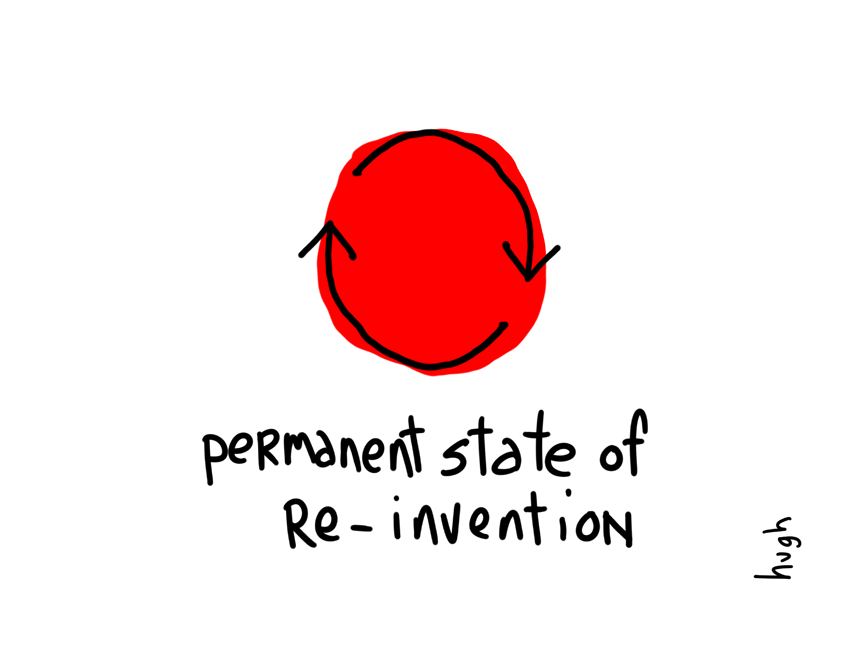
We started with FB, so let’s go full circle. Even as late as last year, there was massive skepticism around Facebook’s ability to adapt and thrive in the mobile space. In the last earnings call, they reported that mobile had contributed 41% to revenue. (read) It would seem that Facebook knew its story, what to focus on, and stuck to it.
until next time, refresh