Tag: favourite

  • Kappa Chakka Kandhari

    With a name like that and the nostalgia it evokes, there is no way any Malayali can ignore the place. In fact, such was the spread that we have already made two visits and probably need at least a couple more to ensure that we have done justice to ourselves and the menu! Our first visit was in December during the week they opened, and the second was in early February. On both the occasions, we ensured we had company – if you want to make the most of the visit, this is what you should do too. The portion sizes are small, and that means you can just keep ordering.

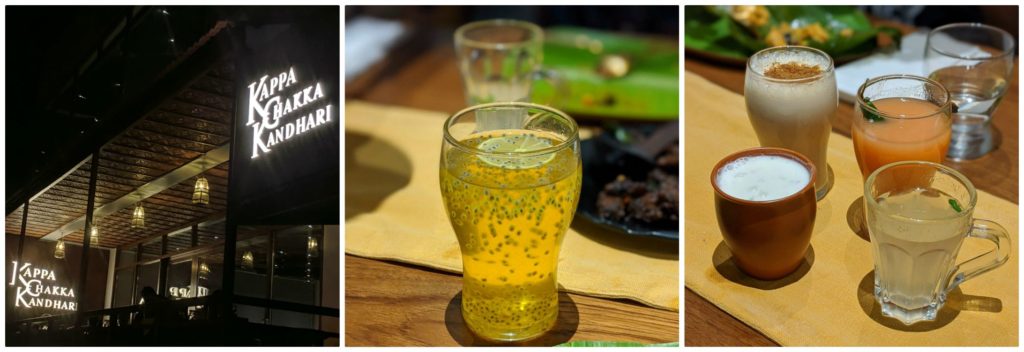
    There is no toddy for now, and the name of the starters section – Touchings – rubs it in! But there are other favourites to make sure that you don’t miss it much. The Nannari Sherbhath is a great example of that, and given that non-Malayalis have seen Nivin Pauly’s Premam, you will recognise that first drink with its trademark khus khus. They also make a thick, delightful Morum Vellam – buttermilk with shallots, bird’s eye chilli and curry leaves. The Absolute Kandhari is another excellent drink, especially if you don’t mind the bird’s eye chilli. A couple of other drinks to try are the Guava Temptation and Kerala’s own Sharjah Shake! 🙂
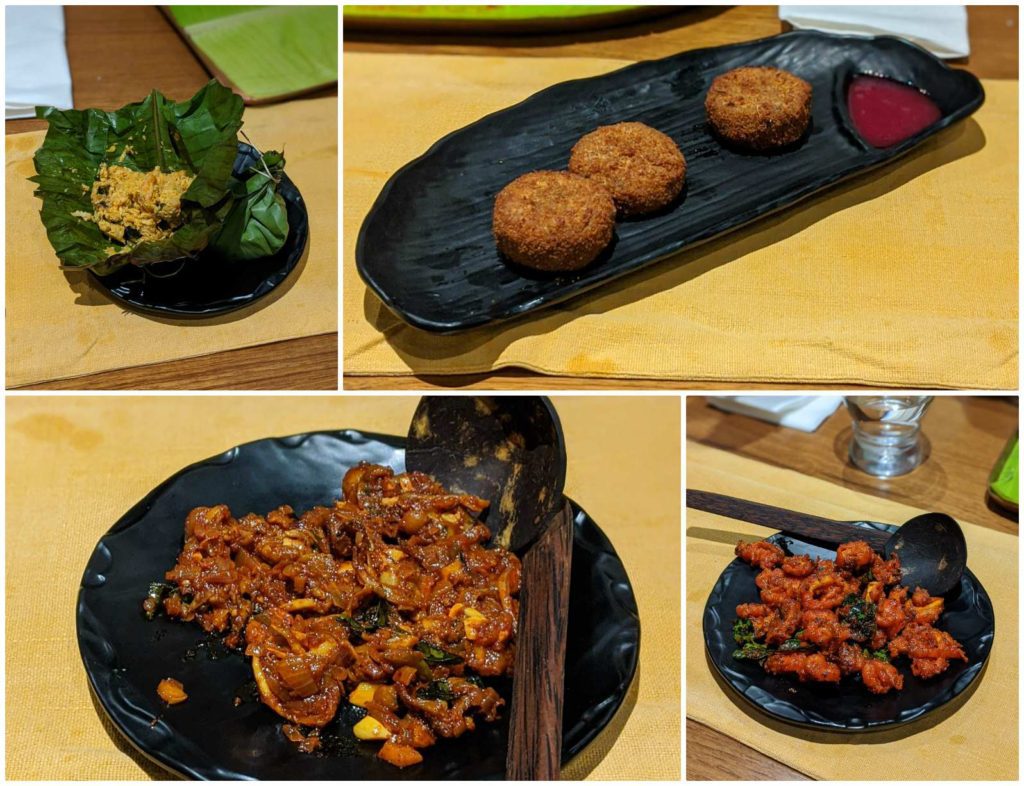
    We began with the Prawn Kizhi. I use “we” loosely since prawns are allergic to me and try to make their way out of my body when I consume them. But I was told that the coconut masala was excellent. The Vazhappoo cutlet was next in line, and I largely ignored it, only tasting a bit. Nothing wrong with it, except that it is a veg dish, and I think when one is surrounded by all sorts of non-veg dishes, this was insulting! 😀 But the banana blossom and potato, crumb fried, is worth a try. And now on to some real food! Kallummakkaya is mussels cooked in a flavourful masala. Ask for it if you don’t see it in the menu. The last of the seafood among the starters was Koonthal Roast – fried squid rings with a chilli and turmeric marinade. How is it different from the standard stuff you get everywhere else? Our not-so-secret weapon – coconut oil!
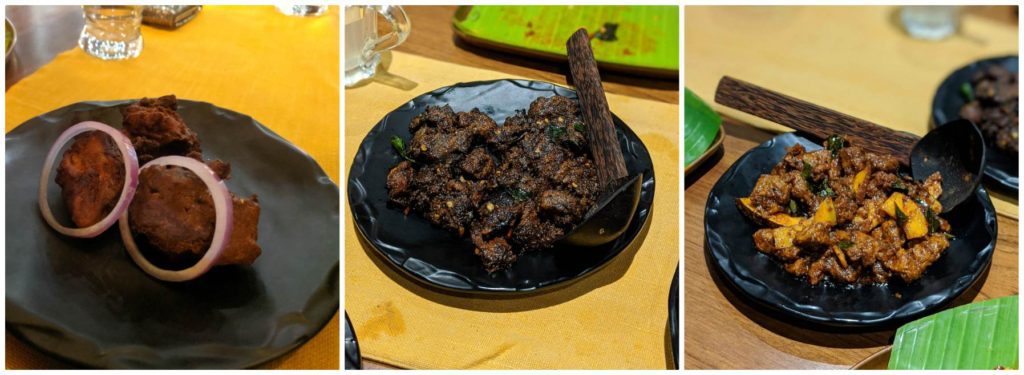
    The only fowl play we experienced was the KCK Chicken Fry, I think there are better options on the menu. The Syrian Irachi fry is one of the reasons why one makes repeat visits – Central Travancore’s gift to mankind. It is quite literally a holy cow of Kerala cuisine, and KCK’s version does not disappoint. The Mutton Coconut fry had a generous portion of coconut shavings, which added a lot to the dish’s texture and complemented the meat’s taste too.
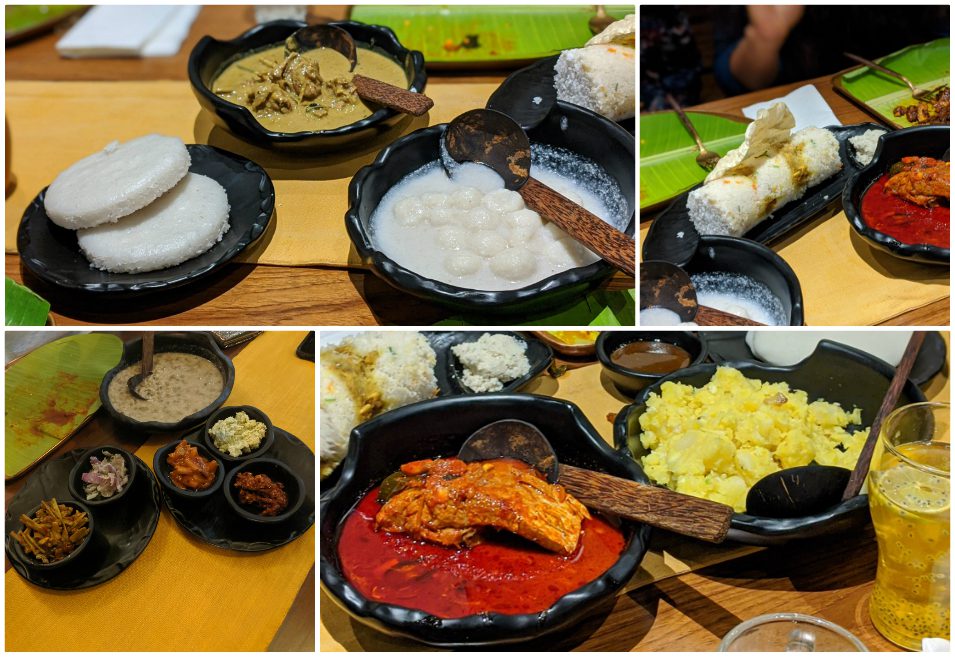
    The expanse of dishes is a feature of the main course too, but I have to admit there are a few things that we (D and I) are repeatedly drawn to. The Kappa Vevichathu and the Shappu Meen Curry is one such combination.  In English, tapioca and a toddy shop style fish curry – the latter served cold just as it should be. The Puttu Biriyani is another. We have tried the beef and chicken versions and loved both. If we had the appetite, we would have also repeated one of the Kanjis. Rice porridge – food for the soul.

    We also discovered new favourites on our second visit. For instance, Vattayappam with Tharavu Mappas. That’s fermented rice cake with a duck curry. What makes it an awesome combination – the mild sweet flavour of the former and the peppery hotness of the latter. The Pidi was great too – rice dumplings with coconut milk. The menu suggests a combination with the Ramapuram Kozhi curry. This is not bad, but I’d stick with the duck. D was adamant about trying the Ramassery Idli this time, and thanks to that, I tasted a “podi” I hadn’t in a couple of decades. This serves as an accompaniment to idli/dosa and is roughly, a coarse dry powdery mix made from a bunch of spices, pulses etc that you then mix with oil. The texture and taste varies as there are many versions. This one, I remember from my childhood vacations in Palakkad.
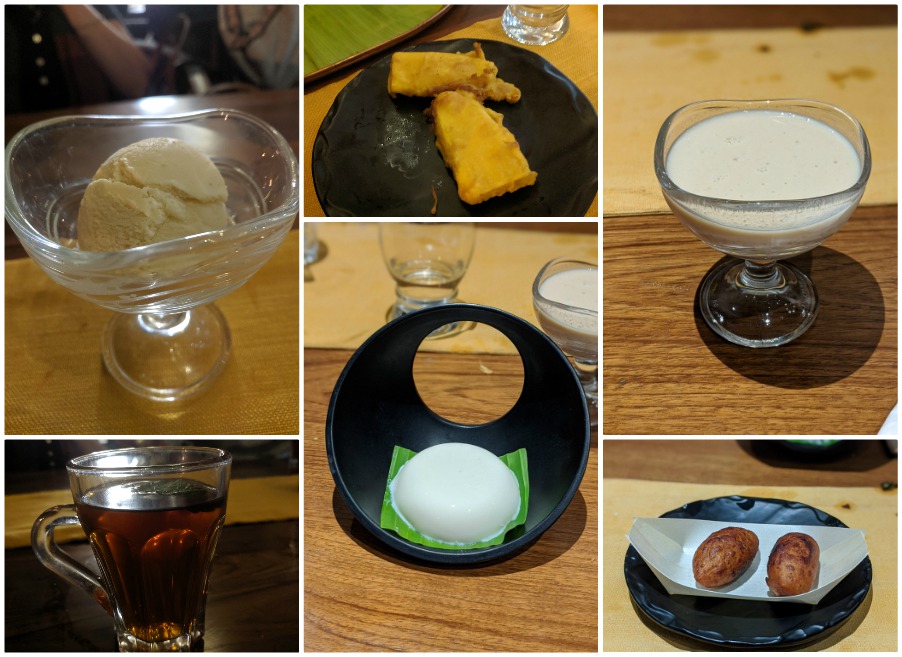
    For desserts, on your first visit, try the Kandhari ice cream because it’s unique- chilli ice cream. If you’ve had Wasabi ice cream, you’d have an idea. The Paalada (rice flakes and milk) is not bad. I am not a fan of Unnakkai so I will stay away from recommending it. The Pazhampori (banana fritters) was a surprise disappointment – the bananas were clearly not ripe enough. But here’s the thing – if you don’t really want to try assorted stuff, just ask for the Cloud Pudding, made of tender coconut. You won’t be disappointed and you will ask for repeats.

    The funny thing about all this is that you won’t really feel very heavy. Ask for a Sulaimani (black tea) to close the meal.
    The service is superb – friendly and prompt. Chef Regi Mathew makes it a point to drop in at tables and have a quick chat, and that adds to the homely touch that the dishes have in abundance. We will most definitely repeat, multiple times, the damn menu is like the Arabian Sea itself! 🙂 Now’s a good time to get back in touch with that Malayali friend of yours, and attack! Make sure you book in advance, because the second time we visited, there was a queue that spilled on to the road!

    Kappa Chakka Kandhari, #438, 18th Main Road, 6th Block, Koramangala Ph: 636471010
  • The Big Book of Science Fiction

    Ann and Jeff VanderMeer

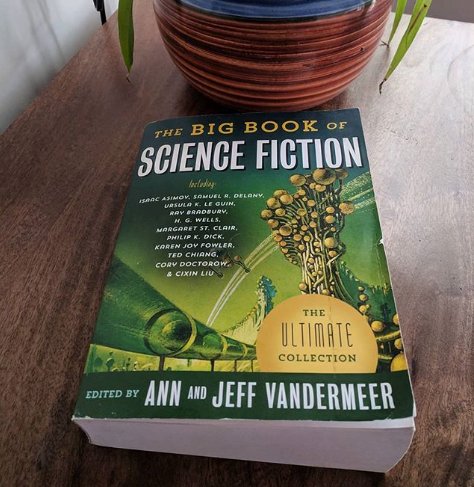
    If science fiction is even remotely of interest to you, this is a veritable treasure trove! 105 stories spanning 1160 pages. Only a couple of authors get to have more than one story, and that means there is a diversity of work that’s arguably unparalleled in any collection of this nature. The stated objective of the book is indeed that – diversity. And it happens on multiple counts – non-English writings (and therefore, the variety of geographical settings – other than Antarctica, all continents are represented), gender (of authors and characters), and most importantly, the type of science fiction – dystopian, alien encounters, space operas, post-apocalypse, and even satire.
    The stories are broadly in a chronological order of when they were written. The introduction to each author before the beginning of a story is very helpful in terms of context setting.
    While I do love science fiction, I really haven’t read enough to comment on the choices of representation made by the authors. I can count on one hand the number of stories I have previously read. But at least a couple of them are my all-time favourites in fiction – Asimov’s “The Last Question” and Ted Chiang’s “Story of your life”. I also found a story – Sandkings -by an author familiar to many of us from an alternate “universe” – George R.R. Martin. An absolute thriller that I thoroughly enjoyed.
    My other favourites are these : The Triumph of Mechanics by Karl Hans Strobl, a macabre, dystopian tale with a sense of humour! Desertion by Clifford D. Simak, a story based on pantropy – modifying humans for space exploration, as opposed to changing the alien environment. Another favourite that uses this theme is Surface Tension by James Blish. Philip K. Dick’s Beyond Lies the Wub seems quite prescient about “we are what we eat”! Katherine Maclean’s The Snowball Effect is about an experiment by academia in a sociological setting that leads to a more-than-anticipated impact. William Tenn’s Liberation of Earth is a brilliant commentary on US intervention in Korea/Vietnam, even while doing a great job of reducing the collective ego of the apex species of earth! His other work The Ghost Standard, later in the book, is an absolutely delightful satire.
    Grandpa, by James H. Schmitz has alien ecology as a theme and builds the tension excruciatingly well! Stranger Station by Damon Knight is an intense first-alien-contact story that dwells on the complexities very well. Vadim Shefner’s A Modest Genius is a lovely tale of romance and invention while Sever Gansovsky’s Day of Wrath is a thriller based on biotech experimentation gone wrong. The Hands by John Baxter is a creepy tale that reminded me of Aliens.
    F.L. Wallace’s Student Body would make it to my top 5 in the book, exploring both alien contact and environmental impact really well. The feminist utopian world created by Joanna Russ in When it Changed is subtle yet impactful. Yasutaka Tsustsui’s Standing Woman is as poignant as it is surreal. Sporting with the Chid by Barrington J. Bayley is dark and builds up to a terrifying climax.
    Josephine Saxton’s The Snake Who Read Chomsky is another incisive tale on biotech experimentation with some excellent twists and turns. Reiko’s Universe Box by Kajio Shinji is somehow sad and upbeat at the same time. Greg Bear’s Blood Music combines microscopic phenomena and macroscopic impact really well. Robert Reed’s The Remoras uses a space opera setting for an excellent human drama. The last story in the book – Baby Doll by Johanna Sinisalo – is a disturbing take on sexualisation of children that falls well within the realms of possibility, sadly.
    Isaac Asimov, Ursula K. Le Guin, Ray Bradbury, H.G. Wells – the book has work by all the greats of the genre, and you are also likely to discover authors whose stories you will enjoy!
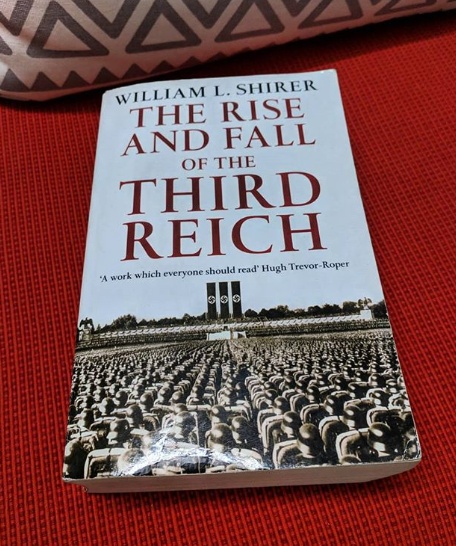
  • The Rise and Fall of the Third Reich

    William L. Shirer

    What a fascinating read! The second world war was one of the most defining events of the contemporary era, and The Rise and Fall of the Third Reich provides a fantastic view of what happened in Germany between 1930 and 1945, chronicling the ascendance of Hitler and the Nazi Party and its eventual demise.

    Hitler’s dream was to establish a Reich that would last a thousand years, though it finally managed just about a dozen. But in those few years, he managed to give the world the kind of shock it had probably never experienced before.

    The book actually begins much earlier, and traces Hitler’s early life, his disenchantment with the socio-political environment prevalent in Austria and Germany, and his entry into regional politics. Through smart thinking, astute use of the economic depression, a lot of outmaneuvering of politicians far bigger in stature than him, and quite some luck, he took himself to a position where the nation was practically begging him to seize control. It is amazing to see the number of instances long before he gained power when a small change would have led to a different history than the one we are familiar with.

    His baby steps into expanding Germany’s borders through cunning and then brute force, his affection for the largely ineffectual Mussolini, the poor judgment and horrendous miscalculations exhibited by the European powers, Stalin’s greed, all led to a state of affairs that made war inevitable. Germany dominated the early period, the Blitzkrieg tore through defenses, and it is astonishing to see how close they came to taking over all of Western Europe early in the war, in addition to Scandinavia and Eastern Europe. Through the mid to late 30s, what is also evident is Hitler’s own iron will, determination and political astuteness using which he outplayed his opponents over and over. But in Stalin, he met his match, and he underestimated the man and his country’s military strength. A costly mistake.

    At some point, Hitler’s megalomania took over, and his downfall began. His allies, the Japanese, didn’t help the cause much by drawing the US into the war. He repeated history by disastrously opening two fronts in battle. He also misread the importance of North Africa and the Suez. But it is chilling to note that with a little patience and by sticking to strategic alliances, he might not have lost the war at all. The Rise and Fall of the Third Reich also covers the role played by several inept leaders of the German armed forces in bringing and keeping Hitler in power, and their inability to stand up to the dictator, even as they realised that he was leading their country into disaster. Also described in detail are the several plots that were hatched to assassinate Hitler, including Operation Valkyrie.

    This is a commendable piece of work – not just for chronicling an important piece of history, but for the painstaking research that must have gone into it, and the control on a narrative with so many moving parts, all of which are important.

    At 1100+ pages and the smallest possible font, The Rise and Fall of the Third Reich is not an easy read. But if you have any interest in history, and the war that shaped the modern world, this is a book you should definitely invest in.

    The Rise and Fall of the Third Reich

  • Punkah House

    Punkah House has its fans, and they have been recommending the place for a while now. But we really didn’t have the appetite to negotiate traffic, and kept postponing the visit until we got one of those weekends when people leave Bangalore for a long weekend and transport it to the past. That also meant that we arrived earlier than anticipated. Not complaining, since we hopped over to the church of Magnolia (judging by the lines of those of us who waited patiently in a queue for salvation) to get ourselves some banana pudding for later.

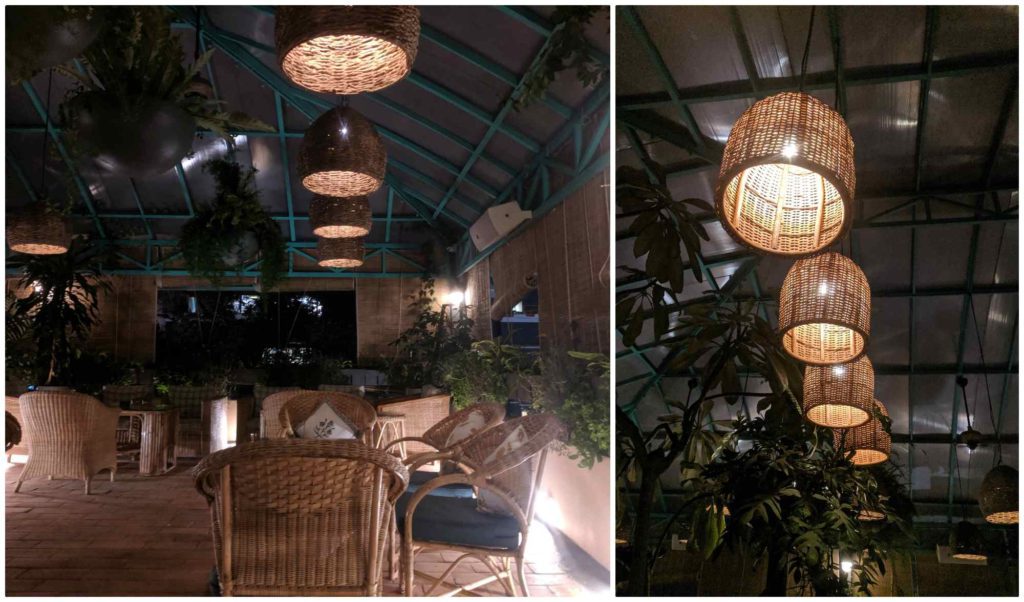
    Punkah House is undeniably classy, and barring the honking, manages to keep the chaos of 12th Main out. The decor and wicker furniture on the first floor, where we sat, would remind you of an older era of clubs. There are other sections too, each with a distinct nuanced layer over the broad colonial theme.

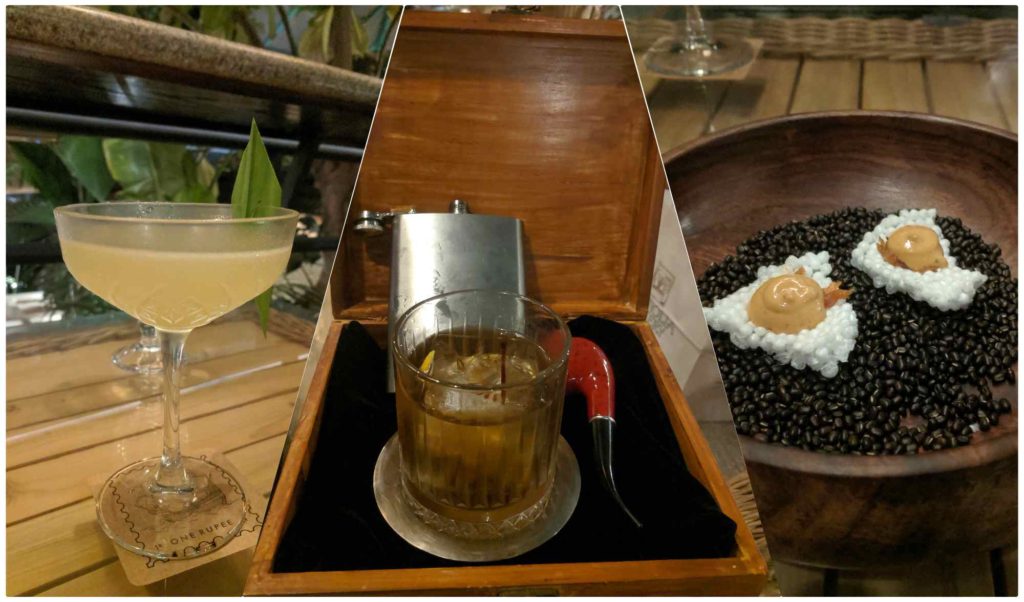
    The menu follows this with dishes from the subcontinent with a lot of representation from Ceylon and Burma and of course, India, albeit with a contemporary twist. An amuse-bouche arrived – sago with a zingy sauce – even as we were debating over drinks – which one to order, that is! D chose a Tokyo Tomo, and I asked for the Brigadier. The first has sake, lime and a mild pandan leaf flavoured gin, altogether quite refreshing. The Brigadier’s presentation is quite something, and bourbon, absinthe and bitters made for a fantastic drink that one could nurse for a long time!

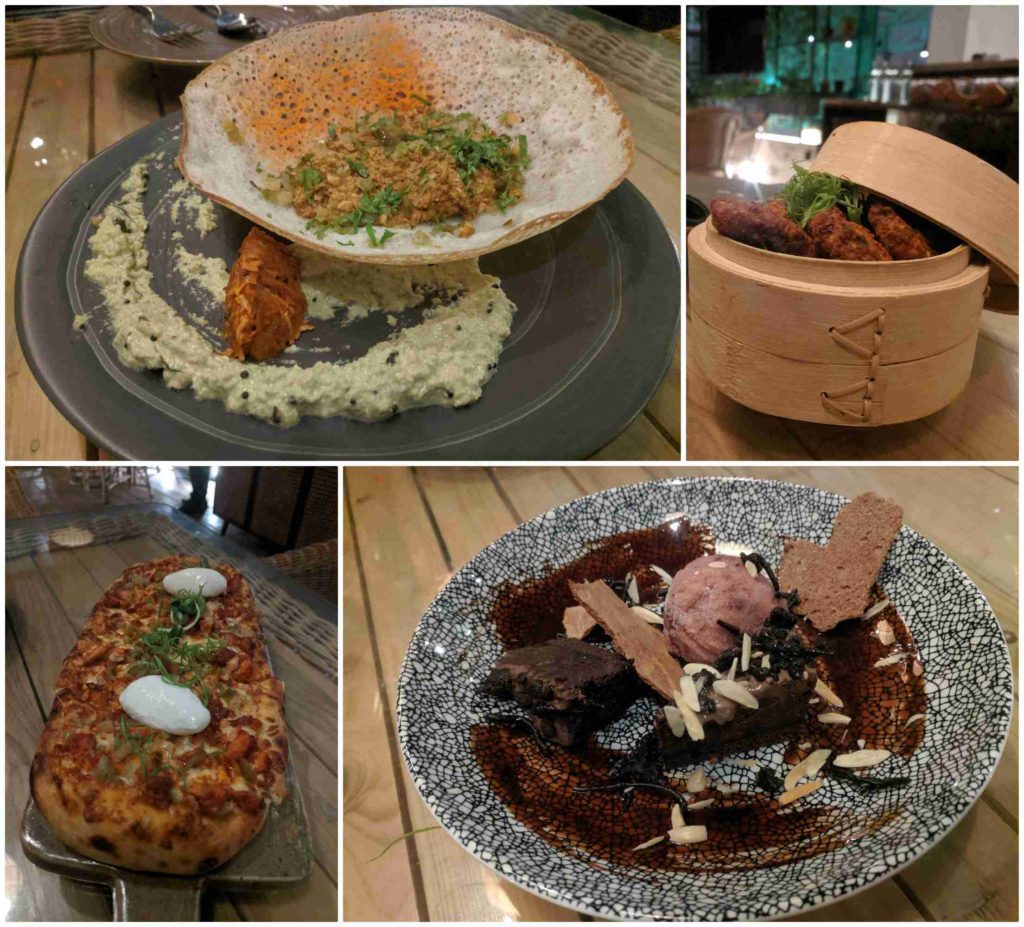
    The Chorizo and lentil Goa vada was intriguing enough for us to try, and it delivered an excellent texture in addition to the combination that worked well together, helped by a spicy chutney that came along! We then went into zombie mode and ordered an Old Bombay Brain Scramble hoppum. I know appam (from my homeland) and hopper (from Lanka) but it seems the combination is a word! Curiously enough, it was served with coconut and chilli-tomato chutneys that are more of dosa BFFs. It wasn’t bad though and in any case we were distracted enough by the delicious brain! Midway through this, we were served another hoppum. We thought the staff were going above and beyond, but turned out it was billed. Oh well, getting punked at Punkah House is probably par for the course.

    There were a bunch of mains we wanted to try, but we were stuffed. The Rustic Chicken flat bread with fermented chilli salsa turned out to be a safe bet. Chocolate won over Kapimisu but the Eton Mess was the only dish that we would file under just ok, at least in terms of flavour if not texture.

    The bill was a a hefty Rs. 3400+ affair, but given the location, ambiance and quality of food, I wouldn’t complain. The service is friendly, the vibe is unlike anything else in the vicinity and we’ll definitely make the trek again.

    Punkah House, 2989/B, 1st Floor, 12th Main Road, Indiranagar Ph: 41471005

  • The Evolution of Everything

    Matt Ridley

    For a while now, I have believed that Darwin’s theory of evolution is the most paradigm-shifting idea to have emerged from a human mind. On a related thought journey, I have also shifted from determinism to free will and back to determinism, all in a few years. This book connects both these thoughts, and is fundamentally an argument for evolution and against creationism. It argues that change is incremental and emergent and has a momentum all of its own, as opposed to the idea that it is directed by a person or a metaphysical force like God. (more…)