
Tag: Facebook

  • Social Icing

    Continuing from what i wrote earlier, the social networks we’re familiar with (assuming you don’t use our friendly neighbourhood sites – cyworld, qq, mixi) have a revenue mix of ads and virtual goods. However, as the chart below will show you, this is not the only way to monetise a social network, as the chart below will show you.
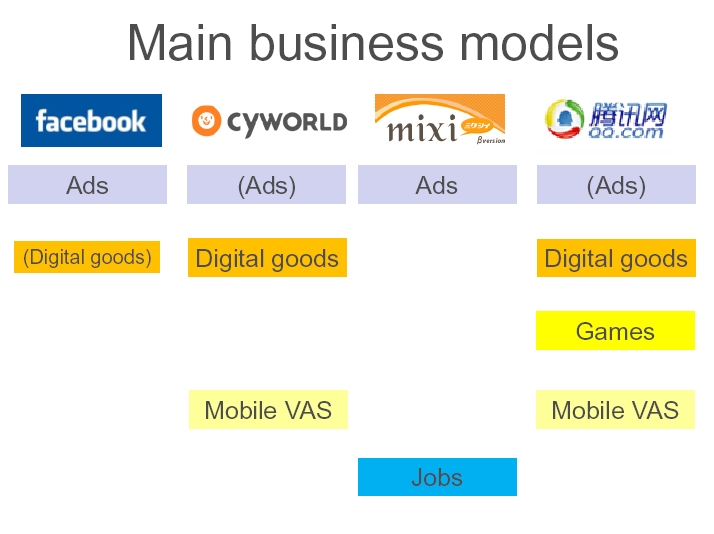
    clipboard01.jpg

    Courtesy – http://www.plus8star.com/ 

    Now, should that make our familiar networks hmm, disoriented? :D. Not exactly, because the population is there, even if its lesser than the other sites. The word of caution, is that the audience reaction to monetisation can never really be predicted.

    Social media is indeed popular, though it is felt that it lacks metrics which are so important for monetisation.That however, has not stopped brands from using the networks in a variety of ways. From making groups to building applications and so on, brands have cashed in on the network’s popularity to hook the customer on one more platform. This, for example is a post on social media marketing strategies.

    The common newspaper ad sales motto is that they lease their relationship with their customers to paying third parties. While the digital scene has diverged from traditional media in a lot of ways, I’m not quite sure why this can’t be made true for social media. I agree that a lot of applications are also a value addition to the site since they keep the visitors glued, but that can’t be the case always.

    For instance, look at this application on Facebook by Coca Cola. I doubt if Facebook is making any money from Coke. But the basic questions are ‘Whose platform is Coke using?’ and ‘Whose audience is Coke using?’. And so, why can’t this be a way for Facebook to make money? By all means, allow developers to make applications, but if brands are involved, no harm in asking them to pay. Use part of the revenues to keep users happy by providing better features. That’d be the icing.

    until next time, socialism 2.0

  • Zen & the art of SNS monetising

    The thought started from this article, which talked of how Google was losing top execs to Facebook. It apparently isnt just a phase because SNS (social networking sites) are increasingly grappling with the issue of revenue, or rather, the lack of it. These hires apparently fit the bill.

    Remember the initial days of the net? I don’t because i was a pretty late starter myself (2000- a virtual space odyssey, thats what my book would be called 😀 ), but that was still the time when (at least in india) revenue was a puzzle for everybody in dotcom, which partly explained the bust that soon happened. They had a partial solution happening with banner ads, and slowly that became the norm. In most places, it still is 😐 . the problem was that to most users, it became a blindspot.

    Then came Google, and the era of contextual ads, first in searches as sponsored links, and then in any site in the context it  had content in. It still works. But the net has moved on. So, users know exactly when its useful to them. This is of particular relevance in the case of social networking sites.

    At a basic level, I go to SNS to have a conversation with friends –  that could be just plain catching up, bitching about work, life etc or (thanks to facebook) just sharing a common interest over a game of scrabble. Can contextual ads work here? It was a difficult question to answer until one takes a look at the Facebook revenue scene. I personally don’t think it does, for the simple reason that, well, the context is wrong. Unlike search, where my intent is clearly info/purchase, its not so in SNS. This video, while totally out of context, shows what i mean about intent.

    [youtube=http://www.youtube.com/watch?v=Ahg6qcgoay4]

    So how does a free site (for users) like Facebook get revenue, and god forbid, if they don’t, will they shut down? No, dont call Mummy yet, this WATBlog article clearly shows the Chinese (damn them) have found a way to monetise their SNS, especially QQ. ( what a name. dont ask me kyun) And its not online ads, thats only 13% of the revenue. The rest is from virtual goods, services and mobile.

    But i personally think there’s more that can be done. And that has a direct connection to brands. We’ll discuss that next week, after i hear from you.

    until next time, remember you need to be social 😀

  • Bill meets Mark

    Well, maybe Bill and Mark have met before in other contexts, but to actually have a promo of MS doing a facebook application in India is perhaps a first. And thats not all, there’s a game on zapak too.

    ‘Heroes Happen Here’ is the theme of the entire promo being done by MS. While the entire deal looks like a mash up (not literally) of information disseminaton & trials for Visual Studio 2008, Windows Server 2008, SQL Server 2008 (do not close the window, i am as technologically challenged as you are on those) and community building, I, for one, am extremely envious of the brand/product guy who got to do this. It has stuff for IT professionals, developers and enthusiasts.

    As you might have guessed, this blog is interested because of the way a social network and a gaming site have been weaved in to the communication strategy. Communication strategy, because i saw an ad for this, not on facebook, but on the rediff homepage. Which means that not only have they spent money on the game and the application, but they’re also spending on advertising the stuff. I say cool!!

    I haven’t been able to add the application, but if you do, lemme know how it went.

     until next time, soft socialism

  • More Socialising

    I’d written this a while back on social networking sites and their relevance/irrelevance, and now i see this. If you’re too lazy to click, Orkut is letting developers make their social applications available to Orkut users.

    In the post I mentioned earlier, I had written how Facebook scores over Orkut due to the sheer pull of different elements which cater to my interests and the way it also allows me to relate to my friends on many different planes. The simple idea being that I’m a blogger, an F1 enthusiast, an avid reader, A Heroes fan etc . My friends also share many of these interests, and there are multiple applications which cater to all of these. Orkut’s only efforts so far has been groups (which Facebook also has) and that was just not enough. The latest announcement means that Orkut’s expansion of services are going to be in that direction.

    While that may spark the thought that it might level the playing field, I , for one, dont think so. For starters, Facebook already has the first mover advantage in the space. That can be argued because crowds have a tendency to flock towards the latest new thing as far as social networks go. But, I’ve seen a lot of Orkut users climbing on to Facebook and then saying ‘Its way too confusing’. For the non-confused Facebook user, its a good place to be, because the confusion acts a filter which prevents the clutter in Orkut. So I don’t think a lot of Facebook users will go to Orkut for the applications. That, however is something that depends a lot on the applications developed. Lastly, Orkut has managed to collect a lot of users hat are undesirable. These are spam/porn guys and the ‘I want to do friendship with you’ specimens who are still regulars in Orkut. So, while Orkut’s applications might be killers, a lot of potential users might be put off owing to the damage already done, the new privacy features notwithstanding.

    until next time, socialise 🙂

  • Social Responsibility

    And the mother of ’em all is finally here- My Space. I wonder if the promos happening on Channel V for its campus star is My Space’s idea of an Indian launch. I hope not, because i kinda liked Big Adda’s efforts, and hope to see a good brand campaign from My Space.Meanwhile, i read this article recently, which talked about social networking fatigue.

    While it did make interesting reading, and gave what could be a popular perspective about the sites, i would tend to disagree on the fatigue factor.While I admit to being a more recent convert to all the sites, i’ve been on orkut and facebook long enough to have come across fatigue if it was lurking there. In fact, the case could be true of orkut where my involvement has perhaps seen a downturn after i joined facebook. But thats because Orkut doesnt have enough meat (IMHO) to keep me interested, and that’s precisely what differentiates Facebook. Its not just about messages and photo sharing, vampires/werewolves and forwards, its also about applications which cater to your interests in life – be it word games like scrabble, Tv shows like Heroes, or the philosophy of Ayn Rand, or a simply super group like ‘I love trashy Hindi movies’, the list just goes on.

    I can’t see fatigue setting in when i’m playing scrabble with friends, while buying and selling in the fantasy stock exchange, and doing a likeness test with my friends and so on. In fact, the kind of fatigue i see is in the number of sites that keep cropping up. While (with the entry of My Space) we have three globally recognised networks, we also have the local clones like minglebox, yaari, Big Adda etc. And here’s were the fight will happen.Thats because there are users, and quite possibly the majority, who are into the social networking sites because its the in thing, and offers the (by now) plain vanilla benefit of connecting with friends. Once that connecting is done, their attention span becomes fleeting, and they’d hop, skip and jump to the newest site before you can say ‘Scrap’.

    So every new site launched and every new campaign for them would create a ripple in that market.But then, there’s also the user who’ll try to derive value from a network which offers such avenues for him, and for him there’s no fatigue. If the site keeps adding stuff that will add to the user stickiness, then they would have to worry only if a better product comes into the market, not because of the wannabes that appear from time to time.

    In essence, social networks, as every other commodity, will be solely responsible for how long they keep the user, depending on the value they create.So you see, the writing, as they say, is on the wall 🙂

    and i bid adieu, wishing you all the best in your socialising efforts..