Tag: Facebook

  • Social Factories

    What self respecting social media blog could let the Facebook redesign slip by without a post dedicated to it. Now is a good time considering that Mark Zuck has deemed that we shut down our silly protests and just accept his virtual reality. Inspite of short term solutions offered, well meaning advice, and groups consisting of millions of supporters, Facebook was unruffled, plodded on with migrating everyone to the new design, and was perhaps quite sure of the premise that there wouldn’t be an exodus of users because of a design change. I, for one, am not unhappy with the new design, since functionality has been improved (for me) but at the cost of a relatively (since Fb was never known to be easy) ‘cosier’ design. I also thought that apps suffer a lot since they are relegated to a separate tab, and are not automatically seen when i visit a person’s profile. I’m not sure if that’s a good thing.

    I was quite intrigued by Startup meme’s smart comparison of the new Facebook design and Vista, and possible strategic implications. The possibility of Microsoft’s increasing interest was further fueled by a TechCrunch article I read recently. It raises a good point of how, to a functionally conscious generation, Windows and Office might be dispensable, in favour of the likes of Facebook, LinkedIn etc. With the rise of collaborative tools, and cloud computing in the horizon, this might be bad news for Microsoft, especially since the success of Windows and Office has always been taken for granted. In such a scenario, a Facebook collaboration (and perhaps acquisition later) makes a lot of sense. After all, Facebook is trying to become a web OS, as this post suggests. Its a great read and goes on to wonder where the Facebook browser is. But to get back, all this means Facebook would open up a crucial second front for MS. 

    The interesting part for me is who will influence whom more. Microsoft, to me, has been an old style capitalist product company which just sends out factory made stuff without listening to consumers, while Facebook, notwithstanding its latest design move, is a ‘social’ service that listens to consumers. Hey, Mark Zuck did write a post to address the plebeians, and as Mashable points out, 4 out of his 6 posts has been to address user concerns. But with 1% MS in its lifestream, Facebook quite firmly put down the user created anti new design rebellion, I wonder if its a change in attitude we witnessed. If MS influences Facebook than vice versa, it could be fatal to both. Or perhaps Mark Zuck is just promoting this movie, just like this Facebook app does. 😉  Speaking of Facebook apps, a new one – Rock the Vote, allows Facebook members to register their names in the voting list, online. (via Startup Meme)

    While on social media and design, there’s been some activity happening on Friendfeed too, they released a new beta version recently, changed the design, and after listening to user feedback, made additional tweaks which were appreciated. The new beta had shifted the navigation structure from the top to the right, and made provisions to organize friends into different groups. Two additional features are photo hosting, and allowing users to view the FriendFeed stream of other users easily from the interface. Following user feedback, the navigation bar was moved to the left. But I think the best addition would be the grouping of same stories. What used to happen was thats everal people used to share the same story when it broke, now the first share will be shown with the option below to check out who else shared the same. The options below is for all services – a tweet, a delicious share, a google reader share would all be displayed. This would go a long way in reducing what makes up a large portion of ‘noise’. Nice to see good changes and the importance they are giving to user feedback.

    Sometimes, I wonder whether organisations, including social media ones, are just like a ‘famous people’ stereotype. Do they stop being friendly and have lesser conversations when they become famous?

    until next time, when socialism turns to capitalism…..
  • The new brand ambassador – you

    Sometime back, I saw a press release of an entity called AdBhai. It is positioned as a no-frills classifieds portal and according to the release, has implemented Google’s Friend Connect. It means that you can use your Orkut/GTalk id to post comments on the site, giving the entire thing a social twist.

    I have come across quite a few interesting sites which link shopping to social media. There’s Tribe Smart, which allows you to make a profile and use crowd wisdom to know about the product. And its not just a product, it could be a website, a movie. In the process, you end up meeting people who share similar interests. Skimbit is a browser add on that allows you to make a project page you can configure, for your purchase, add products from different sites, and then allow others to rate these.  Another startup working on a plugin based model is Notches, which works on two fronts – allows product sites that tie up with it to add review buttons to its product pages, and users who have downloaded it can review any product from any website. (via Center Networks) Meanwhile, there’s a very interesting online music sale model at PopCuts, which rewards you for spotting trends early. You can buy a track, and when someone buys it from then on, you get a cut. A very cool idea, I thought, and would like to see how it pans out. Just like the earlier site, you start meeting people who rock to the same tune.

    Mashable has written about a widget based service called TurnTo, which works on the concept of social shopping. Deviating from the path of the above two, this one lets you add people from your existing circle of friends. During TC 50, which I’d written about earlier, a couple of startups working in the social shopping/reccomendation space were showcased. One was GoodRec, which shows users reccomendations of restaurants, books, movies nightlife, and displays the location on a map. It allows you to make reccomendations, which can also be shared on Twitter, Facebook, Friendfeed etc. According to StartupMeme, GoodRec scores over the existing player – Yelp, in terms of usability. Another player, who is into ‘social’ based decision making is CityVoter, which ‘allows insiders who know a city best to share their insight with information, ratings, and reviews on everyday decisions’.The other startup is GoodGuide, which aims to provide users with information on social, environmental, and health related aspects of consumer products. With people becoming increasingly aware and conscious of the environment and the impact of their lifestyle on it, this is a good space to be, especially because of the clutter of ‘green’ goods that have been hitting the market. You can read more details on them here.

    WOM is no longer a buzzword, it has become a fact of life, if not in ‘low involvement’ categories, at least in ‘high involvement’ ones. Amazon has recently been using passionate Kindle users as brand ambassadors.We are on our way to what this post (quoting from a report) very correctly describes as an ‘influence economy’. As more and more users enter the social realms of Facebook, Twitter etc, their purchase decisions are becoming increasingly influenced by their social peer group. I come across this regularly on twitter – social based decisions on everything from restaurants to laptops and mobile phones. The post also gives a simple path for brands to get invloved in this process. But the essence is that brands need to be truthful, transparent, listen to their customers, be accessible, and most importantly, have a great product, for the reality is that communities cannot be bought. It has to be earned, and this post has a few tips on that. RWW has shared some data on super influencers, from a McCann study done  among 17,000 active internet users in 29 countries.

    Though brands are only beginning to take consumer voices seriously, it is great to see market leaders like Unilever and P&G understanding the limitations of current consumer research procedures, and making efforts to embrace online buzz. Meanwhile, HUL has introduced the concept of a customer ombudsman in india. The ombudsman works on behalf of the consumer and will tackle all cases that cannot be dealt with by Lever Care. A wonderfully radical move, which shows why they are market leaders. Read all about it here.  While on the subject, there’s a company called BazaarVoice, which helps brands create business value out of the positive consumer PR they generate. As fanboy cults emerge on Facebook and impromptu brand wars (among consumers) occur on twitter, I think this space has great potential. Speaking of Facebook, they’re also using users as brand ambassadors in Germany. (via Tech Crunch)

    until next a sociaholic shopaholic?

  • Blurring Social Networking lines

    ET had a story sometime back on how sites like Facebook, LinkedIn etc are helping SMEs and entrepreneurs gain business. It adds on to my belief that when the target is niche market segments, the net is the best medium to try out.The more encouraging part for me is that since these media are working for them, they even plan You Tube ads. So, they grow the medium, and the medium grows them!!

    Yes, social networking is not exactly the most known thing in the world, as this article would argue, but as far as online behaviour goes, the Indian stats are a bit encouraging on some parameters. And, with efforts like these, our internet penetration figures might start looking up sonner rather than later.

    So what have the social networks been upto? Lets start with business networking, where I’ve been reading about a lot of new launches. A new business network called ZaaBiz has been launched in India. More details on its activities can be found here.

    Konnects hopes to bridge the gap between Facebook and LinkedIn. According to them, Facebook has not been designed for business purposes, while LinkedIn is too restrictive. So, Konnects has come out with a few features, that will even enable even fresh graduates, who don’t have many years of work experience or projects to show, to share the projects they’re working on. Konnects, based on your profile, will reccomend groups and discussions that you should be part of, and plans to introduce IM and VoIP integration in the future. (via Mashable) I think all these together make it a very differentiated value proposition.

    The third interesting new site I came across is Publictivity. It aims to use social networking to boost productivity, by allowing users (in organisatons)to create work groups, and share information, files and it even has a video viewing mechanism. What I loved the site for, and it has nothing to do with the service, is that they have used Dunder Mifflin (of The Office fame) and an option to chat with Dwight!! Awesome example!!

    The last one I came across is 2Vouch, an Australian social recruiting website which offers referral rewards, with an option to donate to charity also. Companies don’t have to pay to advertise, they only need to pay if they hire a candidate. (via Mashable) The concept is interesting but I wonder about possible loopholes. Is it, for example, possible for a company to get the contact details of a candidate and then route it through other means?

    So, what has LinkedIn been upto meanwhile? For one, it’s been adding small features, like highlighting the sections of a profile that have changed, since you last saw it. (via Digital Inspiration) It has added enhanced group features, that includes a centralised group hub page. (via Tech Crunch). It has also tied up with CNBC to air content generated by its users on CNBC. (via PluggdIn) I share the view that most of these are quite basic features, and LinkedIn not only needs to be adding such things much faster, but introducing innovations too.

    This is of more significance, when we consider that the competition is not only new business networking sites, which are coming out with some neat innovations and targeting specific requirements, its also generic social networking sites like Facebook, if we go by certain studies, which raises the possibility of  business networking on Facebook superceding that on LinkedIn.

    Speaking of social networks, the interesting part is that inspite of the demise of entities like Yahoo Mash, new social networks still seem to be popping up. I read a post on Fwix, which, in addition to a great GUI, also shows the user, the most trendy information going on in his locality, by aggegating about 500000 stories per day. It also allows add on services, the list includes YouTube, MeetUp, Eventful Delicious, Twitter, Flickr and just about any you can think up. BBC has also launched its radio social networking site Radio PoP. And the omnipresent Google, in addition to its own social network Orkut, has opened up another front by adding a twitter-like ‘following feature’ to its blogging service – Blogger, so that users can now become ‘fans’ of other blogs. They have integrated it with Google Reader, and also plan to integrate Google Friend Connect into this, which brings it closer to creating blog based communities. (via The Inquisitr)

    There are new tools that are emerging in the social media space. How Sociable, which allows you to track your brand in the social media space; Lotame, an online advertising agency that is looking at changing the way advertising happens in social media,  Edopter, a way to discover and share trends in fashion, lifestyle, music and so on. New models are on the horizon, like contextual search in social media. The tools are there, its now for individuals and brands to make sure that they are used to their full potential. Like this article correctly states, business can no longer afford to ignore social media, and what GM has done – launching an anti-misinformation site, is perhaps a great start.

    until next time, socialise

  • Face it

    After the not-so-great response to Facebook’s Beacon ads, it was interesting to watch how Facebook would deal with the advertising and the issue of privacy. In an Indian context, according to the latest Comscore figures, Facebook ranks sixth in terms of the online search market in India. So, in an increasingly contextual world, where there are also fears of user data misuse, advertising has to play a balancing act.

    I’ve come across quite a few attempts at this. To start with, as part of the new design, you might have noticed the thumbs up/down on many ads. On clicking it, it asks you to choose from options as to why you like/don’t like the ad. It gives Facebook some great data that would help it target its ads much better. It makes sense – if I like the ads that appear on the pages I visit, and find it interesting, there are better chances of me clicking on them. As a user, I’m happy to get information/offers that are of use to me. So, positive user experience with ads. Facebook’s advertising options seem to be working well for them, if we go by Mashable’s poll, done last month.

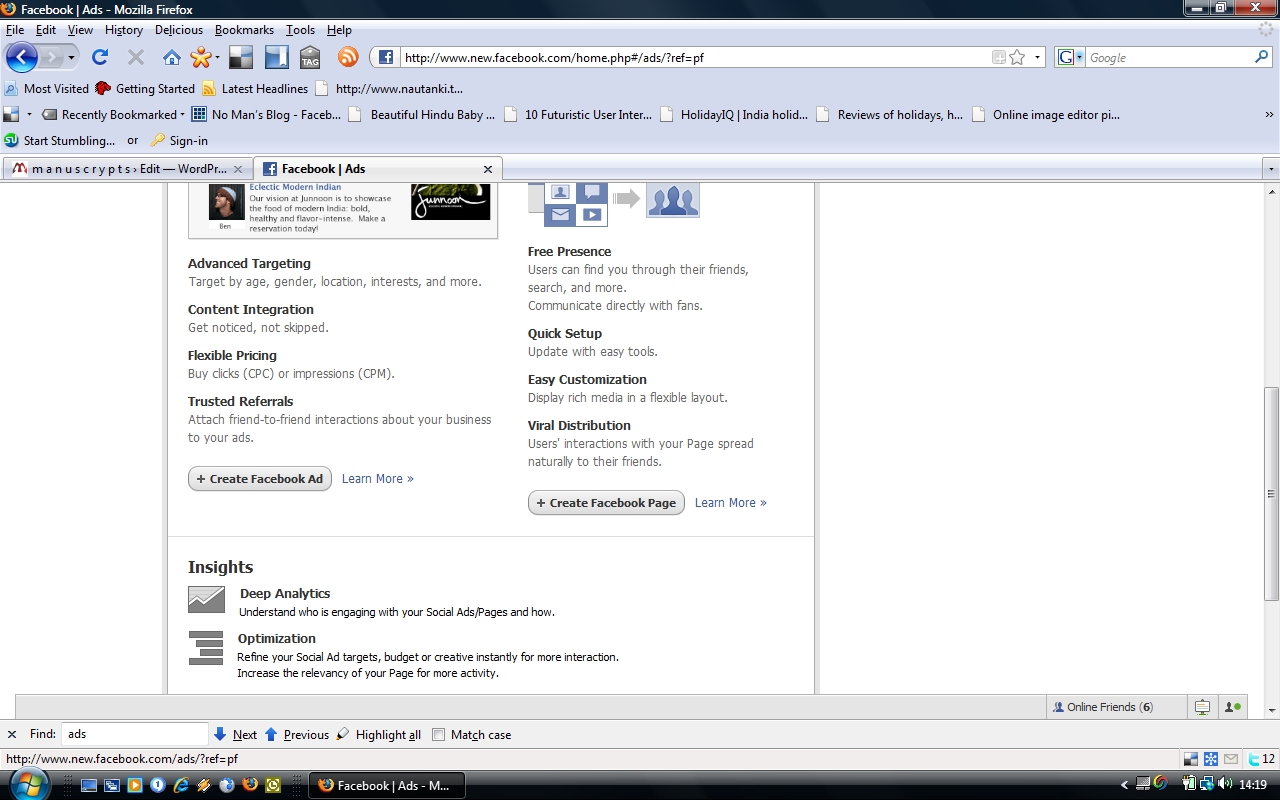
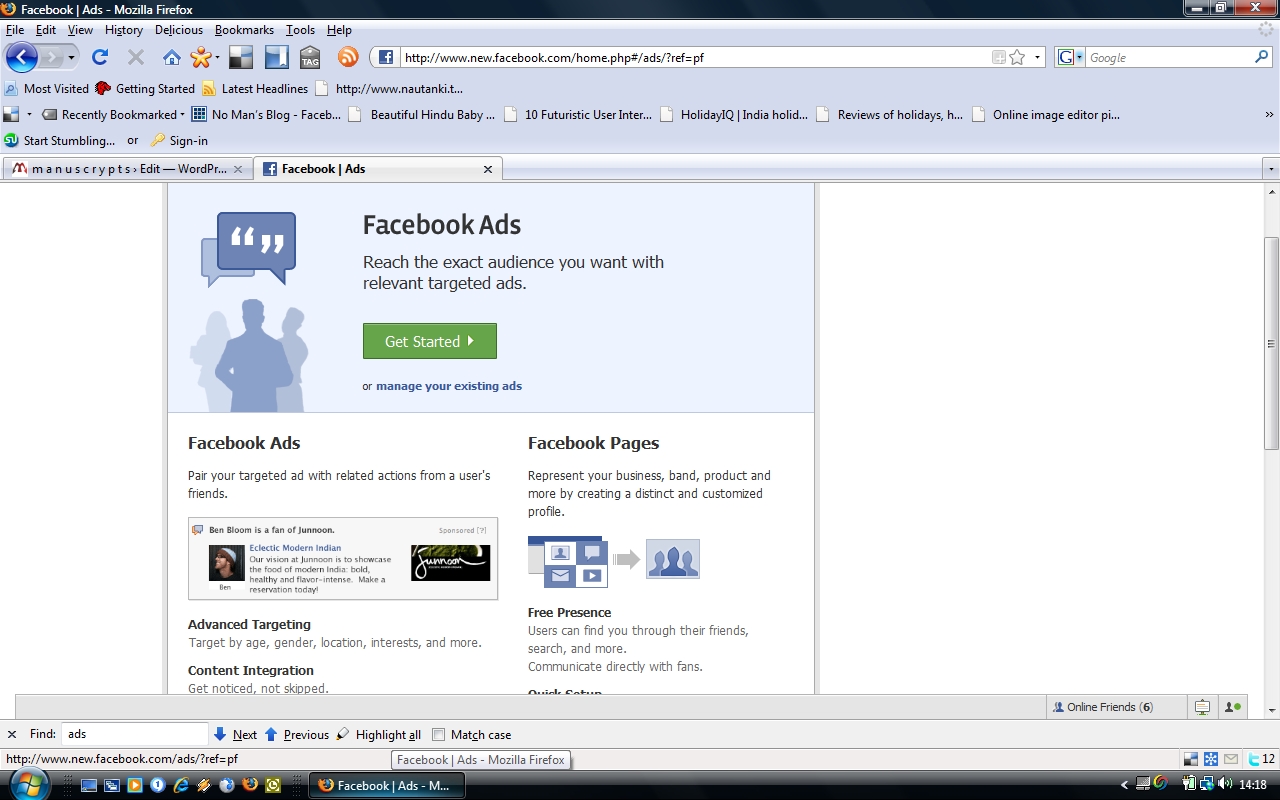
    You might have also noticed the welcome screen below, which help advertisers create ads on Facebook. (click to enlarge)

    Minekey uses the ‘targeted ad with related actions of a friend’ a lot. You might have seen the ‘XYZ has added the Minekey application’. But those won’t have the thumbs option. Also, check out some work done earlier by Career Builder. Its very interesting.

    Another communication I saw was the usage of a user’s action by brands to communicate their offering. So, (to use the example given in the article) if you see me saying ‘I loved The Dark Knight’, Warner Bros might have had a hand in it being shown to you. I hope brands will use this in moderation.

    But the really interesting piece of news I saw was Facebook’ way of social ads – Engagement Advertising. This allows users to leave comments on the ads they see. I wonder how brands will react to this, since it allows users to just diss their communication. It also forces brands to treat their message as secondary, relevance and fit to the community being the primary criterion. But its a great opportunity for brands to truly embrace transparency and a new way of communicating. More about it here.

    In essence, brands are getting newer ways to use social media, and even thread it with their offline activities. There’s more activity happening, check out the application that Microsoft has released on Facebook –Collabio. With users increasingly deciding what happens to brands in social media, it is imperative that brands understand how to present and represent themselves. Meanwhile, here’s some good data on fan trends in Facebook.

    until next time, add socialising to your ads

    PS. Am I the only guy feeling the eeriness of Obama Bi den… Osama Bin Laden ? 😉

  • Linkin Parks

    I’ve been a fan of del.icio.us for a long time, and was extremely happy with the plug-in they’d made for FF3.  Although this offers a perspective of people who don’t bookmark, I’ve found the idea of a taggable, online database that can be shared, extremely valuable, which is why the question of what Del.icio.us 2.0 would offer was an intriguing one. But I was quite disappointed with the url change, to delicious.com . There was something cool about the earlier url, but they have their reasons, as has been well documented by another fan here.

    So what did they say the improvements were? You can hear it right from the horse’s mouth here. To summarise, they have promised speed, a faster and more social search and a new design. Hmm, good, but I think they could have done better, because to me, this is a maintenance job, albeit a good one. As a die-hard fan, I wanted something radical, like Facebook (another favourite) taking the pedal off social networking and putting it on conversation sparking off comparisons to Twitter and Friendfeed. Yes, it has its detractors, and they’d say not many conversations seem to be happening there, but hey, only a small % of my fb friends are on twitter, its early days, and I, for one, am getting responses to my status messages, video uploads etc.

    But meanwhile, more than an FB progression path, this user generated discontent has been sparked off by a couple of entities I happened to come across, each of which could have been the lateral step that Delicious could’ve taken. I’ll start with Social Median. Its an online community where you can share links. So?  Well, if you use twitter, you’d realise the number of link sharing that happens there. Well, you can submit news to SM through Twitter. So, in this age of ‘noise’ you get like minded users to do “collaborative filtering to help people with similar interests identify/discover what to read/view.” And it’s not just people you can follow, its topics too. It is packed with features, perhaps thanks to an extremely user feedback based alpha mode. You can vote on the ranking of the keywords, sources that are used to seed the networks and can rank topics based on how important they are to you. In essence, it allows you to customise how frequently you want to read about ‘x’ topic and from ‘y’ media source. You can share the news you add, find through mail, and even twitter. You can also add a bookmarklet to your toolbar and add news to SN as you browse. A short term problem I see is the noise level, since many people would want to be community makers first. But the system will filter it in due course. They’re also planning to use the Google Social Graph API in some pretty advanced ways. While it seems closer to Digg, or Mixx, as a user, to me its fundamentally a collection of links, and shared interests,  and that’s Delicious’ premise. Meanwhile, there’s another one with the same idea, though not as feature packed.

    The other site I came across is httpfuse (via pluggd.in). The idea here is to allow the community to build a set of ‘fuses’ (bookmarks/links) around a topic of interest. Their differentiation wrt Digg, Delicious etc is clearly explained here. While I agree with the explanation on Digg, I am not quite convinced on the Delicious part. Maybe I need to explore more. But one thing I’ll grant, and I’ll use an example for this. If I search for ‘India’ in Delicious, I’ll get links bookmarked by other people with all the tags they have used. But when I do the same in httpfuse, it shows me the subtopics under India. And that’s definitely better.  I’d like a browser plug-in though, or did I miss it? Again, a focus that Delicious could’ve tried out.

    The last entity, is Browzmi, a browser within a browser. It not only allows real time collaborative browsing and bookmarking, with comments, but also has a chat functionality built in. You can also clip photos from a site you’re visiting, and share only that. All your actions are stored and can be viewed like any lifestreaming service. Unlike say, Yoono, its not an extension, and is actually quite a cute social browser which can be just another tab in your FF/IE browser. This is way lateral, but no harm in imagining. 🙂

    That said, you are still my first bookmarking love, Delicious. But the competition is getting hotter, and  you seem very absorbed in a linear way, so please buck up.  I really wouldn’t want to see you in this list. You could at least have added image bookmarking, you know.

    Meanwhile,a couple of other things you should check out, Feedly, an FF extension, which brings Google Reader closer to home, er homepage 😉 and this one – iglue, which reminded me of Snap (only reminded, its not the same) and left me very impressed, with its potential.

    until next time, spread some link love