
Tag: Facebook

  • Facet

    Facebook’s policy changes a while back meant that suddenly,  the average user (as opposed to the technophile and conspiracy theorist) is raising an eyebrow, or both, depending on knowledge levels, at what it means to his privacy. This is not an indication of whether someone is below or above average, let’s not go there. Meanwhile, K and I have been discussing David Bond (Erasing David), which has to do with online privacy (though not in a Facebook context)  – how one man challenges experts from a security firm to track him down using information they can gain about him from the public domain, while he tries to outrun them.

    K noted that in the olden days, this notion of privacy didn’t exist, as everything was known to everybody. I agreed that in the new age, our connections are more, we include a lot more people in our lives, even indirectly, by just sharing our data online. Our work, lifestyle and advances in technology mean that we communicate more, meet more people, and yes, ‘friend’ them.

    It does good too, no taking away from that. Ironically, K and I know each other from work, from quite a few years back. We never interacted much then, and I was more pally with others in her team. I still remember, a couple of years back, when I met K and another colleague of hers in a shop, I chatted away with him, and rewarded K with a lousy smile. 😀  But these days, we have amazing conversations online, and I’m hardly in touch with her colleagues. Thank you Facebook 🙂

    As perhaps the first generation of Facebook users, we are in an interesting place (and time). I read “Chasing the Monk’s shadow” recently, a book in which the author retraces Xuanzang’s journey (we knew him as Hieun Tsang in our history text books) and it made me appreciate the value of the written word – especially when it resurfaces in a  different era.   It was in this context that I considered what really appears in our profiles on Facebook.

    (Generalising) We friend erm friends, but we also friend parents, siblings, relatives, acquaintances, and even random animals. We display our likes, dislikes, interests, information, and through our conversations, we add layers to this. But its amazing how, sometimes, when I ‘like’ something that someone has posted, and glance at the others who have liked it, I realise that I don’t know them. We’re connected by one common friend.

    The common friend, who I might know from college, and the other person might know from work. How much of mining would it require to unearth the nuances in the relationships between ‘friends’? Would it be possible to mine the fact that while I might make a smart alec comment on a person’s status, I might never have met him/her in real life? Would it be possible to mine the different persons we are, to different people, in different contexts. The worries, the fears, the quirks, whims and yes, likes, that we never express, the things that probably make us human – they exist in our minds. We only share a part of ourselves online. We are still strangers, sometimes even to ourselves.

    So yes, while all sorts of data from browsing history to buying habits are out there, maybe, in this hugely connected world, without the ‘real metadata’, in a way we are still disconnected from most of our ‘friends’… and the information gatherers? Since its slightly difficult to be like Schmidt (Google CEO), who infamously said “If you have something that you don’t want anyone to know, maybe you shouldn’t be doing it in the first place”,  I believe that we should be responsible about what we share (even if that’s in the form of a ‘Like’) online.

    So all I’m saying is, you can press that little ‘Like’ button below, and nothing catastrophic is going to happen… yet 🙂

    until next time, face off
  • Online Segmenting and segregating

    We’ll start the thought from the easiest place. Facebook. 🙂 From industry leaders quitting Facebook to TC stating that media attacks on FB are getting out of hand, to Facebook deciding to launch ‘simplistic’ privacy options, there’s a ton of reading material out there. (I liked Danah Boyd’s ‘rant‘ quite a bit) But let’s get to the scope of the post, before i digress way out.

    I think it might be safe to assume  that we are different persons to different people. To the large set of siblings, friends, relatives, acquaintances and the various people we interact with, we share different aspects and versions of our personality, depending on the nature, time, depth, even expectations of our interactions and relationships. So, in a Facebook context too, we would like to retain different levels of sharing and communicating too, in spite of Mark Zuckerberg thinking that having two identities shows a lack of integrity. I think this might be the core of the current tussle – a failure to understand the need to segregate connections, and therefore the content that gets distributed to them.

    When i read Adam Singer’s take on Chris Brogan’s post, I was completely in agreement, because I think HE has nailed a universal truth about normalisation. The last part of the post also mentions how we write basis the kind of audience we’d like. That is a kind of content segregation too, and it is necessary now more than ever, because of content abundance.

    It’s not just to do with publishing, it is also to do with the kind of communities we become a part of. The net provides tools which allows us to aggregate  people like ourselves – basis interests, attitudes, beliefs, and if everything else fails, even location 😀  My point, there’s segregation all around.

    Which brings me to the usual suspect – brands. I started on this last week, and found myself thinking of it during the recent UTV Bindass scuffle. Now, if we go by UTV’s brand communication, its clearly a youth brand. I’ve realised that ‘Youth’ is a very flexible segmentation, and people my age might argue that its all in the mind etc, but it was interesting to see that the average age of opinion sharers was on the erm, riper side of 30. I wonder if the brand would want this audience segment as its viewers.

    It reminds me of the Facebook user’s need for segregation choices. While the net gives the brand tools to find users in a desired segment/demographic, and the brand can limit itself to engaging them specifically, there really is no way to prevent interactions coming from/happening outside the segment. In an earlier era, it was easy, because it was mostly one way communication. Now, what does a brand do if its dragged into a conversation? The non-open options (protected tweets, invite-only community etc) are not really great. Now some would say that this thought approach is close to advocating control for brands – which is a strict no-no as per the tenets of social media 🙂 – but I can’t help but think of the choice that the brand might want in terms of the discussions they want to be part of.  In a case like Bindass, will “Thank you for the feedback, but we all know that different audience sets have different needs and likes. Hope to have some programming that you’ll like, soon.” really cut it?

    In Facebook’s case, while i can perhaps understand Zuckerberg’s version of how radical transparency will make us all better, I’ll still make a case for it to be a user’s choice, unhindered by beguiling ToS and changes to it. Similarly, in a scenario in which mobs and brand-baiting are rapidly on the rise, I’d say there should be a freedom of choice for brands too. How brands use it is a different discussion altogether.

    until next time, the answer, my friend, is flowin in the stream 🙂

    PS: Noted that Hippo, which is doing some excellent work on Twitter, replied to Tony’s Hippo-crates wordplay, (reply) but ignored the (same) one which i’d tweeted a couple of days earlier. (btw, he usually beats me to most wordplay stuff and more importantly, gives credit to original tweets when he doesn’t) Anyway, smart segmentation, Hippo knows i almost never snack.

    PPS: Its got nothing to do with the fact that Tony is almost a decade younger, okay? 😉

  • Brand Privacy

    The implications of Facebook’s recent moves are still gobbling up most of the virtual column space available. From discussions happening in my own set of connections, it does seem to have gotten a larger crowd (than the usual suspects) interested.

    Jeff Jarvis’ post raises quite a few good points – the different levels of ‘public’, sharing vs publishing, to name a couple. The issue here is that Facebook is controlling where information we share on the network goes, we seem to have no choice in the matter. Mark Zuckerberg is unfortunately seen as pushing us to be public to ‘Everyone’ (a superb visual representation). But that’s where (and this is just an opinion) we might have reached anyway, given a little time. In any case, there are enough tools which allow me to create a network of my own and share it, without involving Facebook. My blogs worked that way, until I connected them with FB. Yes, it could cost me some reach, but there are ways to compensate that too, though yes, Facebook is really big.

    Like I tweeted sometime back, I think we just want the networks to be more ‘open’, so that we can decide who we can be ‘closed’ to. Right now, we don’t get to decide that much, and while I’m not defending FB here, this is something Google has been guilty of for a longer time. But that’s a different topic.

    I was, as usual, intrigued by how this affects brands online. Like I’ve said before, I wonder if there is a kind of hypocrisy involved when we desire privacy for ourselves, but expect brands to be more open on the social web, because it is of use to us as consumers. Many facets of this, so perhaps another post. But all this hullabaloo about privacy means that consumers will be more careful about their interaction with brands, and which ones they want to be associated with, at least online. So now, brands will require to do more to gain their trust and/or provide enough value to convince consumers, who might be otherwise reluctant to associate with a brand . Or will the casual ‘like’ become a commodity? From their own perspective, brands will now have to get used to more attention as the dynamics of Pages/Groups etc change.

    Meanwhile, on another front, another trend that has been creeping up on us is the segregation of crowds on the web. Like this article notes, the web allows us tools to create a ‘people like me’ bubble around us. This is linked to the kind of ‘privacy’ we are talking about – select groups with whom we can share specific things in specific contexts? It remains to be seen how many bubbles overlap and in what way. This trend, I believe will not die out soon, and the ‘groups’ will become even more careful about who is let in. How does a brand balance itself among different groups of people who now agglomerate themselves and are choosy about who they associate with online? Is this an opportunity to finally manifest the idea of being different things to different people, according to their finely split needs?

    until next time, its ‘like’ complicated 🙂

    Bonus Read: How Facebook’s Community Pages and Privacy changes impact Brands by Jeremiah Owyang

  • Converse

    A few days back, I read on RWW that Google Wave has released Wave Elements, which allow waves to be embedded on any website. Despite what might seem a ‘never took off’ status, I still thought Wave had potential. Buzz did confuse me in this context, and I wondered about Google’s strategy – whether they’re simultaneously developing the two products for consumer/enterprise users, or using one as a stepping stone for the other etc. My usage of Google Wave was limited to the first few weeks and Buzz faded out in a few days.

    My primary issue with Buzz was that rather than new conversations, my contacts mostly had feed imports from Reader, Twitter etc, with little value addition. Buzz never gave me the option of removing specific feeds of users. Also, I couldn’t export the conversation which happened inside Buzz to the blog. The latitude-buzz based ideas remain complicated. All this, in addition to all the criticism that came their way right after the launch. It just made a mess of all my contexts.

    But when I implemented the Facebook ‘Like’ button last week, I wondered whether I should implement the ‘Buzz’ button too. Like I’ve said before, I think most offices can’t afford to block GMail, so Buzz might help in the sharing better. 😉 Still thinking about it. Meanwhile, what I did try, is to add Facebook Insights to this domain. I stopped at six ‘Bad Request’ responses. Now, if I have shared my blogs with FB, I can’t see why they can’t make it easier for me to add Insights. They seem to be prompting me for a dozen other things these days!! With all the other plugins, this could really help.

    I had hopes on a similar line for Buzz too. Simplistically put, if i shared my blogs with Buzz as a publisher, could they automatically assign a shortened goo.gl url to it, and notify me when it was shared? While at it, also tie it to my Analytics, for even more details.

    The thought is pretty simple. Someone ‘likes’ this post, shares it on FB/Buzz, a discussion happens around it, and a reader here might not even know about it. Hell, I might not even know about it, if I haven’t implemented a few tools.  Can that be rectified? Also, can FB/Buzz help export the conversations from there and (also) show it on my blog,  because it provides the reader an easy way to know different perspectives on the matter, even though discussions have been happening on other platforms, and perhaps even discover people with similar interests. (There is at least one FB comments plugin that pulls comments from Notes, but I was looking at something that would identify the url irrespective of who shared it)  I’d say the same for Twitter too, except I don’t think they even have threaded conversations completely right.

    until next time, scaling walls

    PS. I don’t think Disqus is there.. yet

  • Early Bird Rewards

    At least two major virtual happenings, one that has massive implications on the future of the web, and the other, slightly more subdued, but not lacking in potential. The latter – Twitter Annotations, announced at Chirp, allowing developers to “add any arbitrary metadata to any tweet in the system.” You can take a look at the various possibilities here, here and here. The former – Facebook’s  Open Graph, unveiled at the f8 conference, and aimed at making itself the centre of everything that happens on the www. A  combination of  plugins, developer tools, new markups which can make the user experience on any site that plays along increasingly personal, social, semantic, from plain hyperlinks to layered information. Already, one small manifestation can  be seen at the bottom of this post – a Facebook ‘Like’ button, which will carry your liking of this post into your activity stream on Facebook. More and more data, not just what you do on FB, but outside as well, across the web. From what I read, smells like Google, perhaps worse, because the flow of information seems possible only through the Facebook conduit. A good round up of implications here.

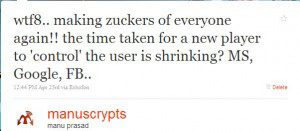
    When I returned from he break, and read up on these developments, my first thought, which i also tweeted was

    1

    And that’s the point of the post. During the break, the only network I was hooked on to was Foursquare. One of the things that happened, thanks to long waiting times in the Kolkata airport was that I became mayor of the neat CCD outlet just outside the airport complex.

    CCD has completed the re-branding at this outlet (unlike the one inside the airport) and has done a decent job at establishing ‘conversations’ as the prime focus area, in terms of in-store design. The feedback posters, ‘snippets’ at each table and the ‘quotes’ design on the roof were nice touches. When I got back, I found a CCD account following me on Twitter. Seemed like a more synergistic effort after the earlier snafu.

    It made me think once again about how alert brands need to be in such a dynamic scenario. If CCD were an early adopter, would they have braved the earlier storm better? What if they become active on Foursquare now, experiment with the new services being built on top of it – friendticker, snacksquare etc, still in their nascent stages. Or at least acknowledge their outlets on Foursquare and engaging the users. “@xyz congrats on becoming the mayor of our abc outlet”, and then build on top of that relationship. Won’t that help them gain some crucial evangelists in a new medium? If not evangelists, at least someone who will listen to their side of the story when something nasty happens? Wouldn’t they get a headstart on ‘authority’ by being an early bird?

    Even the era of quick responses being a reasonable expectation seems to be blurring by fast. Perhaps brands are now required to have an advance scout mechanism, to test out new services, features, changes, understand the implications and see whether/how business and objectives needs to be realigned. Page Rank, Social Platforms at consumer and enterprise level, Social CRM, Location based services, tools and platforms keep shifting. Early adoption and balancing objectives with diverse ways and platforms of engagement may become an imperative. Multiple options, two way communication manifestos, its all changing real time. Hold on tight.

    until next time, service level disagreements