Tag: Facebook

  • Hairsay

    So, the Old Spice manΒ  increased the sales of the product. Now we can renew the debate on the efficacy of social media on the bottom line. We obviously won’t ask for correlation data. πŸ™‚ The other side effect is that every brand manager will now want to replicate it – especially the viral and the ROI. Quite like a poster child (in India) of an era gone by – Sunsilk’s GangofGirls, which at that point had made many aΒ  brand manager experimenting with digital media tell their agency “I want one too”. Damn virals work at meta levels!!

    I recently read Kapil Ohri’s article on afaqs, on the site’s makeover – the shift from blogs and gangs to trends and forums and the ‘mandatory’ buttons – Facebook and Twitter. Its early days, so it’d be unfair to make a comment on the numbers, even if they were to be considered a parameter of success/ failure. But while, on buttons, I think YouTube videos would’ve been a help. More on that in a bit. A revamped GoG, and the Pantene vs Dove war for hairspace being fought offline and on blogs (Karthik, L Bhat) gives me enough food for thought.. and opinion.

    Sunsilk Gang of Girls: GoG could have (like an industry person commented on the afaqs post) integrated Facebook in a much better way. Check out what Levi’s has done at their online store. Instead of separate registrations and profile, Facebook’s plugins could make life easier for the user and automatically bring in the ‘gangs’. It could get them to pull their own photos from Facebook for the ‘Makeover Machine’, suggest it to friends, and so on. Or build a Twitter app that uses the display picture. It could have perhaps thought bigger and had their ambassador (Priyanka Chopra?) interact with the users through her own identities on these platforms. Or used a location based tool like Foursquare (or FB Pages or later Google Places) to start building a resource for salons and tips at each place (think of a Burrp! for salons), maybe in sync with a YouTube channel for tips.

    Pantene: Good Morning! They obviously missed a little thing when they didn’t pay attention to the pwnage of DNA at the hands of the Times Group during the former’s launch campaign in Mumbai back in 2005 (?), or the more recent Airtel- Reliance DTH fun. Not to mention the cliche that after a certain point, the only person who gets teased is the brand manager. Ok, I won’t overstate, but c’mon this is a real-time era AND they did walk into a Dovetailed ambush. Since the internet already has made them un-mysterious (thanks for that info, Karthik), maybe Pantene should have just added those FB page and Twitter links to their mass media communication, and solved the mystery immediately online. Mind you, thanks to our dismal internet penetration, they could still demystify it again on mass media, later, after perhaps, adding the content from their online and offline activities. (think non market research agency 80%) That way, there would’ve been at least some buffer against a Dove’s sneak attack. Arguable, but possible.

    Dove: All of us should take the time and remember the controversy over the ‘campaign for real beauty’. But hey, they saw an opportunity and used it. Effects on long term goals are again arguable.

    A little note on ‘low involvement’. I wrote about brands, content and new media platforms in the last post, in the context of the Old Spice campaign, and also mentioned the importance of ‘intent’ and setting objectives. Once the ‘why’ is done, the relevant crowd can be identified, along with the platforms and activation strategies – ‘(to) who’, where and what. (Read Rohit Awasthi’s comment on Karthik’s first post) When the ‘right’ content is pitched to the ‘right’ people at the ‘right’ time (and the ‘right’ platform too), very few categories are low involvement.Β  (read Naina’s comment on that post) And that’s the beauty of the web in general, and the tools that social media have provided marketers. Old Spice could be seen as low involvement too, until they did this campaign.

    But having mostly seen communication as advertising (except arguably PR), creating content for social platforms is in itself quite a challenge for brand managers. Even if they were toΒ  view ‘social’ as ‘media’, it requires a complete realignment of how media and content strategy is done, mostly because the mechanics of distribution are completely different. At a fundamental level, brands are dependent on users of platforms to create a buzz, and money doesn’t always work. At this point, tools can help with the ‘time’ (including location and other contexts) and ‘people’ (interest), and the way it works, if the ‘content’ is done right, people will get other people.

    Therefore brand managers need to make a more diligent effort. The fragmentation of traditional media does not seem to have made much of an impact on the costs involved in using them as distribution channels. So when ‘social media’Β  presents ‘free’ channels, brand managers see a value proposition and jump right in with a TVC and or/other weapons of mass mediocrity. Brands, I believe, need to invest a bit more on who they’re trying to reach, and then invest some more on building content and designing networks and constructs (irrespective of platform) that will drive the crowd to interact with the content and share it more. Content and people that will drive more connections, and help meet everyone’s objectives.

    But yes, until Augmented Reality allows me to scan a shampoo and tell me how many of my friends liked it, and think I should use it, (though my hair won’t last that long 😐 ) lets keep playing all the shampoo games we can play. πŸ™‚ And while on using social platforms purely with a sales objective, I’m reminded of how Grandma uses her laptop. (vid below) Can it be used for those purposes? Of course! But is that its best case use? We can argue πŸ˜‰

    httpv://www.youtube.com/watch?v=Vg6emajJmEo

    until next time, sometimes brand strategies can be real poo!!
  • A different kind of social

    Despite a healthy skepticism for all things Google attempts with social, Wave and Buzz not having helped very much, I was quite excited after I saw the presentation below by Google’s Paul Adams. (the link which I had shared last week) It meant that Google Me was worth keeping a watch on. No, not the movie, the service.

    [Read Mahendra’s excellent key takeaways+thoughts post if you need a quick snapshot without having to read 216 pages.]

    I was quite impressed with the scope of the presentation – from looking at people’s motivations behind their ‘social’ actions to the insights that have been gleaned. I must admit that i was a bit surprised that Google, or at least its employees took social this seriously. Good to know that Facebook and Zuckerberg’s stated aim of 1 billion users in the near future is finally pushing Google to do something other than killing of services (Jaiku, Dodgeball…) or making a mockery of itself in front of its competitors with half baked products. And that they’re doing research too. My first thought, after I finished reading the document was

    Clipboard02

    Its ironic that Google faces a ‘What Would Google Do’ on itself. The good news is that there is enough scope for developing a network for context based social relationships and transactions. Like I said in my last post, the tools available still don’t allow me the freedom to aggregate and disaggregate connections and content at will in different contexts. It is possible to build a social network around many contexts – enterprise/professional use, location, family, interests and so on. I even saw an interesting app built for ‘proximity based networking’ – it syncs your existing networks – Facebook, LinkedIn, MySpace with location and thereby does a twist on location based networking, with seemingly good privacy controls.

    The bad news is that Mark Zuckerberg won’t take too kindly to encroachments in his space. As if ‘friends’ weren’t universal enough (at least inside the FB universe – including Connect), ‘Like’ is even more universal, and Facebook’s recent play is aimed at pipping Google’s (relative) ability to deliver the most relevant content to the user. It doesn’t help that social doesn’t seem to be what Google’s comfortable with.

    But assuming Google Me is a social platform of some sort, what I’m wondering is that how many users would use Facebook lesser for a service which allows context to be brought into the picture. There’s something really simple about the ‘sharing’ on Facebook. For a service that used to be labeled ‘complex’ in the Orkut era, it has come far. Users have adapted. Also, how difficult is it for Facebook, which already has a massive userbase to introduce features that allow a user to create sub identities to splice and dice friends (already has lists) and content and choose what to use outside the network? It already has filters to control the kind of information I want to see on my newsfeed, these can be improved too.

    The other thing is how/where Google would build this – a separate service/ something around or integrated with iGoogle/Buzz (brrr)/Chrome (browser or OS)/ Search itself ? A lot of the design would be based on this. And how can it balance the simplicity of Facebook sharing with the more complex needs of context and privacy?

    A larger perspective is that we’re nowhere close to the end game as far as our (probably seamless in the future) network of digital and real activities go. Its having a larger impact than what we sometimes credit it for. In fact, we are only discovering how the web is changing our behaviour and even perhaps motivations. A few of us have yet to decide whether we want to sync our multiple online identities. And that means that though Facebook is probably the most accepted solution now, its by no means the perfect one, even for our current understanding. Facebook, Google and the ones we haven’t even heard about are all Work In Progress, but boy, what interesting work it is! No monopoly, lots of chance and multiple community chests πŸ™‚

    until next time, google yourself πŸ™‚

  • Influence Cycles

    The term ‘influencer’ is a recurring one in social media. Mahendra had a tongue-in-click post last week on the subject, and Surekha and I ended up taking it on a tangent, and it reminded me once again of the way ‘influence’ is changing, for all parties concerned – influenced, influencer, the object that links them and the medium that connects them.

    It was relatively easy when the medium was one way – mass media. The number of influencers were limited and there was really no way to locate or measure the individuals who made up the long tail of influencers. Or at least few were interested in doing it. The web disrupted it. The influenced found an abundance of content, the influencer saw his power being diminished by millions of publishers. The object (including the service provider/brand/organisation/group etc) figured out that it wasn’t at the mercy of limited influencers, but discovered a huge list which had its own quirks, but had the power to influence a multitude. Yes, known stuff, just summing up for context.

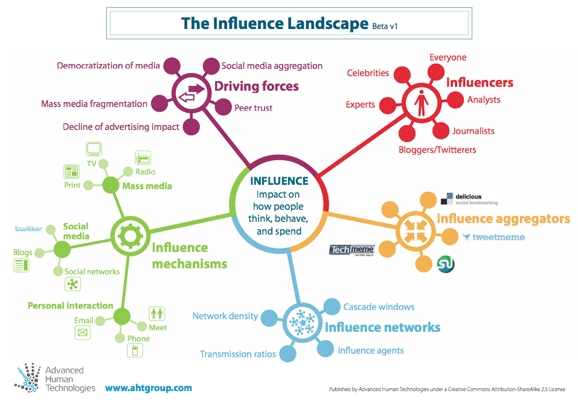
    I remember touching upon ‘social influencer relationship management’ (yes, there is actually a term for it) late last year, and the importance of trust. Influence, for me, has been a difficult thing to wrap my head around. There are so many factors erm, influencing it – time (specific and relative), context, trust (and objectivity) and the fast changing content platforms- each of which seems to add yet another layer. The complex structure has been well illustrated well in the chart below

    Influencer

    via ( a post similar to Mahendra’s, but more serious in tone πŸ™‚ )

    At least in the medium term, I think its only going to get more complex, primarily because the platforms are only evolving – Quora, the service I mentioned in the comment to Mahendra’s post, for example, can help in establishing context specific expertise and therefore trust. Facebook, when its QnA service starts, will try to establish it within a known network. Twitter has already tried it too, but I agree with Surekha. I’ve noticed that with web platforms, after a certain scale is reached, the culture starts resembling that of mass (media) and the ‘influencers’ as well as ‘influenced’ begin a relationship that’s familiar from a mass media era. What also complicates is that the ‘object’ of the relationship sometimes discovers that it too has a voice or can hire a ‘voice’ and attempt influence. This is one of the ways it is trying to adapt to new platforms. But while there might be flaws in each approach, I do feel the direction is right.

    At this point in time, as a user, I’m still evolving in terms of the platforms I use to establish networks of trust. The tools available still don’t allow me the freedom to aggregate and disaggregate at will in different contexts. That’s probably something brands can identify with too, thanks to the plethora of platforms and influencers across networks. Its perhaps the difficult transition state when brands have to manage traditional communication outlets, new media barons, their own content management systems that need to evolve, and a long tail full of influencers. More importantly, brand processes (like advertising, PR etc) had evolved in a mass media milieu and a struggle to adapt to the disruptions brought around by a two way communication mechanism is what we see around now. We’ll keep that for another post, and quickly jump to an aspect that intrigues me from the four influence factors I mentioned earlier- that of time.

    Long back, I wondered how we could juxtapose product and consumer life cycles. Let me address it in this context. Different consumers will ‘reach’ the product/service at different points in its lifecycle. There is a ‘time divide’ that separates the different sets of users. The motivations of this set would differ and therefore , its influencers will also be different, as will their motivations. Brands (using it as a blanket term, includes services too) these days are constantly in the hunt for early influencers, which is why I found this article, which discusses why gadget manufacturers should target late adopters, very interesting. This could apply to platforms as well. I wonder how this thought can affect when and how brands try to influence on new media platforms. Does it make sense to wait till platforms evolve to an extent where they can work better for the brands or is technology moving way too fast and lifecycles of all concerned behaviours becoming too small to wait?

    Meanwhile, what if the millions who have never used Facebook are influenced by the movie? πŸ˜‰

    until next time, in flux

    Bonus Read: I plan to riff on this soon, but in this context, you could check out pages 147-173 of this amazing document. (via Pluggd.in)

  • Services, Information, People

    Even as the first trailer of ‘The Social Network‘ was released last week, and even as fresh rounds of humour/angst on Facebook’s privacy algo (Google’s too) are unleashed regularly, I found that the amount of things I share on Facebook has vastly increased, though the time spent hasn’t increased in proportion. Its probably the ease of sharing information, the threaded conversations (none of my usual twitter clients have it) around the shared item, or the lack of (self imposed) constraints that my blogs suffer from, but photos, videos, comments and all sorts of content (my own as well as the ones I find) get shared on FB. Sometimes I even miss not being able to send a quick mail (where is Project Titan?!) to someone on FB from GMail (yes, I have FB friends who I don’t connect with on GTalk) In a recent interview, Mark Zuckerberg also shared his views on credits, and its portability. With search and location coming up as major initiatives, I wonder when my Facebook data will become portable.

    In this context, I saw the three kinds of webs (similar to the ones mentioned in the last post) and more that are almost seamlessly connected now – information, service and people. The need for filters in this information deluge is indeed pressing. While I do see some nifty tools that are being developed (eg. Pivot , Avoidr, specific search engines or even Twitter’s annotations) I sometimes wonder if it can ever catch up with the broadening scope of commonly used services. That’s also the reason why I think Facebook’s Open Graph search engine, which aims for social semantic search, is a big step, even while granting that not everyone’s on Facebook and their execution still has some way to go. Add to this privacy/security concerns (even Twitter was pulled up recently), and it does look complicated. Further layers like location will only add to this. And I wonder what new levels of complexity Google Me will bring. With each new service, the deluge of information increases, many times in the form of repetition, and our consumption changes.

    The increasing usage of these services has meant that the web of ‘friends’ have also increased. In my case, while FB consisted of only real friends earlier, in the last few months, the number of virtual friends – mostly from Twitter, have increased manifold. Since I don’t usually share anything on the web that I don’t want anyone to see, my problems with privacy have been limited. But as the amount of sharing increases, I realise there are things I share that could be taken out of context. There is also the fact that personal and professional lives are no longer silos. (Read) The other take out from the last point is that its not just communication from brands/services that need to be looked at closely, but people too.

    When the three webs are absolutely seamless, we will also see a shift in the kinds of relationship we have shared with brands, services and people. Facebook making payment for advertisers easier, sending me marketplace links, services making it easier for embedding ads, posts from my ‘friends’ plugging services/products with no disclosure, all work as signs for me. I do see a lot of work in setting up new ‘trading currencies’ and even different kinds of social networks (mobile phones – closed network ) and also note that the one factor that all the three entities need to keep in mind is trust. And that’s when I begin to wonder if similar systems are being developed for ‘sharing’ trust and whether they can keep pace with the deluge of information, services and people. Or maybe its already working under the radar – new services (endor.se), recommendations on LinkedIn, Twitter lists etc.

    until next time, SIP investments for mutual benefits πŸ™‚

  • Square Routes

    Despite my niggle with location based services (specifically Foursquare) – that the game part is taking away from the social/utility part of it, I still believe that they’re an excellent step towards bringing reality and the virtual social networks closer. And hence, I do pay attention to the developments in the domain – from how they stack up against each other in terms of features (and an excellent infographic) to futuristic scenarios and thoughts, which give some good pointers on where these are headed, and the features being added in specific LBS players and the omnipresent trio – Google, Facebook and Twitter.

    Foursquare is the only one I use, and hence I’m a bit biased. But it really has been setting a scorching pace in terms of creating opportunities that widen its scope. Badge fatigue is definitely something I’d been wondering about basis my usage, and I read that they’re now looking at adding more real value to badges, beyond the regular ‘mayor specials’ kind of deals. For example, “users who check-in at an Internet Week venue will unlock a special badge. That badge β€” when presented to bouncers β€” will guarantee users priority entrance into some Internet Week parties and events.” (via Mashable) The association with WSJ for the ‘Add to Foursquare’ button- to add venues with a single click when they are mentioned in articles – is quite a good move, both in terms of publicity, as well as utility. (because WSJ also adds a tip, with a link, so they get traffic later)

    Scoble has an excellent post with suggestions on what Foursquare should be doing, going forward. I think all of them are essential – especially badges as a platform so companies/establishments can use it too (read recently that they’re doing it, but can’t find a link), giving more importance to tips (I don’t even get points for them), adding multimedia content (Brightkite has started this already), and the checking out feature. I’d also like to add to the wishlist – the ability to (direct) message (not shout) other users, (actually buy Meet Gatsby)Β  a way for select users to preview my (say) weekend plan, a way to ‘like’ existing tips so future users can have some kind of mechanism to judge,Β  tie ups with the group buying players (see The Dealmap), and please, an app for Nokia (especially valid for India). Oh yes, these real badges and other merchandise, how about adding some Augmented Reality/Stickybits to it? That goes for the stickers that are coming out soon too.

    Meanwhile, Google has rolled out Tags – an advertising feature for local businesses that allow them to post additional information (eg. deals), Twitter is going ‘Places‘ which will allow users to tag tweets with places – its already integrated with Foursquare and Gowalla and automatically goes to a page associated with the place, and as SearchEngineLand notes, could in time, provide some good competition to Google Places. Ok, Yahoo’s trying too, remember, it bought the Indonesian service Koprol last month.Β  In addition there are new players set to arrive on the scene too, like Placebook!! (via) That reminds me, the Facebook ‘location’ buzz has been happening for long enough now, and I’d say that once the privacy talks have been sufficiently muted, there would be an announcement. For the record, Facebook ain’t the only ones with privacy issues. The aggregators have also arrived on the scene – Fourwhere.

    RWW has a classification of three different webs – data, people and services, all of which are the basis of mashups – current and near future. The web of people has thrown up the issue of privacy and the amount of personal data users want to share. Location based services stretch this even further. (Do read ‘Publicy and the erosion of privacy‘) As we live in the stream and move towards new social and data arrangements, what I find interesting is that without the data we share, mashups might find it difficult to throw up personalised recommendations. Users, services as well as brands will need to walk a fine line on this. Services, I think, have to do the balancing act most. They have to keep users comfortable in terms of privacy and what they receive for sharing the data. Placebook sounds good in this context. They also have to help brands deliver value to the user.Β  But as of now, the business models are still evolving. A recent study showed that only 10% of businesses would be willing to pay for Foursquare.Β  But as users evolve, consumption, social behaviour and data sharing comfort levels change and intersect, and services gear up to accommodate all this, we will surely see a rapidly changing landscape.

    until next time, location based relationships next?