Tag: expectations

  • Expectations? Surely you’re joking!

    Borrowed one part of the title of the book that sparked this thought – ‘Surely you’re joking, Mr.Feynman!’ Towards the middle of the book, Feynman talks about the time he got incredulous job offers and wondered how he could ever meet the expectations. A colleague explained to him how he (Feynman) was doing a good job of teaching, and any other expectation that the university would have of him was subject to luck. They might get it out of him or not, and they were ok with the risk. Freed Feynman from guilt, and gave me a thought on expectations.

    If I plot a me/others and meet/don’t meet 2×2 matrix, I get 4 boxes. Let’s take the easy ones first. I meet expectations, and so do others, life is awesome. I don’t meet expectations, others don’t, I think that would follow a natural progression of drifting apart. More on that in a bit. (more…)

  • Building Slack

    (no, not the product!)

    Towards the end of Life Menus, I had mentioned how I have quite a ‘scarcity mindset’ when it comes to money and time. I don’t think there will be enough, and many of my thoughts and actions are influenced by this. As explained very well in Scarcity, (highly recommended book, and thanks @shefaly) this is related to tunnelling, and my ‘inability’ at a certain point in time to see the larger picture and the broader consequences of my immediate actions.

    One of the ways I have tried to beat it (and the book also has a term for it) is to create what’s called slack. [Remember the space between stimulus and response quote I keep using?] The reason I’m very interested in slack is because it can not just help me maintain equilibrium within myself, but also enable some sort of control in my relationship with others.  (more…)

  • The currency of relationships

    Clipboard02

    Some people know me way too well! 🙂

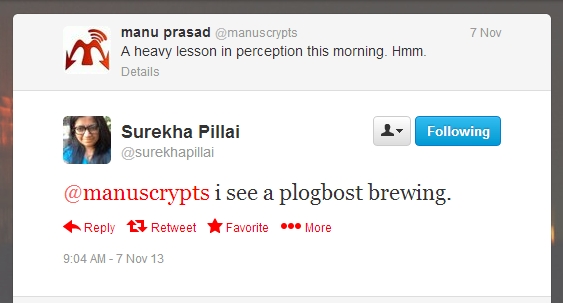
    A few days ago, I received a message that gave a jolt to my perception of how I deal with other people and what they make of it. I had written this post sometime back on taking friends for granted, and while that was in the specific context of friendship, this is an approach I extend to all relationships, be it transactional or emotional. I like to think that I’m fair in my approach and try to give back more than I get. But apparently, at least according to one person, I am not, and am “Mr.Use and Throw”. It hurt because I have always acknowledged the help that I’d received, to that person and others. I have not had an opportunity to repay it in kind, but whenever I have felt that my presence would bring happiness, I have made it a point to be there. I did reply with my perspective on the accusation, but it led me to think of the subject and how our actions are perceived by others.

    In this case, for instance, there were possibly expectations from me that I had not known of – not of a monetary kind, I think, but some other kind of help or acknowledgement. (Generalising) We live in an increasingly transactional world, where we are able to quantify all sorts of things and are also able to throw money at issues/problems/situations to resolve them. In scenarios where that is not applicable, we use our judgment to repay a gesture of kindness/affection/love. Over a period of time, I have dealt with the latter by acknowledgment and thanks in word and deed, and by paying it forward. But there is no standard currency in relationships, and my lesson from this experience is to not to take for granted that my approach is the one that works for people at the receiving end. I should spend some time first in understanding expectations, and then meeting them. When the price and currency are not agreed upon at the outset, you will need to keep paying until both parties have agreed that there are no dues.

    20131117_163614

    until next time, emotional monthly installments

    P.S. and a happy Thanksgiving 😉

  • The questions in Big Data

    In my last post that touched upon Big Data, I had mentioned how the seeming intent of Big Data is to synthesise actionable insights from processed and unprocessed information at touch points related or unrelated to the enterprise, and then use it to target consumers better. While this is probably true for the short-medium term, I read a wonderful perspective at GigaOm by Beau Cronin on its true potential – the path to building the equivalent of global-scale nervous systems. As I tweeted after I read it, it reminded me of something I’d written a couple of years back before I’d heard of #BigData – if we could actually use data to go beyond that to answer life’s profound questions. Before we go into the subject, here’s a nice video by OgilvyOne titled “Big Data for smarter customer experiences” (via) though it’s skewed more towards the experience rather than the data.

    Beau Cronin has mentioned several possibilities this would give rise to, and the post made me think if something like the hive mind concept would mesh into it as well – a sort of hybrid neural network. He has also pointed out the hurdles we would face while we get there – gathering, processing and conversion into actionable insights, and how phenomena such as priming,expectations, and framing matter so much in how we perceive our physical and social environments. In essence, a fascinating read.

    I was particularly intrigued by framing, and began thinking about it in the context of the unstructured data – tweets, posts, mails, videos – that is a major component of Big Data. The fundamental question being – is it unstructured because we’re framing it ‘wrong’? Based on the enterprise’ intent and not the users’? Ironically, I couldn’t frame the questions right until I met the ever-brilliant S, who has always maintained that the answer is easy to find once the question has been framed right. He has developed (Tulpa -to build or construct in Tibetan – is the concept he enlightened me on while we were discussing semantics) something that at a rough level mashes the MECE principle with Frame Semantics and the entity-relationship model. There’s IPR involved, so no more beans shall be spilled, but as always, I learned much from the conversation.

    In essence, structure can definitely be derived from what we currently call unstructured data, provided we frame the queries right. I can intuitively begin to understand that in the era of data abundance, the only way we can make sense of all of it is by focusing on an intent that is derived from a common purpose, so that the sources of data (users) will be more open to help solve the challenges of data collection. The processing and inferences that follow would yield the best results when the right questions are asked. I have a feeling that the questions asked by a business in an earlier era might not cut it.

    until next time, role models

  • Parenthesis

    Sometime back, I saw this relatively unknown Malayalam movie called ‘Calendar’, starring Zareena Wahab, playing mother to Navya Nair. Zareena’s character is widowed at 21 and she refuses to remarry since she wants to give all her attention to her child. The movie worked for me, despite it being built on the cliched “kid grows up, and gives more importance to her own life than her parent’s feelings”, thanks to a tight script and some neat casting.

    On the day I’m writing this, 3 works – one news item, one article, and one short story – appeared in my reading stream. The news was about a 107 year old woman left by her children, one of whom stays nearby, to fend for herself in a cowshed, the article centred around the topic of divorce and its impact on children, and the fiction work had to do more with marriage and infidelity, but with a neat twist in the end. Speaking of the end, I will link to them there, so you don’t escape this early. 😉

    I really didn’t need these prompts to write on the subject, since parenthood has been a source of constant debate recently, thanks to our parents aging and showing the first signs of serious aches and pains, even as we grow older and realise that the body also believes in keeping a low temperature of revenge for sins committed on it during the last three decades. 🙂

    Parenthood is one of those things that seriously lacks an undo feature, just like death, and is hence treated as a decision that merits serious thought. In general, the parents want the child to have a happy life and make choices on its behalf. Choices the child may not like/appreciate, but the parents believe to be the right one. They also make sacrifices for the child, in terms of time, money, and so on.

    But at least for debate’s sake, do you think these acts are always completely selfless? Isn’t brewing underneath it all a set of expectations? Sometimes parents see children as a way of fulfilling their own aspirations, sometimes they see them as support mechanisms in old age. Even if it’s none of these, or others you can think of, they at least get some pleasure out of seeing their child do well in life.

    But what blows me has always been that the parents get to make this considered choice of having a child and the child who is brought into the world and is the recipient of this and later choices, has zero say in the matter. It’s a serious product design flaw, and the only non-utopian remedy is for everyone concerned not to take each other for granted.

    As promised, the news, the article and the story.

    until next time, apparent traps