Tag: evolution

  • Currencies of hope

    In The Narratives of our lives, I had written about how, thanks to the advances of civilisation, many institutional narratives like religion, nation, culture etc have assumed increasing levels of importance in our lives, and how these (and our personal) narratives are probably our way of ensuring a sense of belonging. ‘The Age of Spiritual Machines‘, criticism on the concept of singularity notwithstanding, has convinced me on the cold, sanitised nature of evolution, so these days, I try to see what evolution’s play is, in these narratives.

    Thanks to a wine-induced pop philosophy conversation, I got thinking about theism and atheism. The epiphany (for me) was that they are just two sides of the same coin, and the currency was hope. Simply put, the foundation of the theist’s hope is God, and that of the atheist’s is the ability to determine his own future. ‘Our beliefs create the world we live in’, but across belief systems, hope is a critical ingredient for man’s survival. I realised that as long as we are the dominant species, hope has to hang around, or vice versa. By virtue of providing a common imaginary friend to a sufficiently high mass, religion not only addresses our need to belong, it also gives us hope. What each of us hope for is a very subjective thing, but collectively, it makes religion a really dominant narrative in many lives. When I thought about it, I recognised an even bigger force – money. (more…)

  • Time, Chaos, and Organisational Change

    The first chapter of The Age of Spiritual Machines, by Ray Kurzweil, is titled The Law of Time and Chaos. The law has two strands- The Law of Increasing Chaos and The Law of Increasing Returns, and together they dictate that in a process, the time interval between salient events (i.e. events that change the nature of the process, or significantly affect the future of the process) expands or contracts along with the amount of chaos.  In the book, this is used to explain evolution. Evolution draws upon the chaos in the larger system in which it takes place for its options for diversity, and evolution builds on its own increasing order. Therefore, in an evolutionary process, order increases exponentially, time speeds up, and the returns accelerate.

    It becomes very interesting when I put this in the context of organisations and the business environment they operate in. The business environment consists of various other organisations (exactly like life forms in evolution) and therefore the time interval between salient events (a new ‘disruption’) is becoming shorter. On the flip side, the organisation (akin to evolution of a single organism) is becoming more complex, and thus the time interval between salient events (their own breakthrough developments/innovations) increases. (more…)

  • Natural Law

    After a couple of years of Samsung, I bought a Moto X (2nd gen) phone, the Droid Turbo and Nexus 6 also being considerations. In the first few days of use, the automation that Moto’s Assist, Actions and Voice allows has impressed upon me the potential of such technologies and the dependency we could have on them.  As Karen Landis states in the Pew Internet Project’s Killer Apps in the Gigabit Age, “Implants and wearables will replace tools we carry or purchase…It will also redefine what a ‘thought’ is, as we won’t ‘think’ unassisted.

    It reminded me of an article I’d read in Vanity Fair titled ‘The Human Factor“, and a particular observation in it – To put it briefly, automation has made it more and more unlikely that ordinary airline pilots will ever have to face a raw crisis in flight—but also more and more unlikely that they will be able to cope with such a crisis if one arises. This thought is elaborated in ‘Automation Makes Us Dumb‘, drawing the difference between two design philosophies – “technology – centred automation” and “human- centred automation”. The former is dominant now and if one were to extrapolate this , a scary thought emerges.

    I think the best articulation of that scary thought is by George Dyson in Darwin Among the Machines – “In the game of life and evolution there are three players at the table: human beings, nature, and machines. I am firmly on the side of nature. But nature, I suspect, is on the side of the machines.” I had seen this in Bill Joy’s amazing 2000 Wired article “Why the Future doesn’t need us“, which itself discusses the idea that Our most powerful 21st-century technologies – robotics, genetic engineering, and nanotech – are threatening to make humans an endangered species. (more…)

  • The Art of Live In

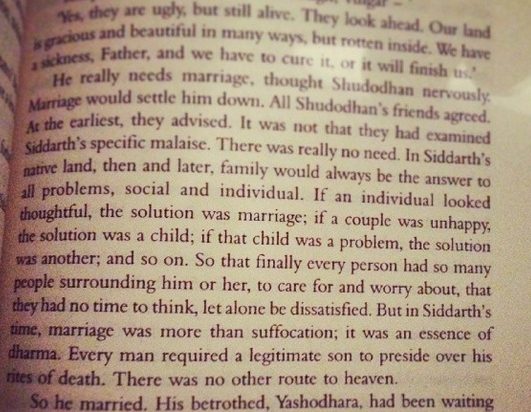
    I borrowed the title from a post I wrote nine years ago on live in relationships. We have come quite a way since then, but I am also seeing an evolution in this narrative. I call it the same narrative because fundamentally it challenges the institution of marriage as we know it. The way I see it, marriage was an evolutionary necessity – as a relatively structured process of procreation, and thereby organising society. The words below are from a work of fiction based on the life of the Buddha, it would seem that neither is it far from truth nor have things changed much.
    Sid

    So why is this institution primed for ‘disruption’ now?

    Technology is one factor. The family unit made sense when younger members of the species had to be protected. As AI advances, maybe a family unit will not be necessary for safety or security. Technology also might play a hand in the physiological aspects, more on that in a bit. As I mentioned in an earlier post (Emotion As A Service) marriage is as much a transactional relationship as an emotional one. To paraphrase Scott Adams,  (fromthe internet has allowed us to have a barter economy of relationships….a virtual spouse comprised of a dozen separate relationships

    The second factor – advances in medicine and increasing lifespans. Imagine living up to 150. The ‘life partner’ that you chose when you were a carefree 20 year old may not be the one you’d want to have fireside conversations with in your middle age – 95. Interests, outlook, worldview, personality etc change with time. Maybe you’d be living in different cities at different stages. 

    Another factor I’d consider is depleting resources – these may be natural, (on a larger scale) and economic (on an individual scale) (any thing else you can think of?) These might force the species to rethink the institution, even though it seems hardwired into the brain by now. 

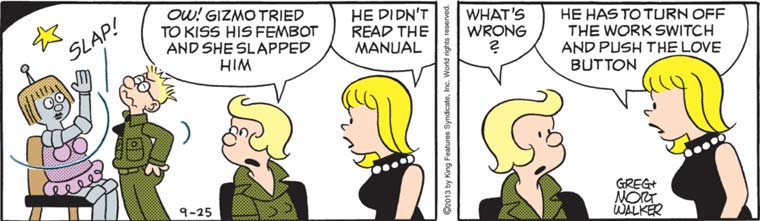
    I can already see several paths diverging from this point. Robots as companions for the aged is a fast developing area, it could be used for young ones in future. In a physiological context,  though we might not be there yet, s3x with robots is a distinct possibility by 2025. There’s bound to be a learning curve, but hey! 

    i130925bb

    (via)

    In a relationship context, The Atlantic had a long article on polyamory, including perspectives on how society sees them, and the challenges involved. I was actually more surprised when Bangalore Times carried an article on the subject on its front page recently. The point here is that it is getting mainstream attention, arguably the first step in societal acceptance of units that are radically different from the traditional family. Even children with DNA from three parents might soon overcome legal hurdles and become an accepted practice.  

    With all these paths, and many more, the institution of marriage might become one of the many options available. Some communities might hold on to it – as a tradition. But as time progresses, both individuals and society will undergo not just transformations on the outside, but in mindset as well.  After all, isn’t evolution just a logical response to a creature’s living environment? If it is, once the evolutionary necessity has passed, even this tradition might just fade away.  

    (The views expressed above are just the author’s attempts at intellectuality, and do not represent his actuality. He hopes he doesn’t have to sleep outside!) 

    until next time, along came poly! 

  • Branded Content.. Returns

    Branded content is making a comeback, I think. I call it a comeback because I noticed quite a few posts in the last few days, but this is something that has been discussed at least since 2009. (here and here) One of the posts I saw was this one which called branded content a game changer for brands. In terms of imagery, I prefer this version of the image, (note the year of posting 🙂 ) largely because the way it pictorially blurs the lines between paid, owned and earned media. In fact, given the way many bloggers accept payment and post no disclosure, the lines are blurred even within each sub-category!

    As you can see, precious little has changed. But the ‘little’ that has changed has made quite an impact – Facebook, Twitter and YouTube have made their way into ‘paid’ as well. In fact, they’re in all three kinds of media. What we call traditional media can at best be in two places at the same time – earned and paid, and that’s obviously why social has disrupted what we just knew as media.

    I wonder if during the dawn of traditional media, anyone would have thought of ‘owned media’ the way we understand it now. Its arrival has been recent but it’s busy delivering near-death blows to other forms of media, which are now forced to adapt. Brands are now scrambling to create a mix that will help them meet their strategic communication objectives, even as they deal with the challenges of multiple platforms, screens and technologies across which they have to deliver a seamless, cohesive stream. But increasingly social is also falling into the frameworks of its predecessors. Revolution is fading into evolution!

    What intrigues me is what happens next – after even this gets optimised. In the medium term, there will obviously be more channels, specially in ‘owned media’, but when this disruption becomes ‘traditional’, what is that new paradigm that will appear? Can you visualise beyond the current owned-earned-paid framework?

    Probably navigational media that will help us make sense of the other three! Also completes OPEN. 😉

    until next time, contend with that