
Tag: emotions

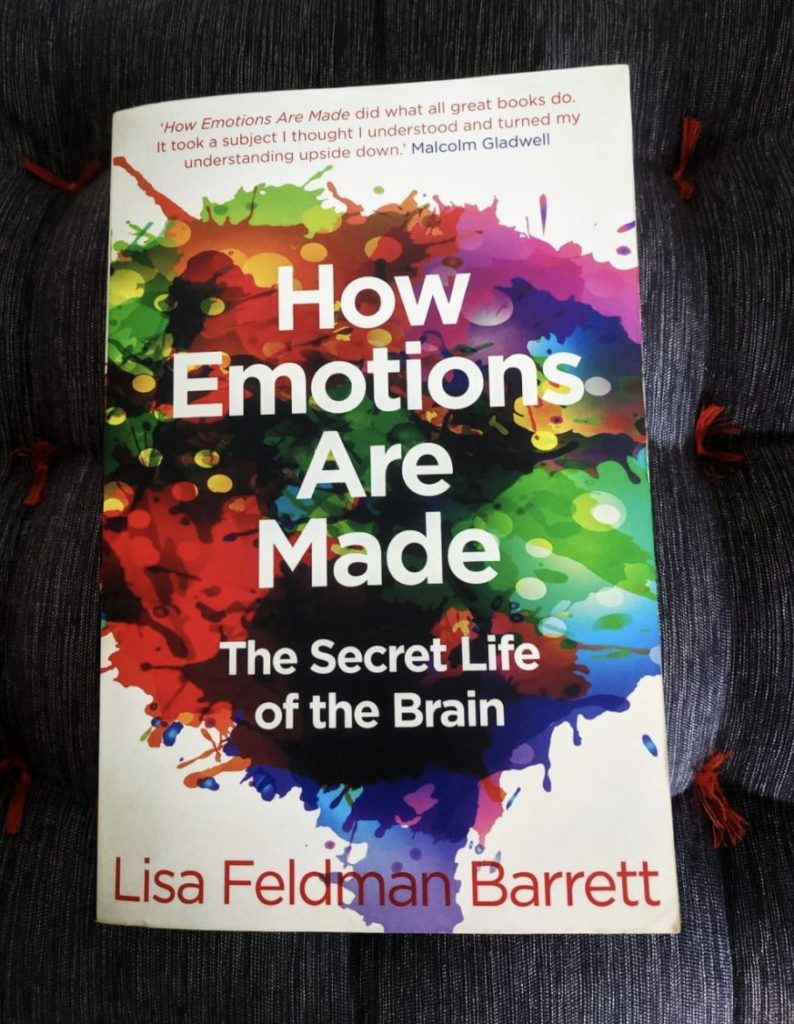
  • How Emotions Are Made

    Lisa Feldman Barrett

    Just when I thought I was getting some stability (in my thinking) on the free will vs determinism debate, here comes fresh food for thought. As per ‘How Emotions Are Made’, while the combination of genetic and environmental factors do determine our behaviour, free will has a definite play.

    The core theme of the book is a constructionist theory of how emotions are made, as opposed to a classic theory. The classical view assumes that each emotion has a unique ‘fingerprint’, as against the opposing view that variation is the norm. This has implications not just on how we physically manifest our emotions but on our understanding of how the nervous system operates as well. And finally, the classical view believes that emotions are inborn and universal. But the alternate view is that emotions are formed based on shared concepts, influenced by social reality and culture.

    The view of the brain as a tiered system (survival, emotion, cognition) is one of the first myths that the author breaks. Further, as opposed to being the result of a stimulus-response mechanism, emotions are a result of the brain simulating and predicting, based on a bunch of factors. What we call emotions – anger, fear, happiness etc- are concepts that get created and honed in the brain. Concepts, goals, words all help the brain frame any new stimulus it receives and then predict. By reframing concepts and looking at them more objectively, we can reshape what emotions are surfaced, and thus exercise free will.

    Towards the middle of the book, the author sets up the answer for “are emotions real” with the classic philosophical question of “If a tree falls in a forest and no one is around to hear it, does it make a sound?”. The answer is that both fall under the “perceiver-dependent” category. Emotions are thus, a social reality and become real because of collective intentionality and our ability to communicate using words.

    This understanding of emotions, and how much we control/are in control has implications on a lot of things ranging from our daily behaviour to the way the judiciary system works and how we deliver justice.

    ‘How Emotions Are Made’ is refreshing because of the alternate perspectives, all of which are backed by science. The author makes it a point to call out hypotheses where it’s not. The language is technical only when needed and explanations are lucid. In all, it is a fascinating book that has made me rethink a lot of what I thought I knew about myself and the world. Not an easy read, but absolutely worth the time. And that’s why it made it to my 2019 favourites.
  • In a world of abstractions…

    It was in Douglas Rushkoff’s Throwing Rocks at the Google Bus that I first became really aware of how much of an abstraction money is. Just to clarify what ‘abstraction’ is in this context, vegetables, meat, human labour etc all have clear, tangible value. Money is a transactional device with many advantages but it has no inherent value. Its common acceptance is its value. The exercise on 8th November 2016 is a great example to illustrate this –  those pieces of paper we thought were valuable until a minute ago suddenly became worthless. In fact, at one point, there was a chance that after Dec 31st, they would even be harmful!

    At some point, I started thinking of abstraction with respect to consciousness. At a very broad level, I think of consciousness as having three basic fluid forces at play – sensations, emotions, and thoughts. We tend to use the adjacent ones (sensation/emotion and emotion/thought) interchangeably but if you think about it, nuances separate them. They all have a role to play, but I also see them as a hierarchy with respect to their influence on consciousness – thoughts at the top. (more…)

  • The man.. the machine

    A while ago, I’d written about my fascination for lifestreaming, and the role it could play in storing our memories and giving it context. In fact memories and the possibility of losing them have always been food for thought for me.  One memory from a long time back, when I was an avid reader of Doctor Who books,  is of one of the Doctor’s villain sets – Cybermen – a fictional race of cyborgs. From Wikipedia

    Cybermen were originally a wholly organic species of humanoids originating on Earth’s twin planet Mondas that began to implant more and more artificial parts into their bodies as a means of self-preservation. This led to the race becoming coldly logical and calculating, with emotions usually only shown when naked aggression was called for.

    The connection. I saw an article recently on what has been called Homo Evolutis (original video here). Human beings have been the dominant species on the planet for a short while now, and as the author explains, there’s no guarantee that the current situation is a stable one. And in this context is seen the beginnings of speciation, in broad terms the evolution of our own species.

    The author talks about three different tracks of speciation -prosthetics (from limbs to hearing aids and beyond), stem cell and tissue engineering (where we are reaching a stage when a single cell can be rebooted back to its original factory settings and can rebuild any part of our body,  and lastly, a track to improve the brain. The author says that the last track will be the slowest to evolve, but the one with the maximum impact.

    And these tracks would create a new race or races- in fact a prosthetic body part, a plastic surgery etc are all the common manifestations of this process. As technology becomes more advanced, it will become affordable to a lot more people. From a physical perspective, who wouldn’t like body parts whose wear and tear can be controlled, an end to pain and suffering. And it doesn’t stop there, because we’d like to have the best physical abilities that any species has in terms of moving, seeing, hearing, strength etc. From the mind’s perspective, an organ that could upgrade itself to store more, to experience more, to work faster, to be more accurate. And it doesn’t stop there – reading others’ minds, telepathy…

    We will see the beginning of all this in our lifetime. The progress might be slow, so slow that perhaps later generations wouldn’t realise how we’d lived without most of the artificial things that they would be taking for granted. How would this affect the experiences of life that we go through now – joy, sorrow, pain, ecstasy, spirituality?  How long before what we call human would give way to a being that would probably exist forever, possibly without living? Will they even realise it when it happens?

    until next time, a man made man….